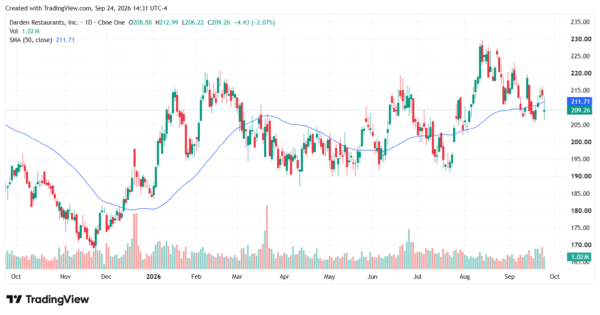
Darden Restaurants (NASDAQ: DRI) missed Wall Street’s earnings estimates by a penny. Its revenue miss was small, too. But investors found a bigger reason to worry in the company’s latest results: Olive Garden, its largest chain, is growing much more slowly than Long Horn Steakhouse.
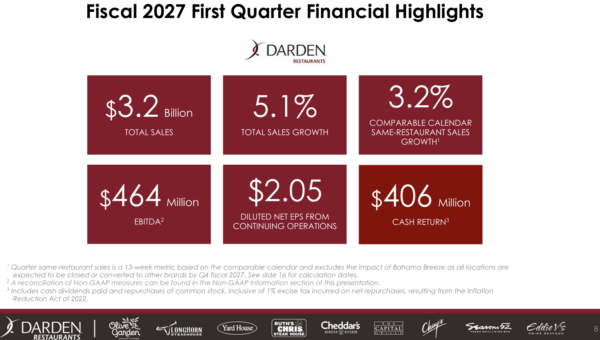
Shares of Darden fell after the company reported earnings of $2.05 per share for its fiscal first quarter. Analysts had expected $2.06. Revenue came in at $3.20 billion, compared with the $3.21 billion analysts expected. Those numbers were close to forecasts, and the company’s sales still rose 5.1% from a year earlier.
LongHorn Is Having the Stronger Quarter
LongHorn Steakhouse was the standout. Sales at LongHorn restaurants rose 6.2% from a year earlier, making it the portfolio’s fastest-growing business during the quarter.
Olive Garden’s sales at established restaurants rose just 1.1%.
LongHorn’s strength is good news. The chain generated about $861 million in quarterly sales, up from roughly $776 million a year earlier. But Olive Garden remains much larger, bringing in nearly $1.33 billion during the quarter. That makes even a modest slowdown at Olive Garden important to Darden’s overall performance.
Olive Garden is still growing, and its sales increased from a year ago. The concern is the pace. When investors look at a restaurant chain this large, they want to see that existing locations can keep attracting customers and growing sales. A 1.1% gain leaves less room for comfort than LongHorn’s 6.2% increase.
The results do not tell us exactly why customers responded differently to the two chains. Diners may be more selective about eating out, but the company’s sales figures alone cannot show what is driving each decision. What they do show is that LongHorn currently has much stronger momentum.
The Rest of Darden Delivers
There was good news elsewhere in the portfolio. Same-restaurant sales rose 1.6% in its fine-dining division, which includes The Capital Grille and Ruth’s Chris Steak House. Its other-business group posted 3.8% growth.
Across the company, same-restaurant sales increased 3.1%. In other words, every business unit grew during the quarter. LongHorn led the way, while Olive Garden delivered the smallest increase among the groups Darden reported.
There is one wrinkle in the year-over-year comparison. The company’s fiscal calendar shifted by a week because the company moved from a 53-week year to a 52-week year. Comparing the same calendar weeks puts Olive Garden’s growth at 1.0% and LongHorn’s at 6.8%. Either way, the difference between the chains is clear.
Profit Tells a Different Story
Darden reported net income of $233.4 million, down from $257.8 million a year earlier. That drop can seem confusing when sales are rising, but last year’s reported profit included a gain from the sale of Olive Garden Canada.
Removing that gain and other adjustments gives a clearer comparison. The company earned an adjusted $1.97 per share from continuing operations a year ago, compared with $2.05 this quarter. On that basis, earnings per share rose 4.1%.
The company also kept its full-year outlook unchanged. The company expects fiscal 2027 earnings from continuing operations of $11.10 to $11.35 per share, with total sales of $13.60 billion to $13.75 billion. Management’s decision to stick with that forecast suggests it still expects the business to meet its goals after the first quarter.
For investors, the next report will offer a useful test. LongHorn is performing well, and Darden’s smaller businesses are adding growth. If Olive Garden picks up speed, the company’s results could look stronger across the board. If its growth stays near 1%, LongHorn and the other chains will have to keep doing more of the work.
That is why this earnings report is about more than a one-cent miss. Darden is growing, but its biggest chain is moving slowly. Investors will be watching to see whether Olive Garden can close some of the gap.