With weekly weight loss injections, even an effective drug can become difficult to fit into everyday life. It’s one reason investors are paying close attention to new results from Viking Therapeutics (NASDAQ: VKTX), which may have just changed the frequency.
On September 22, Viking reported that people taking its experimental obesity drug, VK2735, retained much of their earlier weight loss after switching from weekly injections to less frequent maintenance doses. If that’s the case, VKTX could have quite the opportunity.
What Viking’s Study Found
The study began with 21 weeks of weekly injections. During that period, participants receiving VK2735 lost an average of roughly 16% to 19% of their starting body weight, depending on the dose. The placebo group saw essentially no weight loss. After those 21 weeks, participants taking the drug moved into a 12-week maintenance phase. Some received an injection every other week, some received one every four weeks, and others were switched to placebo.
The difference: The every-other-week groups retained an average of 90% of the weight they had lost during the initial treatment period. The monthly groups retained an average of 85%. Participants switched to placebo retained 61%.
In plain English, imagine someone lost 40 pounds during the first phase. Retaining 85% of that loss would mean they remained about 34 pounds below their starting weight at the end of the maintenance period. It does not mean they lost another 85% of their body weight.
Why Fewer Injections Could Matter
A published study of U.S. adults taking GLP-1 drugs found that discontinuation was common over the first two years. People stop treatment for many reasons, so a simpler schedule will not solve every obstacle. Still, having fewer injections could make ongoing treatment more manageable for some patients.
That is the opportunity Viking is exploring. A patient might begin with weekly doses to lose weight, then move to a schedule that requires fewer injections to help maintain the result.
If further studies support that approach, doctors and patients could have more flexibility when planning long-term care. For now, the key phrase is further studies. Viking’s maintenance results cover 12 weeks, or about three months. They cannot yet show how well monthly dosing would work over a year or longer.
Another Result Caught Investors’ Attention
Viking also followed a small exploratory group that continued taking VK2735 weekly. By week 33, those participants had lost an average of 21.7% of their starting body weight, with no weight-loss plateau observed during that period.
Viking also reported that gastrointestinal side effects during the maintenance phase occurred at rates comparable to placebo. That is useful to know because nausea, vomiting, diarrhea and constipation are familiar concerns with drugs in this category. Larger and longer studies will give a clearer picture of tolerability.
VKTX Stock Technical Analysis: Can Viking’s Breakout Hold?
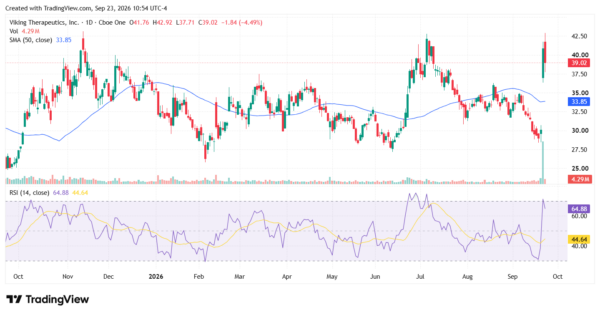
VKTX stock surged sharply after the latest VK2735 results, pushing the stock well above its 50-day moving average. VKTX closed at $39.02 on September 23, compared with a 50-day SMA of $33.85, after reaching an intraday high of $42.92. That high is an important near-term resistance level, particularly because VKTX pulled back from it before the close. The stock also posted unusually heavy volume of about 4.29 million shares, suggesting substantial investor interest behind the move.
Momentum remains positive, with the 14-day RSI at 64.88. That is approaching the 70 level traditionally associated with overbought conditions but has not reached it. If VKTX can break above $42.92, the recent rally could have room to extend. On the downside, the $37.50 area and the 50-day average near $33.85 offer potential levels to watch if the stock gives back some of its gains.
What This Means for Viking Stock
VK2735 acts on two hormone receptors, GLP-1 and GIP, the same targets addressed by tirzepatide from Eli Lilly (NYSE: LLY). Viking’s results suggest it may have a compelling drug candidate, especially if flexible maintenance dosing continues to perform well.
But an encouraging study does not settle the competitive race.
VK2735 remains experimental. Viking still needs to show that its results hold up in larger trials, demonstrate longer-term safety and effectiveness, and clear the steps required before the drug could reach patients. The company also plans to study oral maintenance dosing, which could add another option if successful.
For investors, the appeal is easy to understand. Strong weight loss gets a drug noticed. Helping people keep that weight off with a schedule they can live with could make it considerably more valuable.
Viking has delivered promising early evidence on both fronts. The next test is whether the monthly and every-other-week results last beyond three months. With weekly weight loss injections, even an effective drug can become difficult to fit into everyday life. It’s one reason investors are paying close attention to new results from Viking Therapeutics, which may have just changed the frequency.