Walt Disney (NYSE: DIS) has been working overtime to bring the magic back to investors. Through the first two quarters of 2026, it still has some work to do. DIS is down 8.7% in 2026 and down 7.6% in the last 12 months.
Go back further, and the stock chart explains why DIS has been a difficult hold. The stock is down more than 40% in the last five years. Even with a dividend that was reinstated in 2023, the stock has still delivered a negative total return of over 38%.
But Disney presents investors with a compelling bull case stemming from its theme park business. The weakness in Disney’s business has been in streaming and entertainment. There’s been no such problems with the theme park business, which continues to attract visitors despite many consumers making their displeasure about the cost of a Disney vacation known.
In the third quarter of its 2026 fiscal year, Disney reported a 3% increase in theme park attendance. It was the largest gain since 2023. A key reason for that growth came from promotions and package deals. Two examples of these promotions included:
- Discounts up to 30% on stays of at least five nights
- Free access to park hopping for children ages three through nine.

That number is likely to continue impressing investors in future quarters. The company said bookings are running ahead for 2027. Disney is adding attractions based on its Monsters Inc., Indiana Jones, and Cars franchises.
Getting people in the park is one thing. Turning that into profitable earnings is another matter, and until its last two quarters, it was something Disney had been struggling with.
That’s not all on the theme park business. The company’s promotional model hasn’t curbed spending inside the parks, which is where the magic can happen for earnings. In Q3 2026, Disney reported per capita spending growth of 4%.
A Rising Tide Isn’t Lifting All Boats
Here’s one part of the story investors shouldn’t miss. Disney isn’t the only theme park attraction in Florida. There is competition from Universal Studios, which is owned by Comcast (NASDAQ: CMCSA) and United Parks & Resorts (NYSE: PRKS), the parent company of SeaWorld.
However, both Comcast and United Parks & Resorts are forecasting softer demand through the remainder of 2026. United Parks & Resorts reported a 2.9% decline in attendance in the second quarter of 2026.
Comcast chief financial officer (CFO) Jason Armstrong specifically cited higher airfare and gas prices as a headwind on demand.
Here’s something else to note. Both companies cited fewer international visitors to the United States as one reason for the weakness. Disney’s experiencing that same weakness. However, the company has also committed to spending about 50% of its investment in experiences (about $30 billion) to its U.S. theme parks.
The takeaway is that Disney is pressing its advantage. But is there a risk to the strategy?
Let’s dispense with defining the economy with a letter shape and just say that high-income consumers are still going to Disney’s theme parks. Let’s also say that some lower income consumers have been priced out of the parks for several years.
So why state the obvious you say? Because Disney management is explicitly saying that promotions are part of their 2027 strategy. That’s not being done to attract lower income consumers; they’ll still be on the outside looking in. No, what Disney is doing is trying to secure the higher income consumers.
Still too obvious? Ok, try this. Consumers with incomes over $150,000 are doing the heavy lifting for this economy. If they stop spending, there’s much more difficulty ahead for a company that relies on discretionary dollars, even one with as much cache as the House of Mouse.
For the earnings math to work for Disney, it needs high-income consumers to keep visiting and spending on the in-park attractions. When I start hearing about promotions, my marketing instincts tell me that once they start, they will be tough to stop. It also tells me that Disney may be far more concerned about the higher income consumer than they’re letting on.
Analyst Sentiment is Mixed, and the Chart Agrees
Analyst sentiment is genuinely mixed. The consensus rating of Moderate Buy includes a range of price targets. On the bearish side, analysts believe the stock is fairly priced. However, the consensus price target of $127.61 implies over 22% upside. That said, DIS is likely to underperform the S&P 500 this year, and analysts don’t see a catalyst that will cause a re-rating in the first half of 2027.
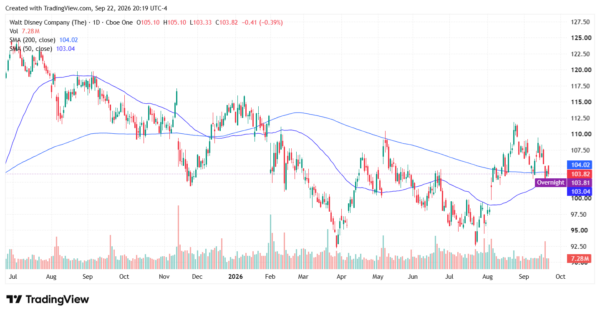
The chart paints the same mixed picture. DIS is testing a key decision zone. Shares closed at $103.82 on Sept. 22, sitting right between the 200-day SMA ($104.02) and the 50-day SMA ($103.04). However, the 50-day is rising and closing in on the flattening 200-day, setting up a potential golden cross. The stock also appears to have carved a double bottom near $93 in March and July, followed by an August breakout.
The bull case would be a successful retest of the moving averages after pulling back from the $112 August high. Still, the recent volume spike came on a down day, suggesting active selling. A cautious entry could make sense near current levels, with a stop below $100. A close back above $107.50 would add confirmation.
Is There Still Enough Magic to Make DIS a Buy?
The growing pains in Disney’s business model have never impacted the company’s theme park business, and I don’t see that starting anytime soon. When it comes to a magical vacation, Disney is still top of mind and getting its share of customers’ wallets.
But you can love the parks and be indifferent toward the stock. That’s where I land with DIS. There’s a lot to like, and the dividend does make the stock a more attractive buy and hold play. That said, “more attractive” isn’t the same as saying it’s the best option for investor capital. DIS is a Hold for me, but without much downside risk, I could certainly see why investors would have it on a watch list.