ajax loader

Loading...


Ride-the-Wave Strategy – Best for Stock Traders

Ride-the-Wave targets multi-day price momentum following a company’s earnings announcement (EA). With this strategy:

  1. Buy a stock one day post-EA if a stock reacts positively post-earnings:
    1. Near the close of trading the EA-day for a pre-market-EA
    2. Near the close of the following day for a post-market-EA
  2. Sell-to-close after 7-10 days, or possibly earlier if a desired price target is reached

Similarly,

  1. short a stock one day post-EA if a stock reacts negatively post-earnings:
    1. near the close of trading the EA-day for a premarket-EA
    2. near the close of the following day for a post-market-EA
  2. then buy-to-close after 7-10 days, or possibly earlier if a desired price target is reached

Important: Ride-the-Wave is predicated on significant price momentum triggered by an EA. The 7-10 day scenario is the maximum trade hold-time. If you see post EA-momentum is halted or reversed by a significant opposite move, re-evaluate your presence in the trade.

This popular StockEarnings screen below will give you a list of stocks that historically exhibit significant price momentum following an EA for the next seven days:

  1. Stocks exhibiting positive post-EA price moves are buy-candidates
  2. Stocks exhibiting negative post-EA price moves are sell/short-candidates

The screen includes those stocks whose Earnings just came out in last two days.

Screen criteria:

  1. Earnings Date Start Date : Current Date + -1 Day
  2. Earnings Date End Date : Current Date + -2 Days
  3. Predicted Move (Next Day) Max : 7%
  4. Predicted Move (On 7th Day) Min : 7%

Strategy Guideline:

  1. Buy the stock if stock has reacted positively. Short the stock if stock has reacted negatively (see above).
  2. Close the position in 7-10 days, or possibly earlier based on price move.

Volatility Crush Strategy - Best for Options Traders

The Volatility Crush strategy is used with stocks that typically experience relatively low-to-moderate price moves (≤4%) following their Earnings Announcements (EA). The basic trade idea is to sell put or call options right before the EA, collecting a credit when options premium is very high due to elevated implied volatility (IV). You then close the position right after the EA by buying the option back much cheaper due to the significant drop in IV that occurs after the mystery of the EA disappears. In assessing this trade, you need to do your homework to ensure you collect sufficient premium to make the trade worthwhile.

This trade is practical due to the low-to-moderate price-move after the EA, which generally won’t significantly affect the options price, unlike an “action” stock, which experience great price moves post-EA. With these symbols, if you’re on the right side of the price move, that’s a great thing. But if you’re on the wrong side of the move, not so great. Consequently, by minimizing the effect of the post-EA price move, you have a much better chance to profit from the reduction in IV without it being ruined by a violent price move.

For this trade, open the position either (1) the night before the EA when the company announces earnings or (2) during the EA day when it announces post-market, generally capturing IV at or close to its peak.

For this trade, open the position either (1) the night before the EA when the company announces earnings or (2) during the EA day when it announces post-market, generally capturing IV at or close to its peak.

This popular stockearnings screen will give you a list of stocks which do not react more than 4% fpost-EA. It includes only those stocks whose earnings are releasing next day.

Screen criteria:

  1. Earnings Date Start Date : Current Date + 1
  2. Earnings Date End Date : Current Date + 1
  3. Predicted Move (Next Day) Max : 4%
  4. Options Type: Weekly

Strategy Guideline:

  1. Options Strategy: Sell Call and Put
  2. Options Strike Price: Current Stock Price – (% Predicated Move x 2)
  3. Expiration Date: It should generally be the closest expiry immediately after the EA.
  4. Buy Insurance: Buying back Call and Put at Strike price which 10% lower than Sell Strike Price is optional but recommended.

Watch Video for More Detail

Volatility Rush Strategy - Best for Options Traders

The Volatility Rush takes advantage of increasing options premiums into earnings announcements (EA) caused by an anticipated rise in Implied Volatility (IV). With this strategy, Buy a Call and Put at-the-money (a long straddle) 2-3 weeks before the EA when IV is lower. Sell the position either (1) the night before the EA when the company announces earnings pre-market, or (2) during the EA day when it announces post-market, generally capturing IV at or close to its peak.

This popular screen will give you a list of stocks whose Options premiums tend to rise into Earnings. It includes only those stocks whose Earnings are at least two weeks away from today.

Screen criteria:

  1. Earnings Date Start Date : Current Date + 15 Days
  2. Earnings Date End Date : Current Date + 30 Days
  3. Predicted Move (Next Day) Min : 5%
  4. Options Type: Weekly or Monthly if that lines up with the two to three-week lead-time for entering the trade

Strategy Guideline:

  1. Buy a Straddle at or close to the money two to three weeks pre-EA.
  2. Sell the position either the night before the EA when the company announces earnings pre-market, or during the EA day when it announces post-market.
  3. Expiration date should generally be the closest expiry immediately after the EA.
  4. Straddle price should not be more 60% of predicted move.

Predicted Move (Volatility)

Similar to Implied Volatility in Options. Expected volatility % based on our Proprietary Volatility Predication Model. We are expecting that stock price will likely to reach % in either direction by the end of next trading session after Earnings are released and not necessarily the closing volatility %.

Why is it important?

    This indicator helps

  1. Knowing expected volatility in stocks after Earnings helps to decide trading stocks before Earnings Announcement.
  2. Taking Advantage of volatility collapse following Earnings Results by using Advance Options strategies such as Spread and Straddles.

Since Last Earnings

Change in share price since last Earnings release.

Why is it Important?

When share has gained more than 10% since it's last Earning release, it tends to over react to minor bad news and give up some gains if not all. So, it contains more downside volatility than upside When share has dropped more than 10% since it's last Earning release, it tends to over react to minor good news and recover some drops if not all. So, it contains more upside volatility than downside.

EPS Surprise (%)

Occurs when a company's reported quarterly or annual profits are above or below analysts' expectations. Here is the formula to derive % EPS Surprice:

Actual EPS - Estimated EPS
------------------------------------- x 100
Estimated EPS

Why is it Important?

Earnings surprises can have a huge impact on a company's stock price. Several studies suggest that positive earnings surprises not only lead to an immediate hike in a stock's price, but also to a gradual increase over time. Hence, it's not surprising that some companies are known for routinely beating earning projections. A negative earnings surprise will usually result in a decline in share price.

Next Day Price Change (%)

Next Regular trading session Closing price following Earnings result.

For After Market Close Earnings, It is a next trading day closing price. For Before Market Open Earnings, It is the same trading day closing price.

Why is it Important?

Next Day price change is a reaction of Earnings result.

Cintas Earnings: Why Its $545 Million Buyback Matters At 35X Earnings

Posted on Sep 24, 2026 by Grayson Cavern

Cintas Earnings: Why Its $545 Million Buyback Matters At 35X Earnings

Cintas Corporation (NASDAQ: CTAS) shareholders just got one more reason to purchase the company at a premium as organic revenue rose 8.9%, gross margin hit a record 51.5%, operating income grew 15.2% and free cash flow surged almost 49%. Then Cintas repurchased its stock for $544.7 million in the first quarter and through Sept. 22. This is quite telling when compared to the valuation. CTAS reported a closing price of $191.97 on September 23, and Cintas’s fiscal 2027 guidance for its adjusted EPS was also increased to between $5.45 and $5.54. The current price of the stock is about 35 times guided earnings at the midpoint.

Cintas, accordingly, is continuing to acquire shares when the company is already trading at a significant premium and is looking to fund its planned acquisition of UniFirst.

Cintas Is Growing Earnings Faster Than Revenue


The underlying operation gives management a strong foundation for that premium. First-quarter revenue reached $3.014 billion, up 10.9% from $2.718 billion, while organic revenue increased 8.9% after adjusting for acquisitions, foreign exchange and workday differences. Even after adjusting for the additional workday, revenue grew 9.2%.

The growth extended to Uniform Rental and Facility Services, which grew 9.7% to $2.295 billion, and Other revenue, which increased 14.7% to $719.2 million, the company’s two major business areas. Cintas then grew at a faster rate than sales to increase profits. Gross profit rose by 13.7% to $1.55 billion, which pushed gross margin to 51.5% from 50.3% of sales, while operating income grew 15.2% to $711.9 million.

Net income  rose 12.3% to $551.7 million and diluted EPS increased 13.3% to $1.36. Adjusted diluted EPS came in at $1.39, or 15.8% higher than the previous year when $14.4 million of the UniFirst transaction costs were deducted.

That’s how you can understand how the company went from 10.9% revenue growth to 13.7% gross-profit growth to 15.2% operating-income growth and still be able to earn a premium valuation from Cintas. The company is making more dollars from every additional dollar of sales.

The Buyback Becomes A Valuation Decision

Cintas generated $572.3 million of operating cash flow during the quarter, up from $414.5 million, while capital expenditures increased modestly to $107.5 million from $102.0 million. Free cash flow consequently reached $464.8 million, compared with $312.5 million a year earlier.

The company then paid $208.8 million in dividends and repurchased $544.7 million of common stock during the quarter and through September 22.

This is where the buyback becomes more serious. Cintas has not disclosed the average price paid for those repurchases in the earnings release, so we cannot assign the purchases a precise earnings multiple. But the current share price gives us a useful reference point: at $191.97, the stock trades at about 34.9 times the midpoint of the company’s new $5.45-$5.54 adjusted EPS range. That means the buyback is happening against a valuation that already assumes Cintas will continue producing substantial earnings growth.

For the repurchase to create meaningful per-share value over time, the earnings base has to keep expanding enough to support that valuation.

UniFirst Makes That Calculation More Complicated

The UniFirst acquisition is now right next to the buyback decision. Cintas had $14.4 million in UniFirst transaction expense in the quarter, eroding diluted EPS by $0.03, while management indicated that the transaction will close prior to the end of calendar 2026, contingent upon the regulatory process.

As of Aug. 31, the balance sheet lists $243.6 million in cash, $999.3 million in debt that must be paid off within a year and $1.43 billion worth of long-term debt.

But most important of all, Cintas states that its revised EPS guidance does not include expectations of future share repurchases, and does not include debt activity or commercial-paper issuance related to it funding the acquisition of UniFirst. Net interest expense is anticipated in fiscal 2027 around $103 million, which is a bit more than $101.2 million in fiscal 2026, due in part to bridge-loan financing costs associated with the acquisition.

So, our view of existing business is in the range of $5.45-$5.54 in EPS, and the UniFirst financing and other repurchases will have a future impact on the bottom line, beyond this range.

That puts investors in a good position to ask themselves the next question: how much is the company going to be able to grow from the business it already has in place, and how would buybacks by UniFirst and future purchases affect the per-share economics?

The Chart Is Putting The Premium To The Test

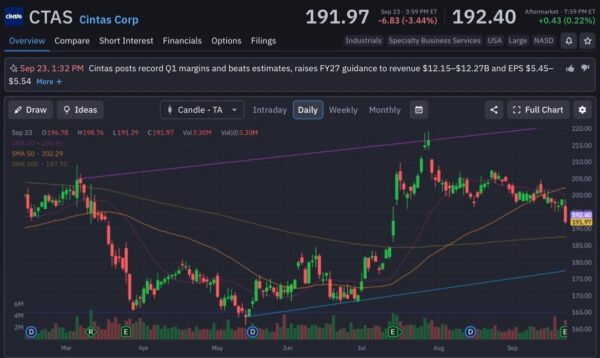
CTAS closed at $191.97 on September 23, below its 20-day moving average near $199.25 and 50-day near $202.29, while remaining above the 200-day average around $187.70. The chart therefore isn’t reflecting the same acceleration visible in the income statement. Cintas has raised its full-year revenue guidance to $12.15 billion-$12.27 billion and adjusted EPS guidance to $5.45-$5.54, yet the shares remain below their short- and intermediate-term moving averages.

That puts the buyback in a different light. Cintas is repurchasing stock while the market values its current earnings at roughly 35 times the midpoint of management’s new EPS guidance, and the company is simultaneously preparing for a transaction whose financing effects the current guidance does not include.

As it stands, the operating business is not only giving Cintas room to keep expanding earnings, it’s also giving the bulls a reason to hold. The valuation and UniFirst now determine how much room that leaves for the buyback to keep adding value on a per-share basis.
cintas - StockEarnings

Join over 1.2M+ investors/traders who receive daily and weekly notable earnings alerts with predicted move