AT&T (NYSE: T) has spent years shifting away from aging copper infrastructure toward fiber internet and wireless connectivity. The strategy is showing up in its numbers, but the company needs another quarter of execution to prove that network investments can fund its dividend, buybacks, and balance sheet.
Analysts expect third-quarter adjusted earnings of roughly 61 cents per share, up from 54 cents per share a year ago, on revenue of approximately $31.65 billion, about 3% growth. AT&T reports Wednesday, October 21, before the market opens, with its conference call at 8:30 a.m. ET.
After Q2, those estimates look achievable. The bigger test is whether growth in AT&T’s modern connectivity business can keep funding its transition as the company expands fiber, retires legacy infrastructure, and accelerates share repurchases.
Fiber and Wireless Are Doing the Heavy Lifting
AT&T’s second quarter offered evidence that the strategy is working. Revenue increased 2.3% year over year to $31.6 billion, adjusted EBITDA climbed 5.2% to $12.3 billion, and adjusted EPS reached $0.65 versus $0.54 a year earlier. Operating cash flow rose to $10.8 billion from $9.8 billion, while free cash flow improved to $4.7 billion from $4.4 billion.
Customer growth shows where the momentum is coming from. AT&T added 367,000 fiber internet subscribers, 279,000 fixed-wireless internet subscribers, and 432,000 postpaid phone subscribers. Advanced Connectivity service revenue grew 5.1% to $23.5 billion, and segment EBITDA increased 8% to $12 billion.
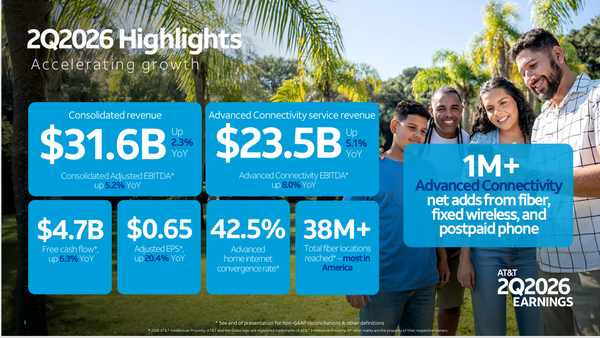
The segment is growing faster than AT&T’s consolidated revenue. Its convergence strategy also creates room to deepen customer relationships: 42.5% of households using AT&T’s advanced home internet services also subscribed to its wireless service.
For Q3, subscriber additions, churn, service revenue, and EBITDA will show whether that momentum held through September. Slower customer growth or weaker profitability would challenge the case that AT&T’s investment cycle is producing a durable earnings engine.
The Copper Business Is Shrinking
The transition comes with a drag. Legacy service revenue fell 25.9% in Q2 to $1.63 billion, while legacy operating income and EBITDA declined 45.5% to $523 million. AT&T is winding down its copper network, but the lost revenue and earnings must be absorbed while fiber scales.
Spending and cash flow are critical. AT&T invested $6.1 billion in capital during Q2, including $5.7 billion in capital expenditures. It ended the quarter with $144 billion in total debt and $126.4 billion in net debt. The network build-out supports future growth, but requires substantial capital before new fiber locations deliver their full economic value.
Management maintained its 2026 outlook: adjusted EPS of $2.25 to $2.35, adjusted EBITDA growth of 3% to 4%, and free cash flow of at least $18 billion. Capital investment is expected to total $23 billion to $24 billion for the year.
Management expects Q3 free cash flow to remain relatively stable year over year, followed by strong growth in Q4. A result consistent with that forecast would keep AT&T on track; weaker cash generation could raise doubts about how comfortably it can fund investment and shareholder distributions.
The Buybacks Raise the Stakes
AT&T plans to return more than $45 billion to shareholders over 2026–2028 through dividends and repurchases. It has accelerated its 2026 buyback target to approximately $10 billion while maintaining an annualized dividend of $1.11 per share.
AT&T expects free cash flow of at least $19 billion in 2027 and $21 billion in 2028, creating room for larger shareholder distributions as the investment program matures. But buybacks compete with other demands on the balance sheet. With net debt above $126 billion and annual capital investment of $23 billion to $24 billion, AT&T needs cash generation to cover the dividend, fund the network build-out, and improve leverage.
For this report, I would focus on confirmation of full-year EPS and free-cash-flow guidance, continued growth in Advanced Connectivity profitability, and updates on capital spending and debt. A beat on the $0.61 EPS estimate would help, but strong cash flow and unchanged guidance would provide firmer support for the longer-term thesis.
The Chart Still Needs a Breakout
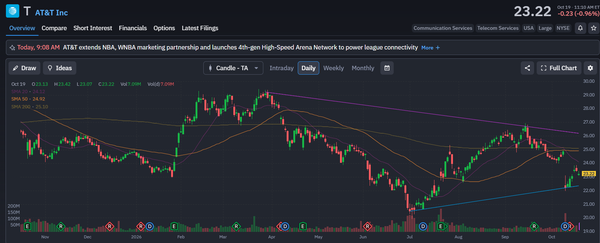
AT&T closed at $23.22 on October 19, down 0.96% for the session. The stock trades below its 20-day simple moving average at $24.12, its 50-day at $24.92, and its 200-day at $25.10. All three sit overhead, creating resistance as the shares try to recover.
Support around 22–22.30 is the near-term level to watch, near the rising support line from July’s lows. A break below it would put the recent base at risk. Reclaiming $24.12 would be the first sign of improving momentum, followed by the 24.90–25.10 band where the 50-day and 200-day averages converge.
I’m bullish on AT&T’s underlying direction because fiber and wireless are growing faster than the consolidated business, and Q2 showed that growth reaching profitability. But the stock has yet to reflect that progress technically. My BUY thesis depends on AT&T protecting its $18 billion-plus free-cash-flow target while sustaining Advanced Connectivity growth. If Q3 confirms both, investors will have stronger evidence that the network build-out can generate dependable cash returns.