Tower Semiconductor (NASDAQ: TSEM) reported record third-quarter revenue of $526.2 million, up 33% year over year, with adjusted diluted earnings per share climbing to $1.15 from $0.55 a year earlier. The company also guided for $600 million in fourth-quarter revenue, putting its annual sales on track to reach $2 billion for the first time.
These results extend the story from last quarter, when Tower’s customer commitments suggested its capacity expansion carried less demand risk than a typical semiconductor manufacturing bet. Now the company is showing what that demand can do for its bottom line.
Customers Are Paying for Tomorrow’s Capacity Today
Semiconductor manufacturers typically invest heavily in factories before knowing whether customers will need the additional production. Tower Semiconductor has been taking a different route, securing customer commitments for future capacity while investing in the infrastructure needed to deliver it.
In Q2, management disclosed approximately $1.3 billion in silicon photonics revenue commitments for 2027, alongside $290 million in customer prepayments largely tied to future capacity reservations. Those commitments helped explain why Tower raised its 2028 revenue target to $3.6 billion and projected $1.2 billion in annual net profit.
The latest quarter suggests that demand is translating into faster growth in the sense that revenue climbed 33% to $526.2 million, while gross profit nearly doubled to $178.8 million. Operating profit reached $127.1 million, more than twice the $50.6 million recorded in Q3 2025. That means the company is growing its earnings faster than its sales. Gross margin expanded from roughly 23.5% to 34%, while operating margin rose from 12.8% to 24.2%. The company is generating more profit from each dollar of revenue as demand scales.
And not to forget, Silicon photonics remains central to that growth. AI infrastructure requires faster data movement between computing systems, increasing demand for technologies that support high-speed optical connections. Tower Semiconductor expects silicon photonics to reach a $1.1 billion annualized revenue run rate in Q4, five times its 2025 revenue from the technology.
That is a run rate, not $1.1 billion in revenue booked during the quarter. Still, the target shows how quickly management expects the business to grow as additional capacity comes online.
They Need To Find A Way To Deliver
Tower Semiconductor’s fourth-quarter forecast raises the stakes. Management expects revenue of $600 million at the midpoint, representing 36% year-over-year growth and a 14% increase from Q3. The company expects to finish 2026 with approximately $2 billion in annual revenue and a $2.4 billion annualized revenue run rate.
CEO Russell Ellwanger also expects Tower to avoid the semiconductor industry’s typical first-quarter seasonality in 2027, with sequential revenue growth accompanied by improving margins.
That outlook not only extends the momentum beyond a single strong quarter… it also gives investors a reason to watch whether Tower Semiconductor can keep increasing production without sacrificing profitability.
But the challenge is that manufacturing capacity takes time and money to build. Tower generated $185.2 million in operating cash flow during Q3 but spent $190.7 million on property and equipment. Using the company’s stated definition, quarterly free cash flow was approximately negative $5.5 million. A year earlier, operating cash flow exceeded capital investment by roughly $35.9 million.
The spending is supporting future growth, so negative free cash flow alone does not invalidate the thesis. But it does show the cost of turning customer demand into production capacity. Tower Semiconductor must install equipment, ramp manufacturing, and meet customer commitments on schedule while preserving the margin gains already visible in its results.
Management’s confidence rests partly on customer demand already secured for future production. That gives Tower greater visibility than a manufacturer building capacity on speculation, although it does not eliminate execution risk.
For investors, the next milestone is seeing revenue growth continue alongside strong margins as that capacity becomes productive.
TSEM’s Chart Has a Bigger Problem
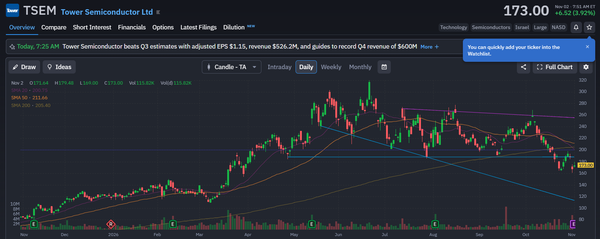
The stock’s technical picture has deteriorated since my Q2 story. Back then, TSEM’s pullback looked more like consolidation after a strong rally, with the shares holding above their 200-day moving average and support near $200.
Today, the chart shows TSEM at $173 in premarket trading, up 3.92%. Despite that bounce, the shares remain below the marked support area around $185 to $190 and below their 20-day, 50-day, and 200-day moving averages near $200.75, $211.66, and $205.40, respectively.
The stock needs to reclaim lost ground before the chart can support a stronger bullish case. A bounce toward $185 to $190 would be an initial sign of recovery, while the moving averages above that range present further hurdles.
The earnings report gives investors stronger operating results to work with, but the chart shows that the market has yet to reward the business with a sustained recovery. We should not assume the selloff reflects a rejection of Tower Semiconductor’s growth plans without more evidence. What we can say is that the stock’s trend has weakened while the company’s financial performance has improved.
Can Tower Semiconductor Sustain Its AI Growth Momentum?
Tower Semiconductor’s Q3 results reinforce the argument made last quarter. Customer commitments are supporting an aggressive expansion, and the company is translating rising demand into record revenue and substantially stronger margins. The $600 million Q4 forecast suggests that momentum could continue into year-end.
All of these have shifted the risk towards execution. Now, Tower Semiconductor must bring additional capacity online, meet customer demand, and generate enough profit to justify the investment. Its current cash flow shows that expansion is already absorbing the cash produced by operations.
I remain focused on whether Tower can sustain its margin improvement as revenue scales. If it can, the customer-backed expansion could support the longer-term financial targets management has laid out. Until then, the business is making progress, but the stock still needs to prove it can recover.