ajax loader

Loading...


Ride-the-Wave Strategy – Best for Stock Traders

Ride-the-Wave targets multi-day price momentum following a company’s earnings announcement (EA). With this strategy:

  1. Buy a stock one day post-EA if a stock reacts positively post-earnings:
    1. Near the close of trading the EA-day for a pre-market-EA
    2. Near the close of the following day for a post-market-EA
  2. Sell-to-close after 7-10 days, or possibly earlier if a desired price target is reached

Similarly,

  1. short a stock one day post-EA if a stock reacts negatively post-earnings:
    1. near the close of trading the EA-day for a premarket-EA
    2. near the close of the following day for a post-market-EA
  2. then buy-to-close after 7-10 days, or possibly earlier if a desired price target is reached

Important: Ride-the-Wave is predicated on significant price momentum triggered by an EA. The 7-10 day scenario is the maximum trade hold-time. If you see post EA-momentum is halted or reversed by a significant opposite move, re-evaluate your presence in the trade.

This popular StockEarnings screen below will give you a list of stocks that historically exhibit significant price momentum following an EA for the next seven days:

  1. Stocks exhibiting positive post-EA price moves are buy-candidates
  2. Stocks exhibiting negative post-EA price moves are sell/short-candidates

The screen includes those stocks whose Earnings just came out in last two days.

Screen criteria:

  1. Earnings Date Start Date : Current Date + -1 Day
  2. Earnings Date End Date : Current Date + -2 Days
  3. Predicted Move (Next Day) Max : 7%
  4. Predicted Move (On 7th Day) Min : 7%

Strategy Guideline:

  1. Buy the stock if stock has reacted positively. Short the stock if stock has reacted negatively (see above).
  2. Close the position in 7-10 days, or possibly earlier based on price move.

Volatility Crush Strategy - Best for Options Traders

The Volatility Crush strategy is used with stocks that typically experience relatively low-to-moderate price moves (≤4%) following their Earnings Announcements (EA). The basic trade idea is to sell put or call options right before the EA, collecting a credit when options premium is very high due to elevated implied volatility (IV). You then close the position right after the EA by buying the option back much cheaper due to the significant drop in IV that occurs after the mystery of the EA disappears. In assessing this trade, you need to do your homework to ensure you collect sufficient premium to make the trade worthwhile.

This trade is practical due to the low-to-moderate price-move after the EA, which generally won’t significantly affect the options price, unlike an “action” stock, which experience great price moves post-EA. With these symbols, if you’re on the right side of the price move, that’s a great thing. But if you’re on the wrong side of the move, not so great. Consequently, by minimizing the effect of the post-EA price move, you have a much better chance to profit from the reduction in IV without it being ruined by a violent price move.

For this trade, open the position either (1) the night before the EA when the company announces earnings or (2) during the EA day when it announces post-market, generally capturing IV at or close to its peak.

For this trade, open the position either (1) the night before the EA when the company announces earnings or (2) during the EA day when it announces post-market, generally capturing IV at or close to its peak.

This popular stockearnings screen will give you a list of stocks which do not react more than 4% fpost-EA. It includes only those stocks whose earnings are releasing next day.

Screen criteria:

  1. Earnings Date Start Date : Current Date + 1
  2. Earnings Date End Date : Current Date + 1
  3. Predicted Move (Next Day) Max : 4%
  4. Options Type: Weekly

Strategy Guideline:

  1. Options Strategy: Sell Call and Put
  2. Options Strike Price: Current Stock Price – (% Predicated Move x 2)
  3. Expiration Date: It should generally be the closest expiry immediately after the EA.
  4. Buy Insurance: Buying back Call and Put at Strike price which 10% lower than Sell Strike Price is optional but recommended.

Watch Video for More Detail

Volatility Rush Strategy - Best for Options Traders

The Volatility Rush takes advantage of increasing options premiums into earnings announcements (EA) caused by an anticipated rise in Implied Volatility (IV). With this strategy, Buy a Call and Put at-the-money (a long straddle) 2-3 weeks before the EA when IV is lower. Sell the position either (1) the night before the EA when the company announces earnings pre-market, or (2) during the EA day when it announces post-market, generally capturing IV at or close to its peak.

This popular screen will give you a list of stocks whose Options premiums tend to rise into Earnings. It includes only those stocks whose Earnings are at least two weeks away from today.

Screen criteria:

  1. Earnings Date Start Date : Current Date + 15 Days
  2. Earnings Date End Date : Current Date + 30 Days
  3. Predicted Move (Next Day) Min : 5%
  4. Options Type: Weekly or Monthly if that lines up with the two to three-week lead-time for entering the trade

Strategy Guideline:

  1. Buy a Straddle at or close to the money two to three weeks pre-EA.
  2. Sell the position either the night before the EA when the company announces earnings pre-market, or during the EA day when it announces post-market.
  3. Expiration date should generally be the closest expiry immediately after the EA.
  4. Straddle price should not be more 60% of predicted move.

Predicted Move (Volatility)

Similar to Implied Volatility in Options. Expected volatility % based on our Proprietary Volatility Predication Model. We are expecting that stock price will likely to reach % in either direction by the end of next trading session after Earnings are released and not necessarily the closing volatility %.

Why is it important?

    This indicator helps

  1. Knowing expected volatility in stocks after Earnings helps to decide trading stocks before Earnings Announcement.
  2. Taking Advantage of volatility collapse following Earnings Results by using Advance Options strategies such as Spread and Straddles.

Since Last Earnings

Change in share price since last Earnings release.

Why is it Important?

When share has gained more than 10% since it's last Earning release, it tends to over react to minor bad news and give up some gains if not all. So, it contains more downside volatility than upside When share has dropped more than 10% since it's last Earning release, it tends to over react to minor good news and recover some drops if not all. So, it contains more upside volatility than downside.

EPS Surprise (%)

Occurs when a company's reported quarterly or annual profits are above or below analysts' expectations. Here is the formula to derive % EPS Surprice:

Actual EPS - Estimated EPS
------------------------------------- x 100
Estimated EPS

Why is it Important?

Earnings surprises can have a huge impact on a company's stock price. Several studies suggest that positive earnings surprises not only lead to an immediate hike in a stock's price, but also to a gradual increase over time. Hence, it's not surprising that some companies are known for routinely beating earning projections. A negative earnings surprise will usually result in a decline in share price.

Next Day Price Change (%)

Next Regular trading session Closing price following Earnings result.

For After Market Close Earnings, It is a next trading day closing price. For Before Market Open Earnings, It is the same trading day closing price.

Why is it Important?

Next Day price change is a reaction of Earnings result.

Tower Semiconductor Earnings Rewrites The Economics Of Chipmaking 

Posted on Aug 05, 2026 by Grayson Cavern

Tower Semiconductor Earnings Rewrites The Economics Of Chipmaking 

Tower Semiconductor (NASDAQ: TSEM) reported another record quarter, delivering $460.1 million in second-quarter revenue, up 24% year over year, alongside $0.79 in diluted earnings per share. The company didn’t stop there.

It guided third-quarter revenue to a record $520 million, raised its 2028 revenue target to $3.6 billion, and projected $1.2 billion in annual net profit by the end of the decade. Though the shares opened down 3.43% to $231.31 anyway, the selloff wasn’t driven by weak execution.

Tower produced record gross profit, record operating profit and record net profit while lifting gross margin to 30%, operating margin to 20%, and net margin to 20%. Those gains arrived as the company continued pouring hundreds of millions of dollars into new manufacturing capacity rather than harvesting cash from existing assets. This is where you need to pay attention because these earnings weren’t just about another strong quarter. They revealed a company changing one of the oldest assumptions in the semiconductor industry: how chip factories get built.

Every Chip Factory Starts With A Gamble, Tower’s Doesn’t.


Semiconductor manufacturing has always been a capital-intensive bet. A company commits billions of dollars to build or expand a fabrication plant years before knowing whether demand will still be there when the first wafers roll off the production line. If customers disappear, the industry is left with underutilized factories, shrinking margins and painful write-downs. Every major downturn in the semiconductor cycle has followed some version of that script.

Tower Semiconductor (NASDAQ: TSEM) is flipping that on its head. The company disclosed that it received $290 million in customer prepayments earlier this year, largely tied to 2027 capacity reservations. During the earnings call, management also revealed that it has already secured approximately $1.3 billion of silicon photonics revenue commitments for 2027. Then came the most revealing remark of the call: the additional manufacturing capacity now being built has already been requested by customers and is “spoken for.”

Rather than expanding first and hoping customers eventually fill the factory, Tower is securing long-term demand before pouring concrete and installing equipment. The company is still committing heavily to growth – a $920 million expansion program remains underway – but a meaningful portion of the commercial risk has already shifted. Put another way, customers are reserving tomorrow’s production years before those wafers exist, giving management a level of visibility that is unusually rare in an industry better known for boom-and-bust cycles.

The Game Of Specialization

Tower’s expansion could easily be mistaken for another beneficiary of the semiconductor recovery. The timing certainly fits. For nearly two years, chipmakers wrestled with excess inventories after the pandemic boom faded, leaving factories underutilized and customers working through existing stock rather than placing new orders. That cycle has started to turn as AI infrastructure spending remains robust and industrial demand gradually recovers. Tower, however, is riding a much more specific wave: silicon photonics, a technology becoming increasingly important as AI systems demand faster, more energy-efficient data movement between processors.

And the numbers show how fast that business is scaling. Silicon photonics revenue climbed more than 270% year over year and 60% sequentially, reaching an annualized run rate above $680 million. Management expects that figure to exceed $1 billion by the fourth quarter as new capacity comes online.

That helps explain why Tower raised its 2028 revenue target to $3.6 billion from $2.84 billion, while projecting gross margins to expand from 39% to 45%. Indicating that the company is now expanding into products customers are already lining up to buy, allowing each new factory to generate more profit than the last.

More Like Consolidation Than A Change In Trend

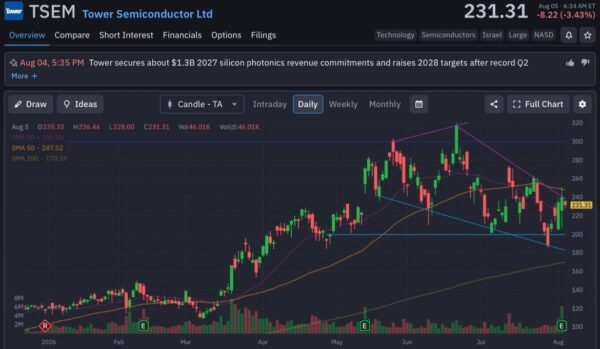
Tower’s rally into earnings explains much of the post-results pullback. After rebounding from July’s low near $190, the stock climbed roughly 30% before stalling at its 50-day moving average of $247.52, a level that has capped every rebound since the May peak near $320. When the earnings report arrived, traders who bought the anticipation locked in profits, sending the shares down 3.43% to $231.31, almost exactly on the 20-day moving average. (chart)

The broader trend, however, remains constructive. The stock continues to trade well above its 200-day moving average at $170.39, while July’s $200 support remains intact. The market isn’t necessarily rejecting Tower’s expansion plans here. It’s asking management to prove that customer prepayments, long-term capacity commitments and an ambitious 2028 roadmap can translate into sustained earnings growth. If that evidence continues arriving each quarter, this chart suggests this pullback may look more like consolidation than a change in trend.
tower-StockEarnings

Contracted Growth Is Worth Buying On Weakness

Tower’s quarter showed more than record revenue and record margins. It showed a business expanding against demand that has already been committed. The company guided third-quarter revenue to another record $520 million, raised its 2028 financial model to $3.6 billion in revenue and $1.2 billion in net profit, while customers continue reserving future production years in advance.

But the risks haven’t disappeared. Tower still needs to execute a $920 million capacity expansion, keep wafer pricing firm and bring new fabs online on schedule. Those are execution risks, not demand risks.  For investors, that’s important to keep in mind as the stock may need time to work through its post-earnings consolidation, while the business continues moving in the opposite direction. 

Join over 1.2M+ investors/traders who receive daily and weekly notable earnings alerts with predicted move