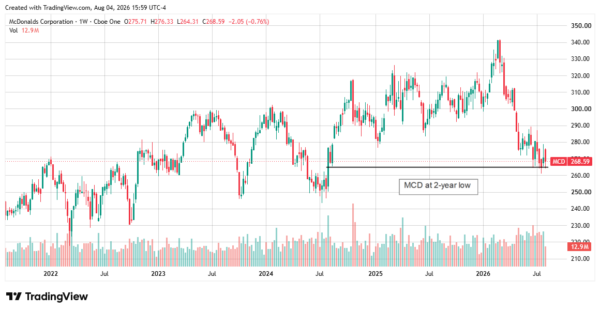
McDonald’s (NYSE: MCD) shares traded near $265.93 Tuesday afternoon, up a modest 0.26% after the company’s Q2 2026 earnings report, following a stretch that took the stock more than 20% below its March all-time high. The setup into the print was rough: rising gas prices squeezing lower-income diners, a brutal comparison against last year’s Minecraft Happy Meal promotion, and a chart that had round-tripped to levels not seen since mid-2024. The report itself told a more complicated story than the sell-off implied.
Diluted earnings per share came in at $3.32, up 6% from $3.14 a year earlier; excluding restructuring charges, adjusted EPS was $3.38. Consolidated revenue rose 4% to $7.1 billion, and Systemwide sales climbed 5% to $37 billion. Global comparable sales rose 1.3%, while U.S. same-store sales climbed just 0.8% — a sharp deceleration from 2.5% growth in the same quarter last year.
The stock’s muted, single-digit reaction says as much about depressed expectations as it does about the quarter itself. Trading around 22 times trailing earnings — well below the multiple near 28 times it commanded at the March high — McDonald’s now looks priced closer to fair value than a premium growth story, even with growth decelerating. That combination of a beaten-down valuation and a still-growing business is exactly what makes this print worth a closer look.
A Fair Price for a Business That’s Still Growing
Here’s the part of the story the headline decline obscures: McDonald’s net income rose 5%, and diluted EPS rose 6% over the past year, even as the stock price fell more than 20% from its high. That means most of the decline came from investors paying less per dollar of earnings, not from the business earning less. At roughly 22 times trailing earnings, McDonald’s trades well below the multiple it commanded in March.
That re-rating matters because the underlying business hasn’t broken. McDonald’s posted positive comparable sales across every segment for the fourth straight quarter, and Systemwide sales to loyalty members grew more than 20% over the trailing twelve months to $40 billion, with 90-day active loyalty users up 13% to nearly 220 million. For value-minded investors, that combination is a reasonable price for a business still generating cash and growing its loyalty base.
Revenue Beat Last Year, Even If the Deceleration Is Real
McDonald’s beat its own year-ago revenue by 4% and grew Systemwide sales by 5%. That’s still growth — the question is the shape of it. U.S. comparable sales rose just 0.8%, down sharply from 2.5% a year ago, driven by favorable check growth that was partly offset by negative guest counts.
CEO Chris Kempczinski acknowledged as much, saying the company sees “an opportunity to raise the bar” in the U.S. specifically. The appointment of Skye Anderson, a 26-year company veteran, as President of McDonald’s USA signals that management recognizes the domestic business needs sharper execution, not just favorable pricing.
Chart Shows an Early, Unconfirmed Bullish Signal
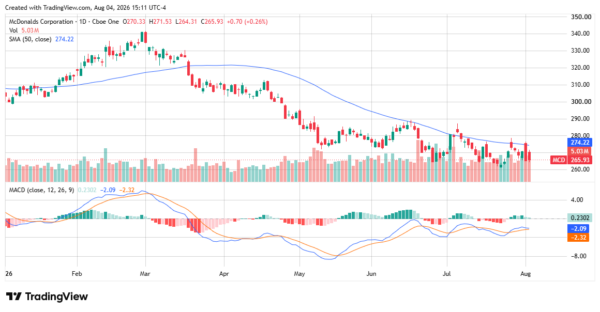
The daily chart shows MCD closing near $265.93, still well below its 50-day moving average of $274.22 — a sign the broader downtrend from the March high hasn’t reversed. Price has spent the last four months carving out a shallow base in the $260s-$280s range, repeatedly testing support without a decisive breakdown.
More encouraging: the MACD line has just crossed above its signal line, ticking to roughly 0.23 versus -2.09, its first bullish crossover since the stock’s decline began. That’s an early signal, not confirmation — the stock still trades under its 50-day average, and one crossover doesn’t reverse a five-month downtrend on its own.
The Bottom Line: Valuation Offers a Cushion, Not a Guarantee
McDonald’s delivered a quarter that beat depressed expectations without erasing the traffic concerns that dragged the stock to a 2-year low. What’s changed is the valuation math: a business still growing earnings and its loyalty base, now trading at a multiple well off its highs, offers investors a fairer entry point than they’ve had in years.
That’s not the same as a confirmed bottom. Gas prices, U.S. guest counts, and a price above the 50-day average remain real hurdles. But for investors comfortable owning a mature, cash-generative business at a reasonable price, McDonald’s looks less overvalued — and worth watching closely for confirmation of the next leg.