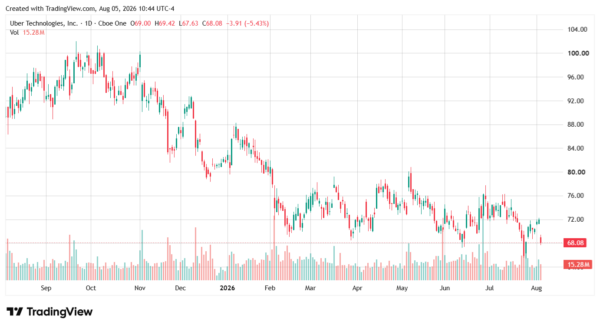
Uber (NYSE: UBER) reported higher profits, growing customer activity, and record levels of cash flow. But its disappointing third-quarter guidance wasn’t up to par.
The company saw $14.19 billion in revenue during the second quarter, an increase of 12% compared with the same period last year. While that marks another year of steady growth, the figure came in just below analysts’ expectations.
One of the company’s strongest performance indicators was gross bookings, which measures the total value of rides, food deliveries, and other services booked through Uber’s platform before fees are deducted. Gross bookings reached $58 billion, up 24% from a year ago, beating Wall Street forecasts.
The results show that people continue to rely on Uber not only for transportation but also for food delivery and other services available through the app.
More Riders and More Trips
Uber’s platform continues to attract new customers. In fact, the company reported 208 million monthly active users, a 16% increase from last year. At the same time, customers completed 3.9 billion trips during the quarter, an 18% increase.
CEO Dara Khosrowshahi added that the company saw more first-time users over the past year than in any of the previous five years, highlighting continued demand for Uber’s services.
Uber’s Profit Improves
The company also posted a significant increase in profit.
The company earned $2.39 billion in net income, up from $1.36 billion a year earlier. Part of that increase came from gains related to investments the company owns, which added about $1.6 billion before taxes. Looking at adjusted earnings, Uber earned 81 cents per share, matching or slightly beating analyst expectations.
Adjusted EBITDA jumped 33% to $2.82 billion. Uber also announced that its trailing 12-month free cash flow exceeded $10 billion for the first time in company history. Strong cash flow gives the company more flexibility to invest in new technology, expand into new markets, or return money to shareholders.
Investors Wanted Better Guidance
Despite reporting strong quarterly results, Uber’s outlook for the next quarter became the biggest talking point.
For the third quarter, the company expects gross bookings between $58.25 billion and $60.25 billion. The midpoint of that range came in slightly below Wall Street expectations. The company also projected adjusted earnings per share between 84 cents and 88 cents, slightly lower than analysts had hoped.
Robotaxi Investments Continue
Uber is also preparing for what it believes will be the next major shift in transportation: autonomous vehicles. Rather than building its own self-driving cars from scratch, the company has been partnering with companies developing robotaxi technology. Management says it wants the app to become the leading platform for booking autonomous rides as the technology becomes more widely available.
The company has announced several partnerships and continues investing heavily in this area. Executives believe autonomous vehicles could lower operating costs over time while expanding transportation options for customers.
However, these investments require significant spending today, and some investors remain cautious about how quickly robotaxis will become profitable.
The Bottom Line
Uber’s latest earnings report paints a picture of a company that continues to grow at a healthy pace. Revenue, bookings, users, trips, profits, and cash flow all moved higher, showing that demand for the company’s services remains strong.
Still, the stock market is focused on what comes next.
The company’s forecast for the third quarter was slightly weaker than analysts expected, leading investors to worry that growth may slow in the near term.
For now, Uber appears to be balancing two priorities: continuing to grow its core ride-sharing and delivery businesses while investing billions of dollars in autonomous vehicle technology that could shape its future. Whether those long-term investments pay off will likely remain one of the biggest questions for investors over the coming years.