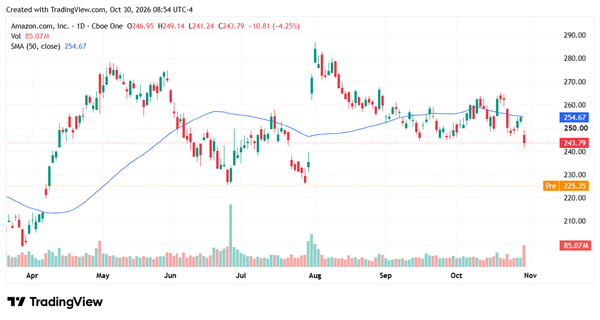
Amazon (NASDAQ: AMZN) is bringing in more money, and its cloud business is growing quickly. But investors are worried about how much the company is spending to keep that growth going.
In fact, shares fell after the company posted quarterly sales and earnings below Wall Street’s expectations. That, plus its substantial investment plans to spend roughly $220 billion on capital projects this year, raised concerns.
Still, despite the chaos, there are reasons to remain bullish.
The Quarter Had Some Weak Spots
Amazon reported third-quarter revenue of $201.9 billion, up 12% from a year earlier. Earnings came in at $1.89 per share. Both fell short of expectations, which were approximately $202.3 billion in revenue and $1.96 per share in earnings.
However, the report wasn’t weak across the board.
Operating income reached $28.1 billion. That exceeded the roughly $26.1 billion analysts expected. In other words, Amazon’s operations performed better than the headline earnings miss might suggest. Its shopping businesses also continued to grow. North American sales rose 6%, while international sales increased 5%.
Why Amazon’s Spending Is Worrying Investors
The biggest concern is how much cash Amazon is putting back into the business. Capital expenditures, or capex, pay for assets a company expects to use for years. For Amazon, those include data centers, servers, and other equipment supporting its cloud and AI services.
Over the past 12 months, Amazon generated $168.3 billion in operating cash flow, up 29%. Yet its free cash flow was negative $42.4 billion because net spending on property and equipment exceeded that cash generation. Amazon said AI investment was the main driver of the spending increase. Put simply, Amazon’s businesses are generating substantial cash. The company is spending even more to expand.
That does not mean AMZN is not profitable. Buying equipment uses cash up front, while the accounting cost is generally spread over its useful life. A company can therefore report strong profits while spending more cash than its operations produce.
AWS Helps Explain the Big Investment
Amazon Web Services, or AWS, provides computing power, storage and other technology services to businesses. It remains a major source of Amazon’s profits. Third-quarter AWS revenue reached $46 billion, up 39%, while operating income totaled $17.8 billion.
Management believes there is considerably more growth ahead. CEO Andy Jassy projects AWS revenue growth above 40% in both 2027 and 2028. Those are expectations, not guaranteed results, but they explain why AMZN is willing to spend so aggressively on additional capacity.
If that demand materializes, today’s investments could support a much larger business. If demand disappoints, the company could face weaker returns on expensive infrastructure.
The holiday forecast offered limited reassurance. Amazon’s fourth-quarter sales guidance has a midpoint of $243.5 billion, slightly below the approximately $244.16 billion analysts expected.
Could the Pullback Be Worth Buying?
I believe the decline makes AMZN worth a closer look.
The company has established businesses, substantial operating profits, and opportunities to expand. Its long-term appeal does not depend entirely on AI. Still, investors cannot ignore AI spending when assessing the stock. Amazon is committing real money today, and the returns on that investment matter even if its other businesses remain healthy.
Debt also deserves attention. Long-term debt rose to approximately $173.1 billion from $65.6 billion at year-end 2025. The company held about $114.2 billion in cash and marketable securities, but those resources alone do not settle whether continued borrowing and spending are sustainable.
For me, the opportunity rests on AMZN turning strong demand into lasting cash generation. The pullback could offer an attractive entry point for patient investors, but a lower price alone does not make the stock a bargain. Continued AWS growth, improving free cash flow, and returns on its infrastructure spending will determine whether the bullish case holds up.