Retirement is supposed to be the time when your money starts working for you. But with everyday expenses rising and paychecks coming to an end, generating enough income from your savings can become one of your biggest financial concerns.
That’s where dividend-paying exchange-traded funds (ETFs) can help. These funds offer investors a way to collect regular distributions from a diversified portfolio of stocks, potentially reducing the need to sell investments every time another bill comes due.
And some ETFs offer an additional advantage: the opportunity to grow your income over time, helping your savings keep pace with inflation.
For investors approaching retirement or already living on a fixed income, here are three dividend ETFs worth considering.
Vanguard International High Dividend Yield ETF
Most American investors keep the majority of their investments in U.S. stocks. While that approach has worked well over long periods, it can leave retirement portfolios heavily dependent on the performance of one market.
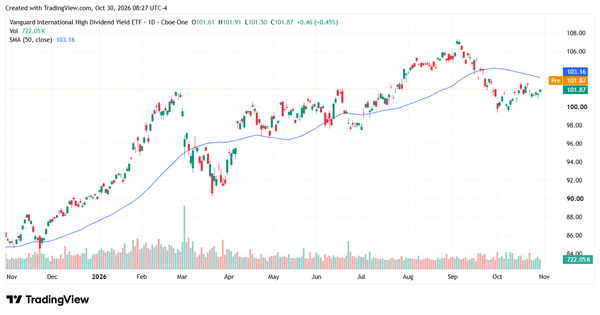
The Vanguard International High Dividend Yield ETF (NASDAQ: VYMI) offers an alternative, providing exposure to more than 1,500 dividend-paying companies outside the United States.
With a dividend yield recently around 3.6% to 3.7% and an expense ratio of just 0.07%, VYMI combines relatively attractive income with low investment costs.
Its portfolio includes established international businesses such as Nestlé (OTCMKTS: NSRGY), Novartis (NYSE: NVS), Toyota (NYSE: TM), and Shell (NYSE: SHEL). These companies operate across industries and geographic markets, giving investors exposure to different economic conditions and sources of revenue.
What could that mean for your retirement income?
At a hypothetical 3.64% annual yield, a $100,000 investment would generate approximately $3,640 annually before taxes. That’s around $303 per month when averaged over the year, although VYMI distributes quarterly and payment amounts vary.
The bigger appeal is diversification. If U.S. stocks experience a prolonged downturn, international holdings may behave differently, potentially helping balance a retirement portfolio. Investors should remember that foreign stocks also carry currency, political, and economic risks.
For retirees who already own plenty of U.S. stocks, VYMI could provide a useful combination of income and international exposure.
Vanguard Dividend Appreciation ETF
One of the biggest threats to retirement savings is inflation. Even modest increases in living expenses can significantly erode purchasing power over a 20- or 30-year retirement.
That’s why some retirees prioritize companies that have consistently increased their dividend payments.
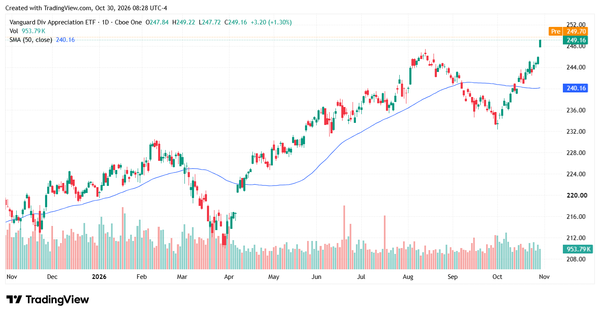
The Vanguard Dividend Appreciation ETF (NYSEARCA: VIG) follows that approach, investing in established U.S. businesses with a history of increasing their dividends. Its portfolio includes companies such as Microsoft (NASDAQ: MSFT), Apple (NASDAQ: AAPL), JPMorgan Chase (NYSE: JPM), Visa (NYSE: V), and Broadcom (NASDAQ: AVGO). These businesses operate in different industries, but they share a focus on generating the earnings and cash flow that can support shareholder distributions. VIG charges an exceptionally low expense ratio of 0.04% and recently offered a yield of roughly 1.4%.
Amplify CWP Enhanced Dividend Income ETF M
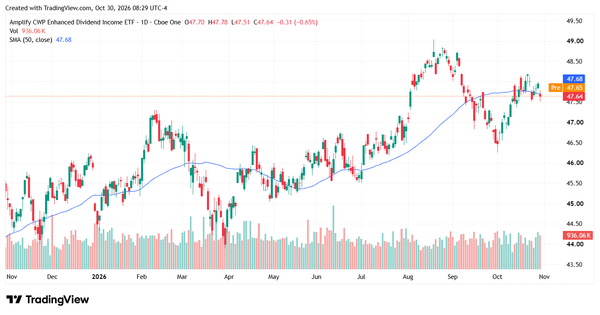
For retirees who want income deposited into their accounts more frequently, the Amplify CWP Enhanced Dividend Income ETF (NYSEARCA: DIVO) offers an interesting approach.
Unlike traditional dividend ETFs, DIVO combines dividend-paying stocks with a strategy known as covered call writing.
The fund invests in established, large-cap companies with histories of earnings and dividend growth. It then selectively sells call options against certain holdings, collecting premiums that can provide an additional source of income.
That combination allows the fund to generate distributions from both stock dividends and options activity. As of September 30, 2026, DIVO reported an annualized distribution rate of 4.88% and paid distributions monthly. Its expense ratio is 0.56%.
Which ETF Makes the Most Sense for Retirement?
Each of these funds addresses a different retirement concern.
- VYMI could appeal to investors seeking higher dividend income and diversification outside the United States.
- VIG may be better suited to investors who want their dividend income to grow over time while maintaining exposure to established U.S. companies.
- DIVO may interest retirees looking for monthly cash flow and willing to accept the trade-offs associated with covered call strategies.
There’s also a case for combining different approaches. An investor might use dividend growth funds as a foundation while adding international dividend exposure and a smaller allocation to monthly income strategies. The key is to evaluate how much income you actually need, when you need it, and how much investment risk you can comfortably accept.