Waste Management (NYSE: WM) delivered a third-quarter earnings report that showed solid growth both sequentially and year-over-year. Revenue rose 6.3% to $6.85 billion, ahead of the roughly $6.80 billion analysts expected.
However, a slight miss on adjusted earnings per share (EPS) compared to what analysts were looking for sent the stock down about 4.5% the day after the report. Adjusted EPS came in at $2.15, about four cents shy of consensus. That was still up 8.6% from $1.98 a year ago.
To be fair, the day after Waste Management’s report correlated with the Federal Open Market Committee’s interest rate decision, which can amplify disappointing news, even news that wasn’t that disappointing.
For example, management affirmed its full-year guidance. It now expects revenue and free cash flow to land at the high end of their ranges.
In an earnings cycle where artificial intelligence (AI) stocks are driving the headlines, a boring waste management company may not excite investors. But that’s the point. Investing isn’t supposed to be emotional, just profitable. By that measure, WM continues to show why it belongs in any portfolio built to put compounding to work.
Volume Was the Soft Spot in an Otherwise Solid Quarter
Pricing did the heavy lifting again. Core price rose 5.8%, and collection and disposal yield increased 3.4%. Volume was the weak link. Collection and disposal volume slipped 0.4%, or 0.5% on a workday-adjusted basis.
The pressure was broad. Residential volume fell 2.6%, and commercial volume dropped 1.3%. Municipal solid waste landfill volume declined 1.1%. Management said construction-related landfill activity also remained soft. It expects full-year volume to decline about 1%.
Not all of that is bad news. Some residential losses are intentional as WM sheds lower-margin contracts. Commercial declines largely trace back to earlier national account losses through brokers. Still, WM’s own data shows core volume tracks GDP closely. Persistent softness reads as an economic signal, and that likely weighed on sentiment.
Diesel Prices Cut Both Ways
WM runs the largest collection fleet in North America, so fuel is a major cost. Higher fuel costs shaved about 40 basis points from adjusted operating EBITDA margin. Rising risk management costs took another 40 basis points. Together, they erased gains from pricing and Healthcare Solutions. Adjusted margin slipped 10 basis points to 31.0%.
The company does have a pass-through mechanism. Energy surcharge and mandated fee revenue jumped $112 million, or 42.2%. But surcharges tend to lag fuel prices. They also add revenue without adding much margin. That helps explain why operating expenses rose to 59.8% of revenue from 58.9%.
The flip side matters. If diesel prices ease, surcharge revenue would shrink, and headline growth could look slower. But margins could widen as costs drop before surcharges reset. WM also has a built-in cushion. It operates the industry’s largest heavy-duty natural gas truck fleet, partly fueled by its own renewable natural gas.
Healthcare Solutions Shows the Value of Diversification
Healthcare Solutions, the former Stericycle business, was the quarter’s standout. Segment revenue grew 3.7% to $651 million. Adjusted operating EBITDA rose about 33% to $146 million. Adjusted margin expanded to 22.4% from 17.5% a year earlier.
Synergy capture, cost discipline, and pricing drove the improvement. The benefits showed up company-wide. Adjusted SG&A fell 70 basis points to 9.3% of revenue. Healthcare’s operating performance alone added 30 basis points to adjusted EBITDA margin.
The sustainability businesses helped, too. Renewable energy revenue climbed 45% to $167 million as new RNG plants came online. Recycling benefited from commodity prices of about $82 per ton, up from $68. That diversity helps smooth results when core volume softens.
The Cash Flow Story Is Hard to Ignore
Free cash flow through nine months reached $3.01 billion, up more than 42%. Operating cash flow rose 12% to $4.87 billion. Lower sustainability spending also helped as major projects wind down.
WM returned more than $2.72 billion to shareholders through September, including $1.58 billion in buybacks. Management still expects to repurchase $2 billion of stock in 2026. The dividend has now risen for 23 consecutive years.
Where Could the Next Catalyst Come From?
WM is the industry leader, but the market remains fragmented. In its June investor presentation, WM sized the U.S. and Canada waste market at about $130 billion. WM’s 2025 revenue of $25.2 billion is roughly 19% of that. Competitors outside the top five generate nearly $68 billion combined.
That leaves room for acquisitions. WM’s last major deal was the $7.2 billion Stericycle purchase in 2024. The stock moved higher that year as investors priced in the combination.
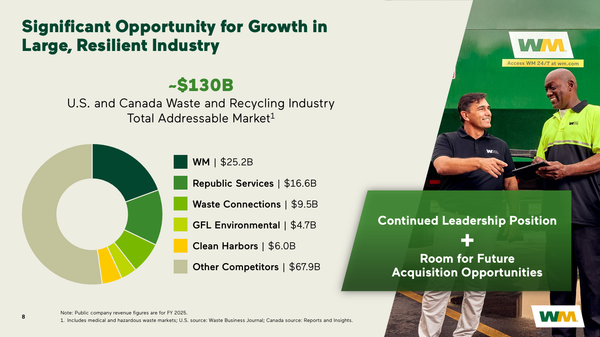 Source: Waste Management Investor Day, 2026
Nothing suggests a deal is imminent, but the balance sheet could support one. Leverage peaked at 3.61x after Stericycle and fell to 3.11x by year-end 2025. Management expects it back within its 2.5x to 3.0x target this year. One caveat: WM paused buybacks in 2025 to pay down debt. A $2 billion buyback suggests capital is flowing to shareholders for now.
The Third Time Could Be a Charm for Investors
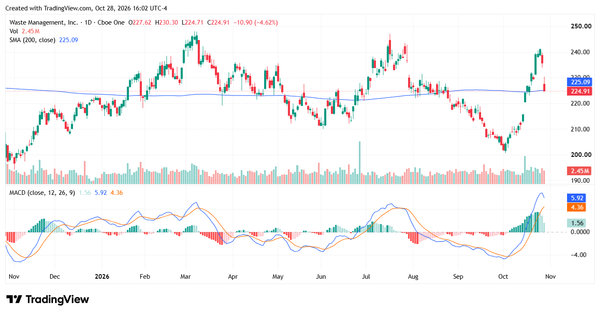
Technical analysis isn’t perfect, but it can tell a story that investors shouldn’t dismiss. That seems to be the case with the Waste Management chart. At two times in the last six months, WM hit resistance at a price around $240. Earlier in 2026, it had pushed as high as about $245 before finding resistance.
What could concern investors who don’t have a position is the pattern of lower highs and lower lows since March. That’s the trend this report hoped to reverse, and it still might.
WM closed Oct. 28 at $224.91, just below its 200-day simple moving average of $225.09. The MACD remains positive, but a shrinking histogram suggests the October rally is losing steam. Reclaiming the 200-day would set up a move toward $240. Beyond that sits the consensus price target of $256.06. That may not happen overnight. Several analysts lowered their targets before the report.
WM Is the Right Stock for the Right Time
In a flight to safety, it doesn’t get much safer than Waste Management. The company cites a beta of just 0.56 against the S&P 500. It’s not going to be the stock that gets the media buzz, but if you’re looking for a sleep-at-night stock with a history of delivering a solid total return, WM may be the right stock for the right time.