Amazon.com Inc. (NASDAQ: AMZN) grew Q3 revenue 12% to $201.9 billion, while earnings per share came in at $1.89 as operating income surged 61% to a record $28.1 billion, pushing its operating margin to a record 13.9%. AWS revenue jumped 39% to $46 billion, yet Amazon’s trailing 12-month free cash flow swung from a $14.8 billion inflow to a $42.4 billion outflow as the company ramps up AI infrastructure spending.
Chief executive officer (CEO) Andy Jassy is expecting AWS growth to top 40% in both 2027 and 2028. That means investors now have to weigh how much that growth is worth against Amazon’s planned $220 billion in capital expenditures for 2026.
AWS Is Growing Fast Enough to Change the Story
Amazon generated $201.9 billion in third-quarter revenue, up 12% year over year, while operating income climbed to $28.1 billion from $17.4 billion. Its 13.9% operating margin was the highest in the company’s history, showing that Amazon is getting more profit from its sales even as it continues investing heavily in technology and infrastructure.
AWS is driving much of that improvement. Revenue rose 39% to $46 billion, its fastest growth in nearly five years, while operating income increased to $17.8 billion from $11.4 billion. AWS now has an annualized revenue run rate of $184 billion, giving Amazon a much larger and more profitable cloud business to build on.
Jassy was direct about what he thinks those investments are delivering, saying AWS revenue growth exceeded 39% in the quarter and that he expects growth above 40% in both 2027 and 2028. That forecast tells me Amazon sees demand continuing well beyond the current AI spending boom.
There is evidence behind his confidence. Amazon said Fortune 500 spending on its Bedrock inference service grew nearly sevenfold year over year, while total Bedrock token volume increased nearly 17 times. Those figures point to companies using AWS for more AI workloads, which can create recurring demand for the cloud infrastructure Amazon is building.
I want to see that momentum continue because AWS is doing more than adding sales. Its operating income rose by billions of dollars, giving Amazon a stronger source of earnings to support investments elsewhere in the business. The question is how much of that progress will reach shareholders after Amazon pays for the next round of infrastructure.
Retail Is Improving, but Free Cash Flow Is Taking the Hit
Amazon’s retail operations deserve more credit than they often receive in an AI-focused market. North America revenue increased 6% to $112.9 billion, while operating income climbed to $8.7 billion from $4.8 billion. International revenue rose 5% to $43.1 billion, with operating income increasing to $1.6 billion from $1.2 billion.
The gains suggest Amazon is getting better at managing the cost of serving customers. Its faster delivery network and broader product selection are helping it compete, while improvements in operating efficiency are allowing more revenue to reach the bottom line.
The cash flow figures, however, show where investors have reason to hesitate. Operating cash flow for the trailing 12 months increased 29% to $168.3 billion, yet free cash flow swung to an outflow of $42.4 billion from an inflow of $14.8 billion a year earlier. Amazon attributed the change primarily to a $94.8 billion year-over-year increase in net purchases of property and equipment, driven largely by AI investment.
Amazon continues to expect approximately $220 billion in cash capital expenditures for 2026. That is an enormous commitment, and the company is making it while free cash flow has already turned negative on a trailing-year basis.
I don’t see that as proof the investment is failing. Amazon is adding capacity to serve demand that is already showing up in AWS revenue and usage. Still, investors need evidence that the new infrastructure will generate enough future cash to justify the spending. Faster AWS growth helps make the case, but the return on that spending remains the part I’m watching most closely.
Tape Responded With A Sharp Sell-Off
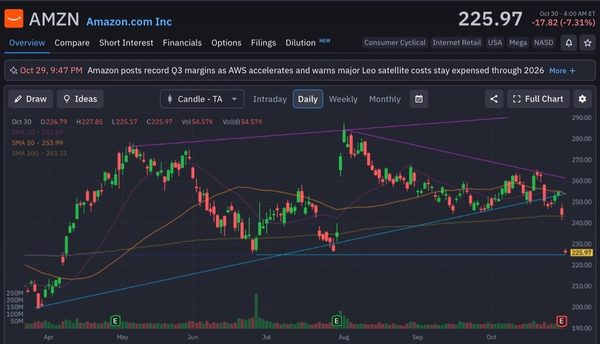
The stock chart shows how much work Amazon has left with investors. AMZN fell to $225.97, down 7.31%, breaking below its recent support area around $245 to $250. The price also sits below its 20-day moving average near $253.67, its 50-day average near $253.99, and its 200-day average near $243.33.
I would want to see the stock reclaim the $243 to $254 area before treating this selloff as a buying opportunity with stronger technical support. Until then, the price action suggests investors are reassessing how much they are willing to pay while free cash flow remains under pressure.
The earnings picture also needs context around net income. Amazon reported $20.7 billion in net income, or $1.89 per diluted share, compared with $21.2 billion and $1.95 a year earlier. The decline was driven primarily by $9.5 billion in pretax gains from its Anthropic investments that boosted the year-ago quarter. That means the year-over-year decline does not tell the full story of the improvement in Amazon’s operating business.
For the fourth quarter, the company expects revenue of $240 billion to $247 billion and operating income of $28.5 billion to $33.5 billion. It also expects advertising revenue to grow in the high teens. Those figures give Amazon another opportunity to show that its retail, advertising, and cloud operations can keep growing while it funds its infrastructure expansion.
All told, operating performance is improving, and AWS is giving Jassy a credible reason to keep investing. My view turns on whether that growth can eventually ease the cash flow burden. Record margins are a meaningful step forward, but the retail company still has to prove that its massive AI buildout can deliver returns that match its cost.