Tesla (NASDAQ: TSLA) has a $43.5 billion cash pile, a growing energy business, and ambitious plans for robotaxis and humanoid robots. Yet its operating margin collapsed to 1.4% in Q2, just as capital spending accelerated. The company is attempting to build its next growth engine while its automotive business faces mounting pressure to deliver the profits that will pay for it.
Tesla reports third-quarter earnings on Wednesday, October 21, after the market closes. The company-compiled analyst consensus calls for $28.34 billion in revenue and 45 cents in adjusted EPS. Revenue would be roughly flat year over year, while adjusted earnings would fall from 50 cents a share.
The stakes extend beyond an earnings beat. The company is committing more capital to AI compute, robotaxis, and robotics while investors debate whether its automotive economics can support those ambitions. This quarter needs to show that the core business can keep funding the transition.
Tesla’s Delivery Beat Needs to Reach the Bottom Line
Tesla delivered 486,532 vehicles in Q3, beating Wall Street’s estimate of approximately 462,000. Deliveries still declined 2.1% year over year from 497,099, according to the company’s Q3 production and delivery report. Production came in at 464,391 vehicles, around 22,000 below deliveries, allowing Tesla to work through inventory.
That is a useful volume result, but Q2 showed how little protection stronger sales provide when margins deteriorate. Revenue increased 26% year over year to $28.24 billion, yet operating income fell 57% to $398 million. Operating margin contracted to 1.4%, while adjusted EBITDA declined 4% to $3.27 billion. Tesla’s Q2 2026 details the pressure from lower average selling prices, reduced regulatory-credit revenue, and higher operating expenses tied partly to AI research and development.
Automotive gross margin excluding regulatory credits stood at 16.3% in Q2. With price competition limiting Tesla’s ability to push vehicle prices higher, manufacturing efficiency and product mix carry more weight in the earnings equation.
For Q3, I’m watching automotive gross margin, average selling prices, regulatory-credit revenue, and operating expenses. A delivery beat has already landed. The next catalyst is evidence that Tesla can turn those vehicles into stronger operating income.
The AI Bill Is Getting Bigger
Capital spending reached $5.79 billion in Q2, up 142% year over year. Operating cash flow of $4.70 billion could not cover that outlay, leaving free cash flow at negative $1.09 billion. Cash and investments ended June at $43.52 billion.
The latest Tesla Q3 analyst consensus projects approximately $7.77 billion in capital expenditures and negative $4.51 billion in free cash flow. For the full year, analysts expect capex of roughly $25.35 billion.
The spending supports Tesla’s expansion into AI compute, autonomous driving, and robotics. During the first half of 2026, the company more than doubled its onsite AI compute capacity in Texas. Cybercab production has begun, robotaxi operations are expanding, and Tesla is installing first-generation Optimus production lines in Fremont. The company also expects Tesla Semi and Megapack 3 production to begin this year.
These projects could eventually produce higher-margin revenue streams. For now, they require substantial upfront investment. Q3 cash flow and management’s updated spending plans will show how much financial flexibility Tesla retains as it builds those businesses.
Robotaxis Must Earn Their Valuation Premium
Tesla’s bull case increasingly depends on software and autonomous driving becoming meaningful profit centers. Active FSD subscriptions rose 56% year over year to 1.48 million in Q2. Services and Other gross profit also climbed $302 million sequentially to a record $648 million, reaching a 14% gross margin. Those figures provide early evidence of a business extending beyond vehicle sales.
The next earnings call should clarify whether robotaxi deployment is advancing toward scalable commercial operations and whether FSD adoption is translating into recurring revenue. Optimus offers another potential growth avenue, but production milestones alone cannot establish its eventual contribution to earnings.
Meanwhile, speculation around a potential Tesla–SpaceX combination has added another variable to the stock. But keep in mind, any transaction remains speculative, so the company’s operating results should carry more weight than merger chatter.
TSLA Needs to Reclaim Its Trend
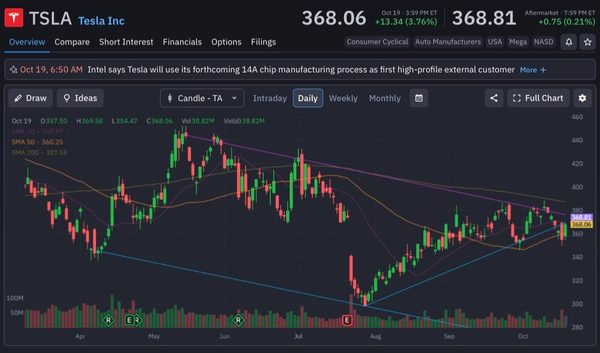
TSLA stock closed at $368.06 on October 19, up 3.76%. Its 20-day moving average sits at $369.97, the 50-day at $360.25, and the 200-day at $387.58.
The recovery from July’s low near $300 has improved the chart, but TSLA remains below its 200-day average and a descending trendline from the spring highs. Resistance around $378–$380 comes first, followed by $387–$390. On the downside, $350–$355 is a key support zone near the rising trendline.
Still A Buy…But
My stance is BUY, with profitability and AI execution as the catalysts. Tesla has demonstrated demand resilience, but the next leg higher needs stronger automotive economics and tangible progress toward monetizing AI. Improving margins alongside disciplined spending would strengthen the bull case. If cash burn accelerates while operating profitability remains thin, the stock could struggle to clear overhead resistance.