Cleveland-Cliffs (NYSE: CLF) and Steel Dynamics (NASDAQ: STLD) reported third-quarter earnings on the same day. The same steel market drove both reports. Prices rose, imports stayed low, and lead times stretched. Yet the way investors reacted to the reports could not have been more different.
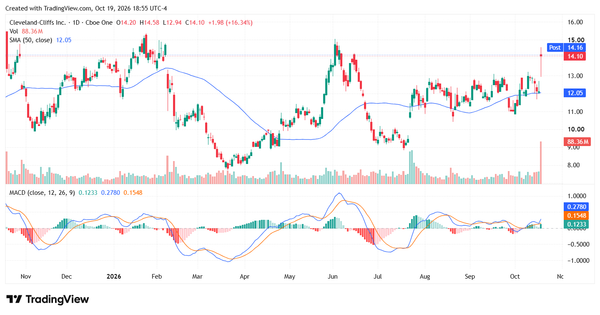
CLF shares jumped 16.3% on Monday after the company swung to a profit. Volume topped 88 million shares, far above its recent run rate. Steel Dynamics reported after the close and fell roughly 7% in extended trading.
On paper, that looks backward. Steel Dynamics earned $5.26 per share. Cliffs earned 28 cents on an adjusted basis. Steel Dynamics turned 18% of revenue into adjusted EBITDA. Cliffs managed about 11%.
But markets don’t price earnings in isolation. They price earnings against expectations and against direction. Cleveland-Cliffs beat the bar and raised it. Steel Dynamics missed a bar it set for itself just one month ago.
That makes this pair a useful case study in why investor perception can be shaped by fundamentals. One company is the better business today. The other has the more compelling story about tomorrow. Here’s what each report showed, and what investors should weigh next.
Cleveland-Cliffs: The Inflection Investors Were Waiting For
Cleveland-Cliffs reported revenue of $5.6 billion, up from $5.2 billion in the second quarter and about 18.5% higher year over year. GAAP net income was $165 million, or $0.26 per diluted share. Adjusted EPS of 28 cents topped the consensus estimate of 24 cents. Revenue came in slightly below the $5.69 billion consensus.
The headline number, however, was adjusted EBITDA of $612 million. That more than doubled the second quarter’s $286 million. It also beat the company’s own $575 million guidance. CEO Lourenco Goncalves called it the strongest quarter in three years.
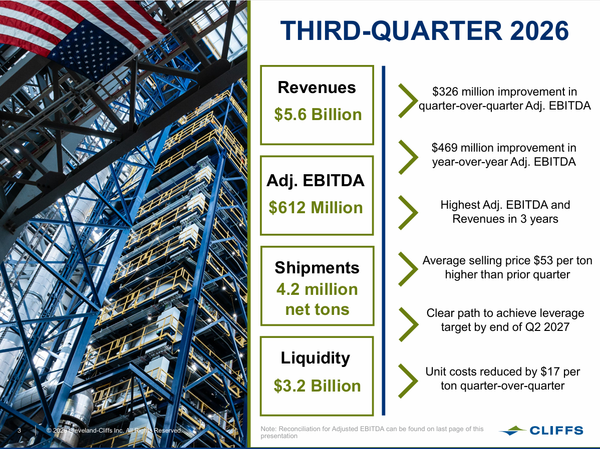
Every lever moved the right way. Shipments rose to 4.15 million tons from 4.03 million. The average selling price climbed $53 sequentially to $1,177 per ton. Steelmaking cash margin nearly doubled to $685 million from $349 million.
Automotive remains central to the story. Direct auto sales made up 28% of steelmaking revenue. Auto shipments were the highest since the third quarter of 2023, even as North American vehicle production dipped.
Canada also turned a corner. Stelco posted its best quarter since Cliffs acquired it and contributed positive EBITDA. However, Cliffs is indefinitely idling Stelco’s galvanizing lines, citing an oversupplied Canadian market. It will shift that tonnage to hot-rolled products.
The outlook drove the rally. Cliffs guided fourth-quarter adjusted EBITDA to roughly $715 million. More importantly, it expects 2027 adjusted EBITDA to exceed $4 billion. That figure rests on newly signed contracts and current index price forecasts. For context, Cliffs has generated $993 million year to date.
The balance sheet is the counterweight. Long-term debt stood at $7.6 billion, up from $7.25 billion at year-end. Liquidity was $3.2 billion. Management expects a major debt reduction in the fourth quarter from free cash flow and property sales. It is targeting net leverage below 2.5x by mid-2027.
Steel Dynamics: A Record Quarter That Missed the Mark
Steel Dynamics delivered revenue of $6.5 billion, up 35% from a year ago and 7% sequentially. That topped the consensus estimate near $6.43 billion. Net income reached $756 million, or $5.26 per share, up 92% from $2.74 a year ago.
The problem was the bar. In September, the company guided EPS to $5.34 to $5.38. Analysts were looking for about $5.41. Missing self-issued guidance by eight cents is small in dollars but large in credibility.
The core steel business was excellent. Steel operating income rose 43% sequentially to $1.03 billion. Shipments hit a record 3.78 million tons. The average selling price rose $102 to $1,400 per ton, while scrap costs fell $8 to $404. That widened the metal spread by about $110 per ton.
The miss came from the edges. Aluminum lost $26 million, though that was a 21% improvement from the second quarter. For several weeks, yield losses at higher mill speeds held volumes below plan. Management traced the issue to the hot strip mill’s coolant and says it is fixed. Metals recycling income also slipped to $33 million from $48 million on lower scrap prices.

Fabrication looks like a hidden strength. Operating income rose to $91 million on 18% higher shipments. The order backlog is 50% above last year and extends into the second quarter of 2027. Data centers, healthcare, and manufacturing are leading demand.
Capital returns remain a hallmark. Steel Dynamics generated $846 million in operating cash flow. It repurchased $276 million of stock and paid $76 million in dividends. Net leverage sits at just 0.9x trailing adjusted EBITDA, with $2.4 billion in liquidity.
Same Tailwind, Very Different Business Models
Both CEOs credited the same backdrop. Imports are well below historical levels. Customer inventories are lean. Lead times have extended. Trade policy is doing much of the heavy lifting for domestic producers.
What differs is how each company converts that backdrop into profit. Cliffs runs integrated blast furnaces with heavy fixed costs. That creates powerful operating leverage when prices rise, and painful losses when they fall. Steel Dynamics runs scrap-based electric arc furnaces with a largely variable cost structure. Its margins swing less in both directions.
End markets differ, too. Cliffs is tied closely to Detroit. Steel Dynamics leans on energy, nonresidential construction and data centers. That diversification is one reason its fabrication backlog keeps building.
The balance sheets tell the clearest story. Steel Dynamics is funding buybacks and an aluminum expansion from cash flow. Cliffs is still working to bring leverage down to a comfortable level.
What the Charts Are Saying
Cliffs gapped above the $13 ceiling that capped the stock since August. Its next test is the June high near $15, then the February peak around $15.40. The stock now trades well above its 200-day moving average of $11.34.
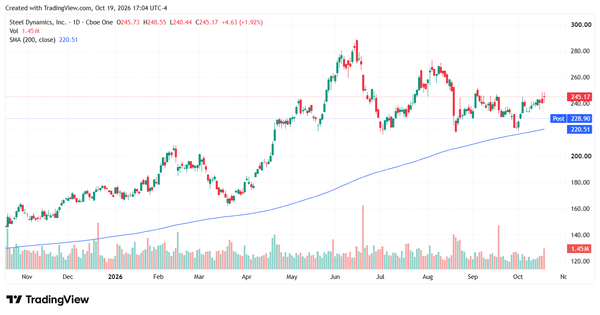
Steel Dynamics has made lower highs since peaking near $288 in June. Its post-market price near $229 would put the stock closer to its 200-day average of about $220. That level held as support in July, August, and early October.
The Bottom Line: Buying a Forecast vs. Selling a Fixed Problem
Investors bidding up Cliffs are largely buying a forecast. A $4 billion EBITDA year in 2027 would transform the stock. But it depends on pricing holding, auto demand cooperating, and debt coming down on schedule.
Investors selling Steel Dynamics are reacting to a problem management says is already solved. The core steel franchise just posted a record. The question is whether an eight-cent miss justifies a 7% haircut.
The Oct. 20 conference call will matter. If management confirms the aluminum fix and offers constructive fourth-quarter commentary, the selloff may look like perception running ahead of fundamentals.