GE Aerospace (NYSE: GE) just delivered a 36% jump in adjusted earnings per share, a 49% surge in orders, and another upgrade to its 2026 outlook. Yet the stock fell 3.16% to $301.45, trading below all three major moving averages. Investors have a strong earnings report to digest, but the next leg higher depends on whether GE can turn its swelling commercial-services business into more consistent cash generation.
The company’s third-quarter results show why demand remains strong. Revenue climbed 16% to $14.12 billion, while adjusted revenue increased 18% to $13.29 billion. Adjusted operating profit rose 30% to $2.99 billion, lifting the operating margin to 22.5% from 20.3% a year earlier. Adjusted EPS reached $2.25, compared with $1.66 in Q3 2025.
GE also raised its full-year earnings, operating-profit and free-cash-flow guidance. The engine powering those upgrades is its commercial aftermarket business, supported by a backlog exceeding $170 billion. The catch: free cash flow fell 14% during the quarter, leaving GE Aerospace with something to prove even after raising the bar.
Airlines Are Keeping GE’s Service Bays Busy
Commercial Engines & Services generated $10.34 billion in Q3 revenue, up 21% year over year, while segment operating profit climbed 21% to $2.89 billion. Orders jumped 58% to $15.27 billion, with service orders rising 23% and equipment orders more than tripling.
The revenue breakdown shows where the momentum is coming from. Services revenue grew 17%, internal shop-visit revenue increased 12%, and spare-parts revenue rose more than 20%. LEAP engine shop-visit revenue grew over 40%, while total engine deliveries increased 8%. GE is benefiting from a large installed engine fleet that requires maintenance, repairs, and replacement parts, alongside continued demand for new engines.
That aftermarket footprint gives GE a more durable revenue stream than equipment deliveries alone. Airlines need engines maintained to keep aircraft flying, and the work can generate repeat business over an engine’s service life. GE’s commercial-services backlog now exceeds $170 billion, giving management substantial contracted demand to work through.
Management expects commercial-services revenue to grow at a low-double-digit rate in 2027. For 2026, it raised its Commercial Engines & Services revenue-growth outlook to the low 20s and operating-profit forecast to 10.5billion – 10.6 billion. The segment is now doing the heavy lifting, although its margin edged down 10 basis points to 27.9% as inflation and business mix offset some benefits from volume and pricing.
The Guidance Upgrade Comes With a Cash-Flow Test
GE raised its full-year 2026 adjusted EPS guidance to 8.00–8.10, up from 7.65–7.85. It now expects adjusted operating profit of 10.9 billion–11 billion and free cash flow of 9.1 billion–9.4 billion. Adjusted revenue growth is projected at roughly 19%–20%.
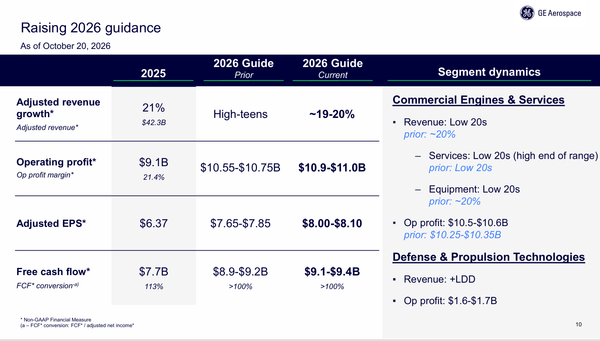
Those revisions imply management expects the strong operating performance to continue into Q4. Nine-month free cash flow already reached $6.73 billion, up 13% from the prior year, which leaves GE needing roughly 2.37 billion–2.67 billion in Q4 to reach its new full-year range.
The latest quarter, however, went in the opposite direction. Operating cash flow slipped to $2.20 billion from $2.56 billion, while free cash flow fell to $2.04 billion from $2.36 billion. GAAP profit rose 12% to $2.81 billion, but the GAAP profit margin contracted 80 basis points to 19.9%.
One quarter does not establish a cash-conversion problem, especially in a business where delivery schedules and working-capital movements can shift between periods. Still, investors should watch the Q4 cash tally closely. GE Aerospace is raising its earnings expectations while promising more than $9 billion in annual free cash flow, so the next report needs to show that higher profits are reaching the cash-flow statement.
Defense Adds Support, but Commercial Still Leads
Defense & Propulsion Technologies provides another source of growth. Q3 revenue increased 7% to $3.47 billion, orders climbed 18% to $4.27 billion, and operating profit rose 8% to $475 million. For the first nine months of 2026, segment revenue advanced 13%, and orders grew 33%.
GE also signed a contract worth up to $2.9 billion to support F414 engines powering the U.S. Navy F/A-18 and EA-18G aircraft. Its agreement to acquire Consolidated Precision Products would expand capacity for mission-critical castings used across commercial engines, aftermarket operations and defense programs.
The opportunity comes with execution risk. GE is working to meet rising demand while dealing with supplier constraints, inflation, and the challenge of expanding production capacity. A larger backlog can support future revenue, but only if the company can deliver the work at attractive margins and on schedule.
GE Needs to Reclaim Its Trend
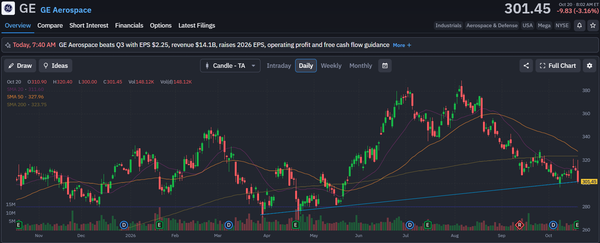
The stock’s technical picture remains weaker than the earnings report. GE closed at $301.45, below its 20-day simple moving average at $311.60, its 50-day at $327.96 and its 200-day at $323.75. Shares have retreated from summer highs near $380, and the latest decline has brought the price toward a rising support trendline around $300.
That level is the immediate line to watch. Holding near $300 could give buyers a base from which to challenge $312, the first meaningful resistance area. A stronger recovery would need to clear the 324–328 zone, where the 200-day and 50-day averages sit. A decisive break beneath the rising trendline would leave the chart vulnerable to another leg lower.
GE Aerospace Is a BUY
GE Aerospace is a buy, supported by accelerating commercial-services demand, a $170 billion-plus backlog and higher earnings guidance. The company has built a formidable aftermarket engine, and its defense business adds another source of growth.
But after the latest selloff, I would look for cash flow to confirm the earnings momentum and for GE to reclaim its moving averages before expecting the stock to return to its summer highs. The fundamentals are strengthening; the chart still needs to catch up.