ajax loader

Loading...


Ride-the-Wave Strategy – Best for Stock Traders

Ride-the-Wave targets multi-day price momentum following a company’s earnings announcement (EA). With this strategy:

  1. Buy a stock one day post-EA if a stock reacts positively post-earnings:
    1. Near the close of trading the EA-day for a pre-market-EA
    2. Near the close of the following day for a post-market-EA
  2. Sell-to-close after 7-10 days, or possibly earlier if a desired price target is reached

Similarly,

  1. short a stock one day post-EA if a stock reacts negatively post-earnings:
    1. near the close of trading the EA-day for a premarket-EA
    2. near the close of the following day for a post-market-EA
  2. then buy-to-close after 7-10 days, or possibly earlier if a desired price target is reached

Important: Ride-the-Wave is predicated on significant price momentum triggered by an EA. The 7-10 day scenario is the maximum trade hold-time. If you see post EA-momentum is halted or reversed by a significant opposite move, re-evaluate your presence in the trade.

This popular StockEarnings screen below will give you a list of stocks that historically exhibit significant price momentum following an EA for the next seven days:

  1. Stocks exhibiting positive post-EA price moves are buy-candidates
  2. Stocks exhibiting negative post-EA price moves are sell/short-candidates

The screen includes those stocks whose Earnings just came out in last two days.

Screen criteria:

  1. Earnings Date Start Date : Current Date + -1 Day
  2. Earnings Date End Date : Current Date + -2 Days
  3. Predicted Move (Next Day) Max : 7%
  4. Predicted Move (On 7th Day) Min : 7%

Strategy Guideline:

  1. Buy the stock if stock has reacted positively. Short the stock if stock has reacted negatively (see above).
  2. Close the position in 7-10 days, or possibly earlier based on price move.

Volatility Crush Strategy - Best for Options Traders

The Volatility Crush strategy is used with stocks that typically experience relatively low-to-moderate price moves (≤4%) following their Earnings Announcements (EA). The basic trade idea is to sell put or call options right before the EA, collecting a credit when options premium is very high due to elevated implied volatility (IV). You then close the position right after the EA by buying the option back much cheaper due to the significant drop in IV that occurs after the mystery of the EA disappears. In assessing this trade, you need to do your homework to ensure you collect sufficient premium to make the trade worthwhile.

This trade is practical due to the low-to-moderate price-move after the EA, which generally won’t significantly affect the options price, unlike an “action” stock, which experience great price moves post-EA. With these symbols, if you’re on the right side of the price move, that’s a great thing. But if you’re on the wrong side of the move, not so great. Consequently, by minimizing the effect of the post-EA price move, you have a much better chance to profit from the reduction in IV without it being ruined by a violent price move.

For this trade, open the position either (1) the night before the EA when the company announces earnings or (2) during the EA day when it announces post-market, generally capturing IV at or close to its peak.

For this trade, open the position either (1) the night before the EA when the company announces earnings or (2) during the EA day when it announces post-market, generally capturing IV at or close to its peak.

This popular stockearnings screen will give you a list of stocks which do not react more than 4% fpost-EA. It includes only those stocks whose earnings are releasing next day.

Screen criteria:

  1. Earnings Date Start Date : Current Date + 1
  2. Earnings Date End Date : Current Date + 1
  3. Predicted Move (Next Day) Max : 4%
  4. Options Type: Weekly

Strategy Guideline:

  1. Options Strategy: Sell Call and Put
  2. Options Strike Price: Current Stock Price – (% Predicated Move x 2)
  3. Expiration Date: It should generally be the closest expiry immediately after the EA.
  4. Buy Insurance: Buying back Call and Put at Strike price which 10% lower than Sell Strike Price is optional but recommended.

Watch Video for More Detail

Volatility Rush Strategy - Best for Options Traders

The Volatility Rush takes advantage of increasing options premiums into earnings announcements (EA) caused by an anticipated rise in Implied Volatility (IV). With this strategy, Buy a Call and Put at-the-money (a long straddle) 2-3 weeks before the EA when IV is lower. Sell the position either (1) the night before the EA when the company announces earnings pre-market, or (2) during the EA day when it announces post-market, generally capturing IV at or close to its peak.

This popular screen will give you a list of stocks whose Options premiums tend to rise into Earnings. It includes only those stocks whose Earnings are at least two weeks away from today.

Screen criteria:

  1. Earnings Date Start Date : Current Date + 15 Days
  2. Earnings Date End Date : Current Date + 30 Days
  3. Predicted Move (Next Day) Min : 5%
  4. Options Type: Weekly or Monthly if that lines up with the two to three-week lead-time for entering the trade

Strategy Guideline:

  1. Buy a Straddle at or close to the money two to three weeks pre-EA.
  2. Sell the position either the night before the EA when the company announces earnings pre-market, or during the EA day when it announces post-market.
  3. Expiration date should generally be the closest expiry immediately after the EA.
  4. Straddle price should not be more 60% of predicted move.

Predicted Move (Volatility)

Similar to Implied Volatility in Options. Expected volatility % based on our Proprietary Volatility Predication Model. We are expecting that stock price will likely to reach % in either direction by the end of next trading session after Earnings are released and not necessarily the closing volatility %.

Why is it important?

    This indicator helps

  1. Knowing expected volatility in stocks after Earnings helps to decide trading stocks before Earnings Announcement.
  2. Taking Advantage of volatility collapse following Earnings Results by using Advance Options strategies such as Spread and Straddles.

Since Last Earnings

Change in share price since last Earnings release.

Why is it Important?

When share has gained more than 10% since it's last Earning release, it tends to over react to minor bad news and give up some gains if not all. So, it contains more downside volatility than upside When share has dropped more than 10% since it's last Earning release, it tends to over react to minor good news and recover some drops if not all. So, it contains more upside volatility than downside.

EPS Surprise (%)

Occurs when a company's reported quarterly or annual profits are above or below analysts' expectations. Here is the formula to derive % EPS Surprice:

Actual EPS - Estimated EPS
------------------------------------- x 100
Estimated EPS

Why is it Important?

Earnings surprises can have a huge impact on a company's stock price. Several studies suggest that positive earnings surprises not only lead to an immediate hike in a stock's price, but also to a gradual increase over time. Hence, it's not surprising that some companies are known for routinely beating earning projections. A negative earnings surprise will usually result in a decline in share price.

Next Day Price Change (%)

Next Regular trading session Closing price following Earnings result.

For After Market Close Earnings, It is a next trading day closing price. For Before Market Open Earnings, It is the same trading day closing price.

Why is it Important?

Next Day price change is a reaction of Earnings result.

Despite a 50% Drop, AeroVironment (AVAV) Stock Could See a Dead-Cat Bounce

Posted on Oct 20, 2026 by Joshua Enomoto

Despite a 50% Drop, AeroVironment (AVAV) Stock Could See a Dead-Cat Bounce

When a publicly traded security drops 50% on a year-to-date basis like AeroVironment (NASDAQ: AVAV), it’s generally a good rule of thumb to avoid picking up the supposed discount. Sure, AVAV stock looks tempting. As a defense specialist focusing on autonomous weapons systems — particularly drones — AeroVironment is incredibly relevant. However, relevance doesn’t always guarantee positive outcomes.

If AVAV stock is about to show any sign of a recovery, even a dead-cat bounce, it’s doing a rather poor job. In the past 52 weeks, the ticker has slipped roughly 67%. After coming to prominence following Russia’s invasion of Ukraine, AVAV has often struggled to build off its peaky bouts of momentum.

Of course, there’s another side to this argument, and that’s the fundamental picture. We’ve generally had a feeling that the Ukraine crisis would continue to persist unless one side made a groundbreaking, penetrating assault. That really hasn’t happened, with the fighting essentially frozen along dense fire zones.

With the latest news that the Trump administration has waived broad new Russia sanctions, there’s little incentive for the aggressor to pull back now. Subsequently, the conflict will likely ramp up into a new phase, which may cynically lift sentiment for AeroVironment stock.

It’s a highly risky idea, mainly because it’s stupidly obvious. Further, geopolitical flashpoints — especially the kinetic ones — are extraordinarily difficult beasts to predict. With so many variables and nuances, there’s really no clean, narrative-based inference to make.

Still, there might be a quantitative argument for AVAV stock that the most aggressive speculator may consider.

Aiming for a Reversion to the Mean for AVAV Stock


Technically speaking, the case for AeroVironment stock is relatively straightforward. Despite being a relevant enterprise, the defense specialist has fallen amid a broader risk reassessment against key geopolitical backdrops. But with fighting in Ukraine likely to enter a new, aggressive phase — along with rising unrest in other areas — the risk reassessment may change again, this time positively.

Further, with so much bad news apparently baked into the AVAV stock price, upside resistance may be relatively limited. Naturally, it’s a huge gamble to bet against the current dominant trend. However, if you took the so-called conservative approach and merely “waited for confirmation,” if the confirming event does materialize, a premium valuation will also emerge — thus erasing the discount for which you were awaiting confirmation.

True, if you did wait and AeroVironment stock continued to tumble instead, you’ll thank yourself for waiting. Like I said, it’s a gamble — and there’s no guaranteed, safe way to do it.

What I will say is that AVAV stock is currently structured in a deeply bearish state; that’s not disputed by anyone serious. But according to historical data over the last five years, whenever this state has flashed in the technical chart, there is typically a transition to a higher, bullish one.

We’re not interested in betting on the future state itself but rather the transition. Prior to a possible move higher, we may speculate on AVAV stock option spreads now. Better yet, the pricing of these options suggests a potentially favorable miscue.

Targeting a November Lift for AeroVironment Stock

If we assume the typical state-to-state transition, there may be an outside chance that AVAV stock may trigger the second leg of the 130/140 bull call spread expiring Nov. 20. If this event occurs, the $340 net debit (cash outlay) used to enter the trade would convert to a $660 maximum profit, a payout of over 194%.

On paper, it’s an attractive idea because you have a chance of getting back almost twice as much as you put in, which is another way of saying that the trade offers favorable payout asymmetry. Plus, $340 isn’t too terrible of a cost in nominal terms.

However, the challenges mainly center on the probabilistic risk. With this November bull spread, the breakeven price comes in at $133.40 on expiration, meaning that the threshold sits some 9.53% away from the current AVAV stock price. Wall Street’s options-pricing mechanism (Black-Scholes) assigns a probability of profit (breakeven) of 29.8%.

Even more challenging, the odds of actually hitting $140 on Nov. 20 sit at only 18.05%. If you run the above parameters of this spread in an expected value (EV) calculator, you’d get an EV of $159.50 below zero. That would translate to an expected return on capital (ROC) of -46.91%.

Almost certainly, any professional financial consultant will steer you away from this “opportunity” — but it all raises a question. What if we could change the core parameters of the trade?

A New Probabilistic Framework May Be Required

If it were possible, the most straightforward solution would simply be to get more payout for the $140 spread. As mentioned earlier, the listed payout (as of this writing) is 194.12%. If this number were to magically rise to 600%, that would make the wager a no-brainer.

Unfortunately, we can’t just demand a greater payout without also agreeing to a higher probabilistic risk. So, what’s the next best thing? We change the probability of our trade.

There’s a common misunderstanding that somehow the probabilities assigned to options trades are handed down by thunderous decree from Mt. Apollo. Rest assured, nothing could be further from the truth.

Here’s the dirty little secret: if you assume that AVAV stock will undergo a random walk between now and the Nov. 20 expiration date, then yes, those probabilities that I just mentioned are completely relevant and appropriate. However, the core dispute is whether AVAV will indeed traverse randomly.
avav stock

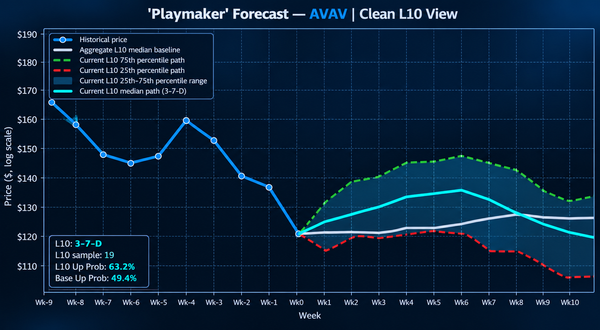
I very much doubt that it will. In the last two months, AeroVironment stock printed 10 weekly candlesticks in the technical chart. Of this figure, only three of the candlesticks resulted in net positive price action, where the closing price on Friday was higher than the opening price on Monday.

This particularly bearish sequence has only materialized 19 times on a rolling basis over the last five years. When it has flashed, the frequency of contrarian bullishness has been enough so that it’s plausible that the odds of AVAV stock reaching $140 on expiration are between 36.8% and 42.1%.

Recalculating EV for the Bull Spread

Basically, the analysis is as follows. If you believe that AeroVironment stock will trade randomly to the November expiration, you’re looking at a low-probability trade you should avoid. However, if you believe that AVAV will undergo a nonrandom walk — and subsequently transition from a bearish state to a bullish one — the odds of success (while still nominally low) improve significantly.

At a nonrandomly adjusted probability of 36.8%, the aforementioned November spread would have an EV of $28, or an expected ROC of +8.24%. At a probability of 42.1%, EV rises to $72, translating to an ROC of +21.18%.

Granted, AVAV stock remains a high-risk play, no matter how you cut it. But with an adjusted probabilistic framework, there’s a real speculative case here.


Joshua Enomoto is a seasoned financial writer with a strong track record of in-depth stock analysis, offering clear, insightful commentary for retail investors across all levels of expertise. Renowned for his ability to blend analytical rigor with engaging wit, Joshua's work has been featured on leading investment platforms, including TipRanks, InvestorPlace, Barchart, Benzinga, and Fintel. He was also handpicked to spearhead high-impact initiatives such as InvestorPlace's "Trade of the Day" and Benzinga’s ETF coverage. As a frequent guest expert for CGTN America, Joshua discusses a wide range of economic, societal, and consumer market trends. A graduate of U.C. San Diego, Joshua brings a thoughtful and fresh perspective to complex financial narratives, helping enterprise clients connect with their audiences. He also composes music in his spare time.

Join over 1.2M+ investors/traders who receive daily and weekly notable earnings alerts with predicted move