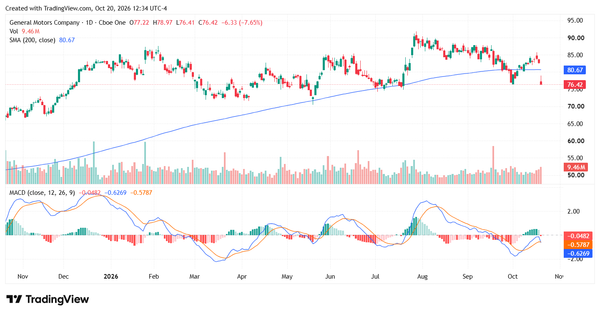
General Motors (NYSE: GM) earnings topped Wall Street’s expectations, revenue came in stronger than forecast, and the automaker raised its cash flow outlook. It also announced a new $20 billion stock buyback.
And while GM delivered a solid quarter, rising costs and expectations for a weaker fourth quarter left questions about how much more the company can deliver this year.
General Motors reported adjusted earnings of $3.70 per share, beating the $3.63 analysts expected. Revenue reached $50.02 billion, comfortably ahead of the $48.7 billion forecast.
The company also improved on its results from a year earlier. Revenue rose about 3%, while adjusted earnings per share climbed roughly 32% from $2.80. Net income attributable to stockholders reached $3.3 billion, compared with $1.3 billion a year earlier. North America remained the company’s biggest source of profit. The region contributed about $3.6 billion of GM’s $4.1 billion in adjusted earnings before interest and taxes, or EBIT.
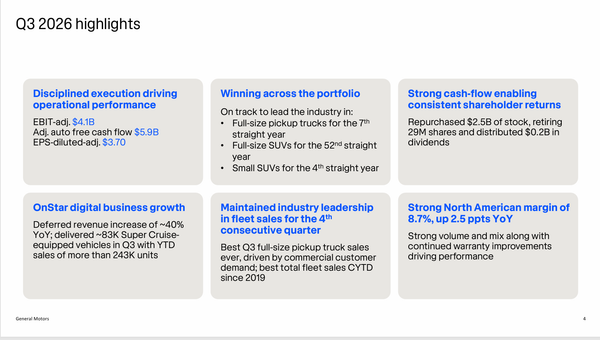
Those results demonstrate that GM’s core business is still generating substantial earnings. However, its heavy dependence on North America also makes consumer demand and production costs in that market especially important.
And, as noted by General Motors Chair and CEO Mary Barra:
“GM is performing well, and we are working hard to continue our momentum despite growing inflationary pressures through strategic investments in new products and services, and through improved quality and operating efficiency. Over the next several years, our portfolio will only get stronger as we complete the launches of the all-new 2027 Chevrolet Silverado and GMC Sierra light-duty pickups and follow them with our next-generation heavy-duty pickups, our next-generation full-size SUVs, all-new Cadillac sedans and crossovers, and more.”
GM Narrows Its Outlook as Inflation and Costs Rise
GM narrowed its full-year adjusted EBIT forecast to between $14.5 billion and $15.5 billion, compared with its previous range of $14 billion to $16 billion. Its adjusted earnings-per-share outlook moved to $12.75 to $13.75, compared with $12 to $14 previously. General Motors expects about $2 billion in commodity inflation costs, placing the figure at the high end of its previous forecast. Higher logistics expenses and costs for memory chips are adding pressure.
One encouraging development was GM’s higher adjusted automotive free cash flow forecast.
The company now expects $11.5 billion to $12.5 billion, up from $9.5 billion to $11.5 billion.
GM’s $20 Billion Buyback Boosts Shareholder Returns
That money gives General Motors flexibility to invest in its business and return capital to shareholders.
In fact, the company’s new $20 billion buyback authorization follows completion of a $6 billion repurchase program. The company also declared an 18-cent per share dividend, which is payable on December 17 to shareholders of record as of December 4.
For investors, it helps to understand what a buyback can accomplish. When GM repurchases shares, it reduces the number outstanding, spreading its earnings across fewer shares. That can increase earnings per share even without an increase in total profit. However, the price it pays matters. Repurchasing shares at an attractive valuation can make better use of shareholder money than buying at an expensive price.
The authorization also does not mean the automaker will spend the money immediately. Investors should watch how quickly purchases happen and whether the company maintains enough financial flexibility to support vehicle launches and handle unexpected business challenges.
Can GM Sustain Its Earnings Growth and Cash Flow Momentum?
The good news — GM’s quarter offered real progress: higher earnings, stronger cash expectations and a substantial commitment to repurchases. The next test is whether those strengths can withstand mounting expenses.
At the end of the day, if General Motors can keep buyers interested, control expenses, and deliver on its stronger cash flow outlook, it would give investors more reason for confidence. The next quarter should offer a clearer picture of whether the company can keep that momentum going.