For extreme speculators, Gildan Activewear (NYSE: GIL) may offer one of the more tempting options trades on the table right now. As a manufacturer of branded clothing, Gildan offers everyday products that are relevant to a broad consumer base. However, this relevancy hasn’t exactly spared GIL stock, which is down more than 15% in the trailing month.
The culprit? Primarily, the blame rests on a disappointing earnings miss during the third quarter, along with a guidance cut. Management was forced to downgrade its expectations due to persistent macro headwinds and retail deleveraging (i.e., widespread declines in discretionary spending for essential innerwear categories).
Still, those who are bullish on Gildan stock have some reason to support their optimism, mainly that the HanesBrands integration remains on track. According to Google Finance’s summary sheet, the company remains well on pace to realize approximately $100 million in cost synergies for fiscal 2026, with an expected annual run-rate of approximately $250 million by the end of 2028.
That’s still true even with macroeconomic operational pressures in mind, suggesting that GIL stock hasn’t been completely blown out of the water. However, caution continues to be the overriding theme for speculators — we’re talking about a ticker that has shed 39% in the past 52 weeks.
In other words, the turmoil is real, and probably most traders (especially the prudent ones) need to stay away from GIL stock. That may sound contradictory as the theme of this article is overall bullish. This optimism, though, comes with a specific caveat: there is a rational, quantitative basis for going long GIL, but it’s definitely a pie-in-the-sky type of proposal.
If you can accept that serious limitation, here’s what the data has to say.
Making the Quantitative Argument for GIL Stock
Essentially, the bullish case for Gildan stock comes down to mean reversion. Generally speaking, the market doesn’t engage in value erosion in a linear fashion. Instead, when negative sentiment gets overloaded, additional bad news is often required to continue justifying the downward trend.
This dynamic creates a diminishing-return phenomenon. As the magnitude of volatility rises (meaning that the security tumbles aggressively downward), the market usually needs to see not only bad news but pessimism of an increasingly powerful nature. However, it’s difficult to generate such negativity when there has already been so much red ink baked into the share price.
Technically, then, there’s enhanced incentive for the security to swing upward as the northbound resistance is relatively more limited. In other words, a small bit of good news could have a disproportionately positive impact. That’s the basic thesis behind GIL stock right now.
Of course, this mean-reversion concept would enjoy more confidence if Gildan were a more financially stout organization or if the surrounding fundamentals were more credible. As circumstances stand right now, the consumer spending erosion is a legitimately concerning headwind.
However, it’s important not to ignore the quantitative evidence. As a matter of empirical observation, we know through historical share price data that, over the trailing five years, Gildan stock has demonstrated a tendency to transition from an extremely bearish state to a bullish one.
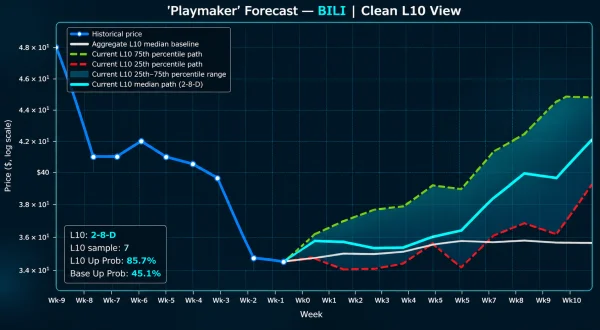
Specifically, in the last 10 weeks, we know that GIL stock has only managed to post two weekly positive candlesticks. Put differently, the ratio of negative weekly sessions versus positive sessions lands at an eight-to-two ratio. And whenever this ratio has materialized in the charts, GIL tends to rise higher over the next 10 weeks.
Looking at past analogs of this quant signal, a $40 target for the January monthly options chain appears quite realistic. The problem, though, is that at time of writing, not enough derivative-market participation exists, leaving the January chain barren.
What are the Available Options for GIL Stock?
Answering the natural question, what is available to the retail trader as of this writing is either the December monthly or the March (2027) monthly. Both have serious challenges.
Regarding the March chain, there’s currently only one bullish vertical spread trade available, which is the 27.50/37.50 bull call spread, specifically expiring March 19. Unfortunately, the maximum payout here is a paltry 25% on top of a net debit required of $800. It might be billed as a high-probability trade now, but that’s a massively long exposure for a trade with a puny expected value (EV).
Plus, with an expiration date that far out, you’re talking about compounding plenty of potential event risks (i.e., lots of bad stuff can happen over the next nearly five months). In my opinion, this trade is a bad deal.
The other solution is to consider the December chain, which is five weeks away. I’m looking at the 37.50/40 bull call spread expiring Dec. 18. With a net debit required of only $75 and a maximum payout of over 233%, these figures look enticing. But the big question mark comes down to the win probability.
Right now, if we assume the bearish-to-bullish-state transition materializes this time around, we can expect a basic probability of 25% that GIL stock will terminate above the $40 strike on expiration. In terms of EV, this win probability will suffer from a negative expectancy of $12.50 or a return on capital (ROC) of -16.67%.
Obviously, that’s not good. But here’s the wrinkle. We know that over the next seven weeks (which would be two weeks past expiration), the odds of landing above $40 clocks in at 37.5%. At that win rate, the EV would jump to $18.75, translating to an ROC of 25%. At weeks 8 and 9, the rate soars to 50%, resulting in an ROC of 66.7%.
An Agonizing Decision to Make
Of course, we need to address the elephant in the room: these favorable probabilities are estimated at time periods that extend two to three weeks beyond the Dec. 18 expiration date. If that is how GIL stock ultimately plays out, that’s not going to do the buyer of the Dec. 18 spread any good.
Nevertheless, a tempting “what if” question exists here. What if Gildan stock decides to swing higher ahead of schedule? At that point, the decision to pull the trigger on the December monthly spread may look ingenious.
Still, the narrative comes with a serious warning. With the fundamentals being this poor, it may be that GIL stock takes more time to recover. Indeed, analysts expect sideways action until closer to the Q4 disclosure. There’s also no guarantee that Gildan will rise at all.
But it’s true too that the aforementioned 7-to-3 ratio is extremely rare. With so much bad news baked in, there is a contrarian case for GIL stock popping dramatically higher over a short time period. It’s an agonizing decision, but that $40 December spread is waiting should you make the call.