Walt Disney (NYSE: DIS) spent years investing billions in streaming. At the same time, its traditional television business lost ground, leaving investors to wonder when the money would finally show up in the earnings.
But the fourth-quarter earnings just showed Disney’s streaming investment is now translating into profits. Entertainment SVOD generated $2.57 billion in operating income during fiscal 2026, nearly double the previous year’s contribution, while Experiences produced another record $11.19 billion.
Disney now has three businesses contributing billions in operating profit, and management is preparing to spend $35 billion on content and physical expansion in fiscal 2027. The question is how much more earnings power that investment can create.
Disney Spent Years Promising This Streaming Transformation
Disney’s Entertainment segment generated $46.56 billion in fiscal 2026 revenue, up 10%, while operating income increased 16% to $5.44 billion. Streaming was a major contributor, with Entertainment SVOD operating income reaching $2.57 billion compared with $1.30 billion a year earlier. That’s a substantial change for a business that spent years absorbing the cost of building its subscriber base, securing content and competing for viewers against established platforms.
The fourth quarter delivered another strong reading, with SVOD revenue increasing 19% to $6.05 billion and operating income climbing to $824 million from $402 million. Subscription revenue grew 22%, supported by subscriber growth, higher effective rates, and the additional 53rd week. Advertising revenue increased 6%, although lower advertising rates offset some of the benefit from higher impressions. Disney estimates that the extra week contributed approximately $160 million to quarterly SVOD operating income, so the reported increase overstates the underlying improvement.
There is also a reporting change coming. Disney plans to stop disclosing standalone SVOD operating income from fiscal 2027, folding the measure into its broader Entertainment reporting. I would prefer the company kept that figure available. Streaming has only recently become a meaningful profit contributor, and investors should be able to track whether subscriber growth and higher engagement continue translating into better margins. Disney has finally put a number on streaming’s earnings contribution, just as it prepares to take that number away.
Management To Spend More On Parks & Experiences
Experiences generated $39.57 billion in fiscal 2026 revenue, up 9%, and $11.19 billion in operating income, an increase of 12%. That makes it Disney’s largest segment by operating profit. Q4’s revenue climbed 15% to $10.11 billion, while operating income increased 20% to $2.25 billion. Even excluding the additional week, the full-year segment delivered record revenue and operating income.
Domestic performance was particularly strong, with fourth-quarter Parks & Experiences operating income increasing 36% to $1.25 billion. International operating income fell 7% to $347 million, as weaker attendance at Hong Kong and Shanghai weighed on results. Global guest numbers increased 4% after excluding the extra week, while per-capita spending rose 4% at domestic parks and 5% internationally. Disney is getting more spending from visitors, although the international results show that demand is not moving uniformly across its destinations.
The company plans approximately $9 billion in fiscal 2027 capital expenditures, much of it directed toward Experiences. New cruise ships, park expansions and attractions built around established franchises give Disney several ways to monetize the same intellectual property. The economics can be attractive because a successful franchise can generate admissions, hotel bookings, merchandise and cruise demand. However, the investment only makes sense if those new attractions and capacity produce returns that justify the additional spending.
ESPN Is Becoming Part of A Larger Distribution Strategy
Sports generated $18.63 billion in fiscal 2026 revenue, up 5%, while operating income increased 7% to $3.09 billion. Fourth-quarter operating income jumped 53% to $1.39 billion, supported by an 18% increase in subscription and affiliate fees and 20% growth in advertising revenue. The additional week and NFL transaction contributed to the comparison, while higher programming costs absorbed part of the improvement.
ESPN networks recorded their highest annual consumption since fiscal 2015, with hours watched increasing 10% during the year. Disney is extending that reach by bringing sports content into Disney+ in more markets and building its bundle offering around live events, subscriptions and advertising. This gives the company more opportunities to monetize sports across different distribution channels, although premium rights remain expensive.
Management expects approximately $26 billion in cash content spending during fiscal 2027, up around 9%, alongside the $9 billion capital expenditure budget. That’s a combined $35 billion commitment. Disney forecasts approximately $11 billion in free cash flow, compared with $10.57 billion in fiscal 2026, and double-digit adjusted EPS growth. Most of the expected earnings improvement will arrive in the first half, making the second-half performance an important test of how much momentum the company can sustain.
DIS Is Approaching A Breakout, But The Earnings Must Follow
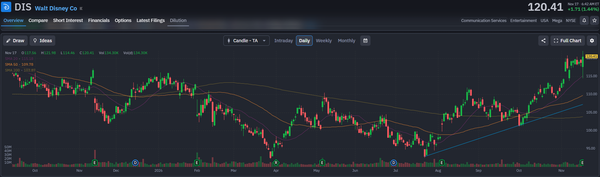
Disney shares reached $120.41 on November 17, trading above the 20-day moving average at $115.18, the 50-day at $109.78 and the 200-day at $103.87. The stock has climbed from its July low near $95, reclaimed all three averages, and established a series of higher lows since August. The $120- $121 area is immediate resistance, with the next upside reference around $125. A retreat toward $115 would test whether the former resistance zone can now hold as support.
Disney’s earnings mix is improving, and the stock’s recovery reflects that progress. I see a stronger business than the one investors were evaluating a few years ago. The $35 billion spending programme is the next major test, particularly as Disney reduces visibility into standalone streaming profits. And at $120, I would want to see the company convert its expanding ecosystem into faster earnings and cash-flow growth before chasing the shares higher.