Tyson Foods (NYSE: TSN) generated $56.4 billion in fiscal 2026 sales, up 3.6% from the previous year, yet adjusted operating income fell 14% to $1.977 billion and adjusted EPS declined 17% to $3.44. Tyson’s Beef segment actually made modest progress on an adjusted basis over the full year, but the company’s overall earnings still weakened considerably.
Management is forecasting another year of lower revenue and a possible decline in operating income. However, investors need to understand where the pressure is coming from and whether the portfolio can absorb another difficult year.
Beef Is Still Bleeding
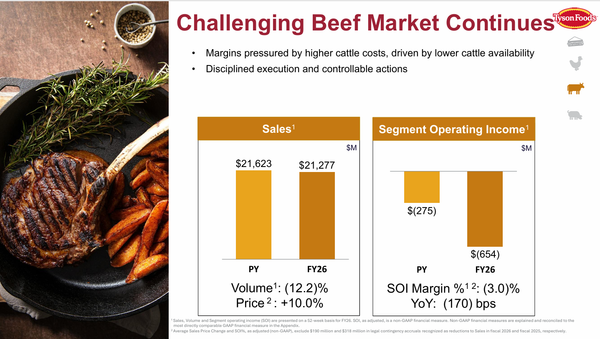
Tyson’s reported Beef operating loss reached $1.215 billion in fiscal 2026, compared with $954 million in fiscal 2025, making the segment appear to be the obvious explanation for the company’s weaker performance. The adjusted figures tell a more nuanced story, however, with the Beef operating loss narrowing from $675 million to $654 million.
The $21 million improvement barely moved the needle against Beef’s $654 million adjusted operating loss, but it exposes a more important detail in Tyson’s earnings. The segment’s full-year performance was relatively stable, while consolidated adjusted operating income fell by $321 million. That means the deterioration came from pressure elsewhere in the portfolio as well, making Chicken’s recent performance important to understanding why Tyson’s earnings weakened.
The fourth quarter was considerably worse, with Beef posting an adjusted operating loss of $171 million against $52 million a year earlier. Adjusted sales fell 12.7% to $4.91 billion as volume declined 13%, while average selling prices increased just 0.4%. Tyson’s lower volume overwhelmed the modest pricing improvement, leaving the segment with a much larger quarterly loss. The contrast between the full-year and quarterly results also suggests that the modest annual improvement offers little assurance that Beef’s operating conditions are stabilizing.
Management now expects Beef to lose between $300 million and $500 million in fiscal 2027, compared with its $654 million adjusted loss in fiscal 2026. That forecast implies a potential improvement of $154 million to $354 million, which would provide meaningful relief to consolidated earnings if achieved. Even at the favorable end of the range, though, Beef would remain unprofitable. The recovery investors are being asked to anticipate is a reduction in losses, not a return to the earnings contribution this segment would need to make the entire company grow.
Tyson’s Chicken Business Also Deteriorated
While Beef attracts attention because of its billion-dollar reported loss, Tyson’s Chicken business generated $1.859 billion in adjusted operating income during fiscal 2026, making it one of the company’s most important earnings contributors. That figure was down from $1.892 billion in fiscal 2025, a modest annual decline that became much more pronounced in the final quarter. Chicken’s adjusted operating income fell to $389 million from $562 million, a 31% drop that put pressure on a business Tyson needs to help carry the wider portfolio.
Prepared Foods provided a more encouraging contribution, generating $1.332 billion in adjusted operating income for the year compared with $1.265 billion previously. Its fourth-quarter contribution also improved to $321 million from $278 million. Pork and International, meanwhile, delivered relatively smaller contributions, with adjusted full-year operating income of $228 million and $180 million, respectively. These results show why looking at Beef in isolation misses an important part of the earnings story. Tyson has profitable businesses supporting the company, but the performance of those businesses is uneven, and Chicken’s recent weakness matters because it is such a significant source of operating income.
Management’s Forecast Leaves A Narrow Path to Earnings Growth
Tyson expects fiscal 2027 adjusted operating income of $1.7 billion to $2.15 billion, compared with $1.977 billion in fiscal 2026. That range allows for a meaningful decline at the lower end or modest growth at the upper end, even with the anticipated improvement in Beef. The company also expects revenue to fall 3.5% to 5.5%, primarily because of lower Beef volumes associated with tight cattle supplies and network restructuring. Management is therefore projecting a year in which lower Beef losses must help compensate for weaker sales and potential pressure elsewhere in the portfolio.
The segment forecasts make that balancing act clearer, with Chicken expected to contribute $1.3 billion to $1.6 billion in adjusted operating income and Prepared Foods projected at $1.25 billion to $1.4 billion. Both ranges leave room for results below fiscal 2026 levels. Tyson is also forecasting $800 million to $1.3 billion in free cash flow, compared with $1.663 billion generated in fiscal 2026, while capital expenditures are expected to reach $1.1 billion to $1.4 billion. The business has liquidity of $4.1 billion, providing financial flexibility, but the lower cash-flow outlook means investors should pay attention to how much earnings recovery actually converts into cash.
TSN Is Approaching A Technical Decision Point
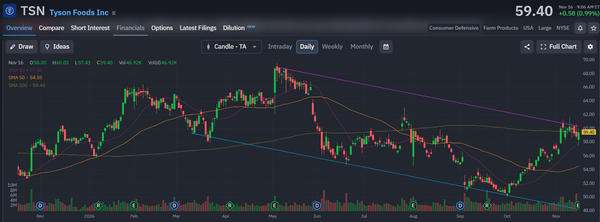
Tyson shares were trading at $59.40, sitting just below the 200-day moving average at $59.45 after recovering from the October low around $50. The stock has reclaimed its 20-day average at $57.86 and its 50-day average at $54.55, giving the recent rebound a stronger technical foundation. However, the descending trendline extending from the May peak still places resistance around $60 to $61, an area the stock needs to clear before the recovery can develop into a more convincing trend reversal.
Tyson has enough profitable operations and balance-sheet flexibility to manage another difficult year, but the earnings release does not establish a broad recovery. The key issue is that management is counting on Beef losses narrowing while forecasting lower revenue, a potential decline in Chicken earnings, and substantially less free cash flow.
That combination leaves little room for execution errors. So I would be cautious about treating the recent share-price rebound as evidence that the earnings cycle has turned. The more compelling opportunity would emerge if Tyson delivers its projected Beef improvement without sacrificing the earnings power of Chicken and Prepared Foods.