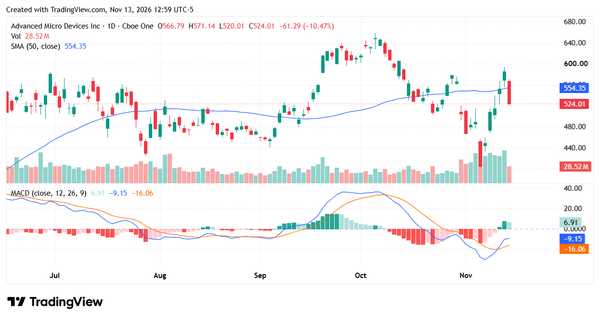
Advanced Micro Devices (NASDAQ: AMD) has been one of the most explosive AI stocks on the market. Up nearly 200% since the year began, it could see further upside.
Analysts at Oppenheimer just upgraded the stock to an outperform rating from perform, with a $600 price target. In fact, the firm sees a growing opportunity for AMD to become a long-term supplier of the chips powering artificial intelligence.
The upgrade comes as investors look beyond the immediate AI accelerator race and consider the broader infrastructure required to support increasingly demanding workloads. AMD is positioning itself to benefit from both sides of that market, selling the processors that power servers and the accelerators designed to handle specialized AI computing. That gives the company multiple opportunities to capture spending as cloud providers and enterprise customers expand their infrastructure.
Why Oppenheimer Turned Bullish
Oppenheimer analyst Rick Schafer pointed to momentum in server processors and AI chips following the company’s earnings report and discussions with management. The broader opportunity involves becoming a supplier that customers keep choosing as their computing needs expand. Schafer expects OpenAI and Meta to support growth through the first quarter, with Anthropic beginning to ramp later in that period.
He also sees deployments involving other major customers continuing into 2028. Those are analyst expectations, but they help explain the upgrade.
That longer timeline is important because it suggests the opportunity isn’t limited to one product cycle or a handful of large AI infrastructure projects. If AMD can maintain its relationships with major customers while attracting additional buyers, it could establish a more durable revenue base.
For investors, repeat business matters just as much as winning an initial contract. It provides greater visibility into future demand and gives AMD an opportunity to build on its existing customer relationships.
Data Centers Are Driving the Results
AMD’s latest earnings offer tangible support for that longer-term argument. Third-quarter revenue reached about $13.38 billion, an increase of 45% from a year earlier. Adjusted earnings were $2.09 per share, up 74%. Data center revenue climbed 97% to $8.5 billion, reflecting demand for EPYC processors and Instinct AI chips.
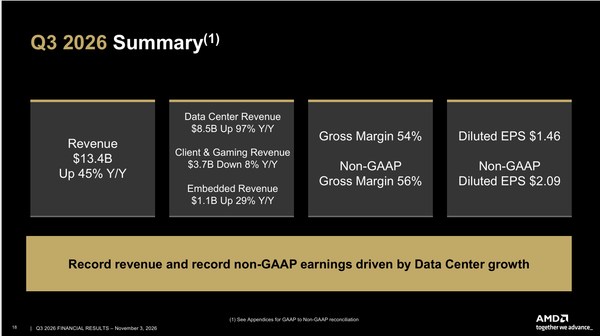
That means data centers supplied roughly 64% of total quarterly revenue. AMD’s fortunes are increasingly tied to the computing systems behind cloud services and artificial intelligence.
For shareholders, that is an encouraging combination: rapid expansion alongside improving operating profitability.
The data center contribution also helps explain why the company is increasingly being valued as an AI infrastructure company rather than simply a traditional semiconductor designer. Its EPYC server processors serve an important role in conventional cloud computing, while Instinct accelerators give customers another option for AI workloads. As those two businesses grow together, AMD has an opportunity to benefit from a broader range of infrastructure spending.
Google Adds Another Route to AI Growth
AMD’s opportunity extends beyond selling its own AI accelerators. The company announced that fifth-generation EPYC processors power the host infrastructure for Google Cloud’s TPU 8tx system. These processors help prepare data, coordinate workloads, and manage communication with Google’s AI accelerators. The collaboration also supports protections for sensitive information while it is being processed.
Google’s TPUs perform specialized AI work, while Advanced Micro Devices supplies processors that help the broader system operate.
For investors, this suggests AMD can participate in AI spending through multiple types of hardware. Its opportunity includes both Instinct accelerators and the server processors supporting systems built around other companies’ chips.
That distinction could become increasingly important as major technology companies develop their own specialized AI chips. Not every company will rely exclusively on a single accelerator supplier.
The infrastructure surrounding those chips still requires powerful server processors to manage data and workloads. AMD’s Google collaboration demonstrates how the company can participate in that spending even when another company’s technology handles the specialized AI calculations.
Meanwhile, AMD’s planned annual AI chip releases give customers a roadmap for future purchases. Oppenheimer highlighted the MI500 generation expected in 2027 as part of that continuing development effort.
The challenge is execution. Product announcements become more valuable when they lead to reliable shipments, repeat orders, and profitable growth.
A Strong Outlook, With Margins Worth Watching
AMD expects fourth-quarter revenue of about $17 billion, plus or minus 3%. At the midpoint, that would represent roughly 27% growth from the third quarter. Management also projects an adjusted gross margin of approximately 55%. That revenue outlook points to considerable momentum. However, the gross margin forecast is below the third quarter’s 56%, making profitability an important number to watch alongside sales.
The margin outlook deserves attention because rapid AI expansion does not automatically translate into better profitability. AMD needs to invest in product development, manufacturing capacity, and its broader ecosystem while competing for customers in a market attracting enormous investment. Revenue growth is encouraging, but investors should also look for evidence that the company can convert that growth into sustainable earnings.
AMD has several ingredients investors want: expanding demand, established customers, and a growing role in AI infrastructure. In addition, the pullback in Advanced Micro Devices makes the stock worth another look.
But the lasting opportunity rests on AMD delivering its next generation of products, converting customer plans into revenue and maintaining attractive profitability. Continued progress on those fronts would give investors a much stronger reason to own the shares than a bullish price target alone.
From its current price of about $585, we’d like to see it challenge $650 before the end of the year. In 2027, we’d like to see it closer to $800.