Nebius Group (NASDAQ: NBIS) has a $40 billion to $45 billion infrastructure bill coming in 2027. That is an enormous amount of capital to deploy in a business where data centers, power, and GPUs must be paid for before they produce revenue.
The usual options are familiar. Borrow the money and take on interest costs, or issue shares and dilute existing shareholders. But Nebius’ Q3 2026 earnings point to a funding strategy that could make it considerably less dependent on either route.
Nebius Is Getting Customers to Fund More of Its Capacity
The company is getting customers to pay more upfront for the capacity they want, then using long-term customer contracts to secure asset-backed financing. Prepayments on deals signed in Q3 covered more than 100% of associated capital expenditure, compared with approximately 50% to 60% in Q2. More than 90% of Q3 contract value carried a prepayment, while the weighted-average prepayment as a share of contract value increased by roughly 20 percentage points quarter over quarter.
Those payments arrive before Nebius delivers the contracted capacity. They also come from recontracted capacity already deployed, where the infrastructure has already been paid for. Nebius can put that cash toward its next build. The company signed more than $12 billion in total contract value since the beginning of Q3, with the vast majority coming from AI-native companies. Existing customers expanded their commitments, while Nebius also signed its first agreements with leading enterprise data and AI platforms.
Customers are also accepting higher prices. Average annual contract value per megawatt exceeded $25 million, up from the $20 million to $25 million range for Q2 deals. Average GPU-hour pricing increased more than 20% quarter over quarter, while reserve auctions cleared more than 15% above reserve prices. Payback on comparable one-to-three-year deals improved to one year and seven months from one year and ten months, covering operating expenses and capex but excluding prepayments. With Nebius collecting more cash upfront while getting better prices for the capacity it sells, the company has a heavier cash vault to put toward expansion before seeking outside capital.
Asset-Backed Financing Adds Another Source of Capital
Nebius is also using long-term contracts with investment-grade customers as collateral, allowing it to raise money against contracted revenue instead of relying only on corporate-level borrowing. In July, the company closed its first facility under this framework, securing $775 million at SOFR plus 2.50%. Management says more than $40 billion in similar committed revenue could support repeat transactions, including financing against agreements with Microsoft Corp (NASDAQ: MSFT) and Meta Platforms Inc. (NASDAQ: META).
Management expects customer prepayments to reach $17 billion to $20 billion in 2027. Alongside asset-backed financing and its balance sheet, these sources are projected to cover 75% to 85% of the company’s $40 billion to $45 billion capex plan.
Make no mistake, Nebius will still use other funding sources. It raised $5.75 billion through convertible notes in August and generated approximately $1 billion in net proceeds from its at-the-market share program during Q3. A $3.5 billion senior secured facility with Citi followed in October. Management says it will continue using external financing when the terms make sense.
But the goal is to make outside capital a choice rather than the default source for every expansion, giving management more control over borrowing costs and shareholder dilution.
Guidance Depends on Getting Capacity Online
The funding strategy depends on Nebius delivering the infrastructure behind those customer contracts, and execution has already affected its outlook.
Some third-party capacity expected online in 2026 has been pushed into the first half of 2027. In New Jersey, the transition from temporary power generation to Bloom Energy fuel cells has delayed parts of the ramp. Management says customer contracts remain in place, while owned sites are on schedule or ahead. Nebius now expects 2026 revenue at the low end of its $3.0 billion to $3.4 billion range, with capex of approximately $27 billion. Its target of exceeding $7 billion in monthly annualized recurring revenue has moved from December to February.
For 2027, management expects revenue of $12 billion to $13 billion, more than one gigawatt of new capacity and pretax breakeven in Q4. Q3 revenue reached $980.8 million, up 571% year over year, while adjusted EBITDA climbed to $465.8 million from a $5.2 million loss a year earlier. Nebius AI Cloud generated $973.8 million in revenue and posted a 53.2% adjusted EBITDA margin. The company still reported a $37.5 million GAAP net loss.
NBIS Stock Still Has Ground to Recover
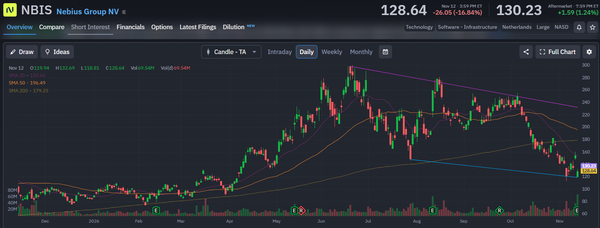
The Nov. 12 selloff took NBIS to a $128.64 close, down 16.84% for the session. The stock remains below its 20-day moving average at $153.60, its 200-day at $179.25, and its 50-day at $196.49. After retreating from a peak near $300 earlier this year, the chart still shows lower highs and lower lows. The $120 area is immediate support. A recovery above $153.60 would be an early improvement, while $179 to $196 is a much larger area for the stock to reclaim.
The Funding Strategy Could Convince Me
I like what Nebius is building here. The next move is execution. If management delivers the promised capacity and its funding projections hold, the company has a credible path to scaling without constantly returning to shareholders or relying on corporate debt. At $128.64, NBIS has plenty of ground to recover, but the Q3 earnings give me a reason to stay with the business while the stock works through its damage.