Applied Materials (NASDAQ: AMAT) just gave investors another reason to pay attention to the companies supplying the artificial intelligence (AI) boom. The semiconductor equipment maker reported strong quarterly growth, record adjusted operating margins and an outlook that topped Wall Street’s expectations.
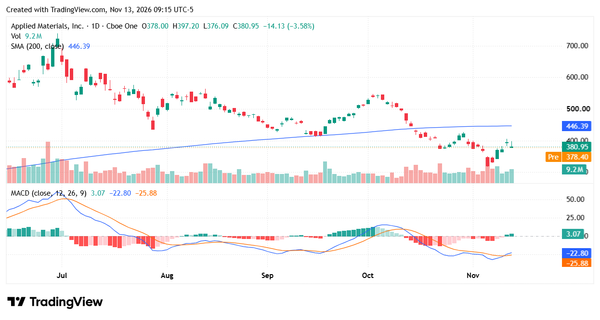
Its results suggest chipmakers remain willing to spend heavily on the equipment needed to produce increasingly powerful semiconductors. Still, the stock’s reaction was mixed. It seems the strong results were welcome, but investors wanted more.
A Strong Quarter Beyond the Headline Numbers
For the fourth quarter of its 2026 fiscal year, Applied Materials reported revenue of $10.41 billion, up 53% from a year earlier. Adjusted earnings reached $4.16 per share. Both figures exceeded expectations, which called for revenue of $10.3 billion and adjusted earnings of $4.06 per share.
Profitability also improved. Applied Materials posted a record adjusted operating margin of 35.3%, meaning it retained about 35 cents of operating profit from each dollar of sales before interest and taxes, on that adjusted basis. Management also reported its 14th consecutive quarter of year-over-year gross margin improvement.
Applied Materials also generated about $2.6 billion in quarterly free cash flow and returned more than $2.4 billion through dividends and buybacks.
AI Spending Is Creating More Equipment Demand
CEO Gary Dickerson said the company’s Semiconductor Systems business was on track to grow more than 40% in calendar 2026. He pointed to AI as an additional source of semiconductor demand and a potential driver of revenue and profit growth over several years.
The opportunity also involves more than adding factories. Increasingly complex chips require more sophisticated manufacturing techniques. Advanced packaging, for example, helps connect multiple chips within a single package. Process control helps manufacturers identify problems and improve production consistency. Both become increasingly important as customers seek better performance from expensive semiconductor designs.
The Forecast Points to Continued Momentum
Applied Materials expects fiscal first-quarter 2027 revenue between $10.6 billion and $11.6 billion. The $11.1 billion midpoint exceeds the $10.85 billion consensus cited in the supplied earnings coverage. Adjusted earnings are expected to range from $4.15 to $4.55 per share. The $4.35 midpoint also exceeds the $4.24 analysts anticipated.
In its earnings presentation, Applied Materials said its largest customers were providing forecasts covering eight quarters and placing orders earlier. Management expects the wafer fabrication equipment market to grow more than 30% in 2027.
With that, Morgan Stanley maintained its Equal-weight rating while lowering its price target to $507 from $538. “The company is executing strongly in advanced packaging and process control, although the scale of these businesses limits their contribution to overall revenue growth,” added the firm, as quoted by Seeking Alpha.
JPMorgan retained an Overweight rating but reduced its target to $500 from $660, citing a broader decline in semiconductor equipment valuations. Jefferies viewed the results as evidence of a strong industry cycle, while suggesting the outlook largely matched investors’ existing expectations.
“The results reinforce the strength of the current cycle and though the initial outlook for C27 looks strong, we expect this is largely in-line with investor expectations heading into the print,” analysts at Jefferies said.
What Comes Next for AMAT Stock?
Applied Materials has a compelling growth story, but its stock still has to earn investors’ confidence. Strong demand, improving profitability and healthy cash flow give the company a solid foundation. The next step is turning customers’ expansion plans into equipment shipments and sustained earnings growth.
For investors, that makes AMAT stock worth watching during periods of weakness. A pullback could create a more attractive entry point if the business continues to deliver. But price matters, even for a company benefiting from AI spending. The strongest investment case would combine continued operating momentum with a valuation that leaves room for potential delays or slower growth.