Honda Motor (NYSE: HMC) has spent billions of yen unwinding an electric-vehicle strategy that no longer fits the market it wants to compete in. The financial damage is now weighing on its second-quarter earnings.
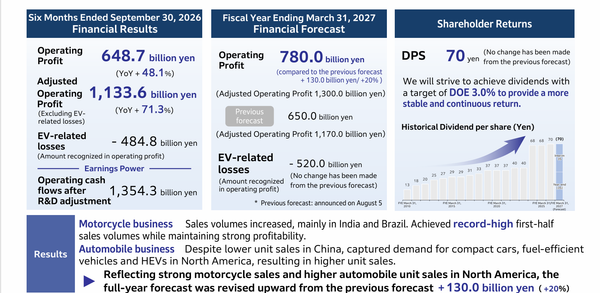
Operating profit fell 39.2% year over year to ¥117.9 billion, despite revenue increasing 12.9% to ¥5.976 trillion. Yet separating the EV restructuring charges reveals a different picture. Adjusted operating profit more than doubled to ¥602.8 billion from ¥295.7 billion a year earlier. As you’ll discover, Honda is now absorbing a costly strategic reset while several established operations are becoming more profitable.
The Automotive Recovery Is Hiding Behind The EV Charges
Honda’s automobile division generated ¥3.804 trillion in second-quarter revenue, up 10% year over year, but reported a ¥197.9 billion operating loss compared with a ¥43.4 billion loss a year earlier. Excluding EV-related charges, the division produced ¥286.9 billion in operating profit, nearly five times the ¥58.3 billion recorded in the prior-year quarter. Its adjusted operating margin climbed from 1.7% to 7.5%. Higher sales volume and model mix contributed ¥89.2 billion to adjusted automotive operating profit, lower expenses added ¥66billion, and foreign-exchange effects supplied another ¥57.4 billion.
But while these gains show Honda extracting more profit from its automobile operations, even as the company absorbs the consequences of its EV strategy change… the restructuring remains expensive. Honda recognized ¥479.2 billion in incremental EV-related expenses during the first half, alongside ¥5.6 billion in development-asset and equipment impairment. Those costs belong in the investment case because shareholders ultimately bear them. However, they also obscure the improvement in the existing automotive business. The more useful question is whether Honda can sustain those improved margins as the restructuring bill starts to recede.
Motorcycles Are Providing The Earnings Muscle
Honda’s motorcycle division gives the company a profitable foundation while its automobile operations work through the reset. First-half motorcycle sales reached 11.9 million units, up 10.6% year over year. Revenue climbed 18.3% to ¥2.273 trillion, and operating profit increased 19.2% to ¥439 billion. The division maintained a 19.3% operating margin, giving the company a substantial source of earnings from markets where it already commands strong positions.
India and Brazil are driving much of that growth, with higher sales volumes in both markets contributing to a ¥70.7 billion increase in motorcycle operating profit. The plan is to expand annual production capacity at its Manaus factory in Brazil from 1.6 million to 2.3 million units by 2029. The facility serves as an export hub for 19 countries, and Honda estimates its share of Brazil’s motorcycle market at approximately 70%.
This is the foundation beneath Honda’s wider recovery. Its motorcycle business already generates substantial profits, while its automotive strategy increasingly emphasizes hybrids and markets where the company sees stronger demand. Honda can therefore fund its transition from established operations rather than depending entirely on a future EV rebound.
Higher Guidance Comes With A Heavier Investment Bill
Management raised its fiscal 2027 operating-profit forecast by ¥130 billion to ¥780 billion, a 20% increase. Honda now expects ¥24.4 trillion in revenue and ¥500 billion in net profit attributable to owners of the parent. Its adjusted operating-profit forecast also increased to ¥1.3 trillion from ¥1.17 trillion, despite a full-year estimate of ¥520 billion in EV-related losses.
The revised sales outlook shows where management sees its opportunities as Honda cut its full-year automobile sales projection by 230,000 units to 3.16 million, with the reduction concentrated in China, while raising its motorcycle forecast by 500,000 units to 23.3 million. North American demand for fuel-efficient and hybrid vehicles has provided support, and Honda plans to expand regional automobile production capacity by 2029 as it prepares to introduce larger hybrid models.
Sure, the expansion will consume significant capital. In fact, First-half operating cash flow from non-financial services businesses increased to ¥929 billion, but investing outflows climbed to ¥662.6 billion, pulling free cash flow down to ¥266.4 billion from ¥760.6 billion a year earlier. Capital expenditure reached ¥829.7 billion, and Honda expects full-year spending of ¥1.4 trillion. Its ¥5.028 trillion cash balance and ¥3.404 trillion net cash position provide room to execute, but investors need to see the investment cycle produce stronger returns.
HMC’s uptrend is approaching a decision point
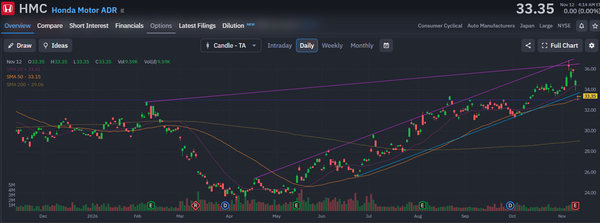
HMC’s daily chart still reflects a broader advance, with shares climbing from roughly $24 in April to a recent peak near $36. At $33.35, the stock has slipped below its 20-day moving average of $34.41 but remains just above its 50-day average at $33.15. The 200-day average sits at $29.06, keeping the longer-term trend pointed upward. The $33 area is where buyers need to show up. Holding the 50-day average would give HMC room to reclaim $34.41 and challenge its recent $36 high. A decisive break below $33 would weaken the setup and put the rising trendline under pressure. The pullback has cooled the stock’s momentum, but it has not yet broken the broader advance.
Honda’s Recovery Deserves A Place In The Portfolio
Honda is taking a painful charge to redirect capital toward businesses with firmer commercial footing, and the second quarter shows that the established operations are already generating better returns. Motorcycle profits provide a strong earnings base, adjusted automotive margins have improved sharply, and management has raised its full-year forecast. China, EV restructuring costs, and heavier capital spending remain risks, but Honda’s balance sheet gives it room to work through them.
I’d stay long HMC. The stock is testing support after a substantial advance, while the earnings picture continues to improve beneath the headline EV losses. As long as buyers defend the $33 area, the path back toward $36 remains open, and I see more reason to hold through this pullback than to step aside.