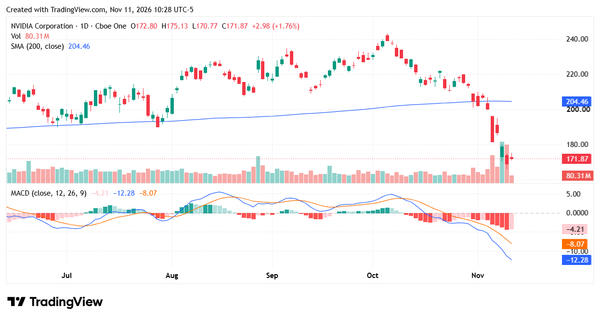
NVIDIA (NASDAQ: NVDA) has given investors plenty to worry about lately. Questions surrounding CEO Jensen Huang have pressured shares, even as some analysts argue that the company’s earnings outlook makes the stock increasingly attractive.
Among them is Mizuho Securities analyst Jordan Klein, who recently described NVIDIA as “silly cheap,” as quoted by Seeking Alpha. His argument is straightforward: investors are paying considerably less for the company’s expected profits while uncertainty dominates the headlines.
That could create an opportunity. But understanding the recent decline is essential before deciding whether NVIDIA has become a bargain.
Why NVIDIA Shares Fell
The immediate catalyst was uncertainty surrounding Huang and an investigation announced by NVIDIA’s board on November 8. The company said independent directors would oversee a review of reports that Huang had been targeted by a foreign intelligence effort. The announcement raised questions about his future at NVIDIA and whether the situation could create broader business or regulatory problems.
In a statement, NVIDIA’s board said it had no reason to believe national security or company secrets had been compromised. It also expressed confidence in Huang and his leadership team and said he would cooperate with the review. Those statements don’t settle the matter, but they provide important context for the selloff.
On November 10, independent directors announced that former acting U.S. Attorney Joon H. Kim and his law firm would conduct the investigation.
Why Klein Thinks NVDA Looks Cheap
Klein’s bullish argument centers on valuation.
In his CNBC interview, he said NVDA’s forward price-to-earnings multiple had fallen below 10, based on his earnings estimates. That means investors were paying less than $10 for each dollar of annual profit he expected the company to generate.
Klein believes the company’s valuation increasingly resembles what investors might assign to a struggling business. His view is that the company’s underlying growth prospects don’t justify that degree of pessimism.
The Business Still Deserves Attention
NVIDIA’s latest reported results provide some support for the bullish argument.
For its fiscal second quarter, which ended July 26, 2026, the company reported revenue of $96.2 billion. That represented growth of 106% from a year earlier and 18% from the previous quarter. Those numbers show why investors should examine the operating business alongside the leadership controversy. The most recent reported sales figures describe a company experiencing rapid expansion.
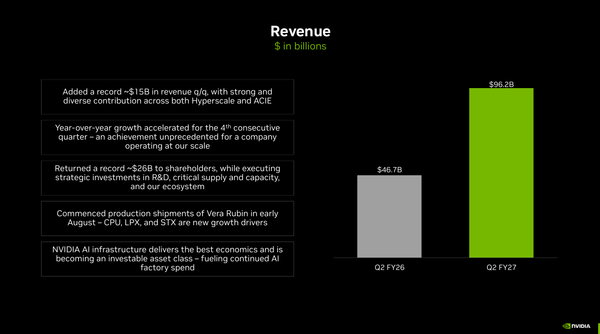
They also create a demanding comparison for future quarters.
Investors will want to know whether customers continue purchasing equipment at the expected pace, whether profitability holds up, and whether management’s outlook supports current earnings forecasts.
Even strong companies can disappoint when expectations become too ambitious. That is why the investment case needs more than an impressive historical growth rate or an analyst’s description of the shares as cheap.
Huang’s Future Remains the Big Question
Klein also acknowledged the importance investors place on Huang. NVIDIA’s co-founder is closely associated with its strategy and its rise in artificial intelligence, making uncertainty about his position especially difficult for shareholders to evaluate.
Evercore ISI’s Julian Emanuel offered a more optimistic perspective, suggesting the weakness could present a substantial opportunity if leadership remains stable.
That condition is central to the argument.
If the investigation concludes without a major leadership disruption and earnings continue growing, investors could become more comfortable paying a higher valuation. If the review produces damaging findings or business disruption, the apparent discount could prove justified.
NVIDIA’s next scheduled earnings discussion is November 17, covering its fiscal third quarter. That will give investors another opportunity to assess the company’s performance and outlook.
For now, NVDA offers a potentially attractive combination of growth and a lower valuation. The opportunity depends on whether that growth continues and whether the leadership uncertainty can be resolved without lasting damage to the business.