AST SpaceMobile (NASDAQ: ASTS) is approaching the milestone that could turn years of satellite development into a commercial business, but its third-quarter 2026 results show how much infrastructure still needs to come together before that opportunity produces meaningful recurring revenue. The company generated $42.3 million in Q3 revenue, while its GAAP net loss attributable to common stockholders reached $132.4 million, or $0.44 per share.
With nationwide intermittent service targeted for key markets before year-end and satellite manufacturing moving toward a six-unit monthly production rate, AST SpaceMobile is entering a different phase of its development. Investors now have to judge whether deployment can keep pace with the company’s expanding production capacity.
Commercial Opportunity Is Moving Closer to the Ground
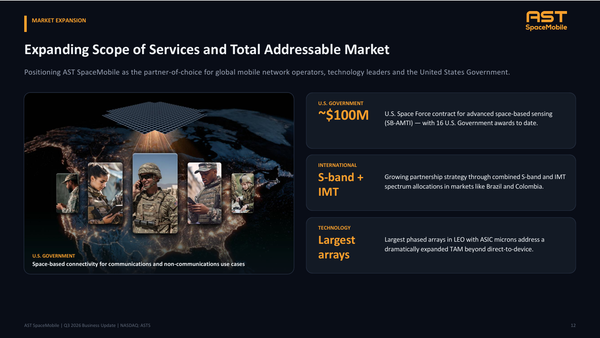
The most important development in AST’s third-quarter update is its progress toward activating commercial service markets, where the company intends to use existing mobile network infrastructure and spectrum partnerships to bring satellite connectivity directly to ordinary smartphones. Management remains on track for nationwide intermittent coverage in the United States and other key markets before the end of 2026, with the first rollout involving the United States, Canada, Japan, Saudi Arabia, and the United Kingdom.
That rollout has a stronger foundation than a simple promise of future coverage because AST SpaceMobile has already validated satellite beam handovers between ground-based and space-based cellular networks with AT&T, using everyday smartphones. The company also has agreements with more than 60 mobile network operators representing over 3 billion subscribers. Its strategy is to work with existing operators, their customer relationships, and spectrum arrangements to extend coverage beyond terrestrial networks.
Management sees a revenue opportunity approaching $1 billion in the 12 months following commercial service launch, with growing confidence based on progress across government and international markets. That remains a forward-looking opportunity, not revenue already secured or recognized, and its timing depends on commercial service becoming available.
The immediate revenue base remains tied largely to gateway deliveries and U.S. government milestones, which drove the $42.3 million recognized in Q3. Management reiterated full-year 2026 revenue guidance of $150 million to $200 million, with potential upside from recent contract signatures. Q4 revenue also depends on satellite launches and deployment, government contract milestones, gateway equipment sales, and service and software revenue associated with commercial activation. The year-end service target therefore carries considerable weight for the company’s near-term commercial progress.
Manufacturing and Launch Capacity Will Determine the Pace of Growth
AST SpaceMobile’s ability to turn its commercial partnerships into an operating network increasingly rests on whether manufacturing and launch plans can keep pace with one another. Two factories in Texas are running full shifts, BlueBird 51 is in production, and management expects to reach a manufacturing rate of six ASIC-enabled satellites per month in December. Full-scale ASIC integration has also been pulled forward to BlueBird 34 from BlueBird 50, with the next-generation ASIC expected to deliver a 10x improvement in processing bandwidth compared with the Block 1 satellites already in orbit.
Launch access remains the other half of that equation. BlueBirds 14, 15, and 16 have been shipped to Cape Canaveral and are awaiting SpaceX launch-date confirmation, while BlueBirds 17, 18, and 19 are expected to ship for a Blue Origin launch in early Q1 2027. The company is targeting approximately 45 BlueBird satellites in orbit by the middle of 2027, with existing launch agreements covering more than 100 satellites for deployment during 2027 and 2028.
Blacklift is intended to give AST SpaceMobile greater control over deployment over the longer term. The planned 20-ton reusable rocket is designed to carry up to five BlueBird satellites per launch, with its first orbital launch expected in late 2028. Management sees the project as a way to secure regular access to orbit and pursue more attractive ownership economics, while continuing to use external launch providers for nearer-term deployments. Blacklift will not solve the immediate launch requirements for the first commercial service rollout.
The investment required to build that capacity is already substantial. Q3 capital expenditures were approximately $310 million, and management expects Q4 spending of approximately $400 million to $500 million, primarily reflecting the timing of launch payments. It also expects several hundred million dollars in incremental capital expenditures in 2027 associated with Blacklift.
AST SpaceMobile ended September with approximately $3.2 billion in cash, cash equivalents, and restricted cash. The J-LEO agreement with Japan and Rakuten provides approximately $1 billion in non-dilutive funding for satellite manufacturing and launches, while another $1.2 billion in U.S. quasi-governmental financing remains a pipeline opportunity.
ASTS Stock Still Has a Significant Technical Hurdle
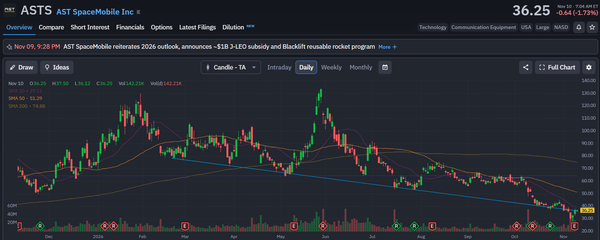
The stock has yet to recover from its prolonged decline, despite progress toward commercial service and the latest manufacturing milestones. At $36.25, ASTS is trading below its 20-day moving average at $39.11, its 50-day at $51.29, and its 200-day at $74.88. All three averages remain above the current share price, leaving the stock in a weak technical position.
A sustained move above the 20-day average would be an early sign of improving momentum, while reclaiming the 50-day average would provide stronger evidence that buyers are regaining control. The 200-day average remains a much bigger challenge for a longer-term trend reversal. For now, the chart shows that investors have yet to reward the company’s operational progress with a sustained recovery.
AST SpaceMobile Has Reached the Execution Stage
AST SpaceMobile has made meaningful progress toward commercial service, expanded its government and international opportunities, and secured funding to support a much larger satellite deployment program. However, the company still needs to demonstrate that it can translate those milestones into dependable service revenue while managing the capital requirements of its constellation and Blacklift. I’m bullish on the long-term opportunity, but the weak technical position and execution demands ahead make this a business that still needs to prove its commercial model at scale.