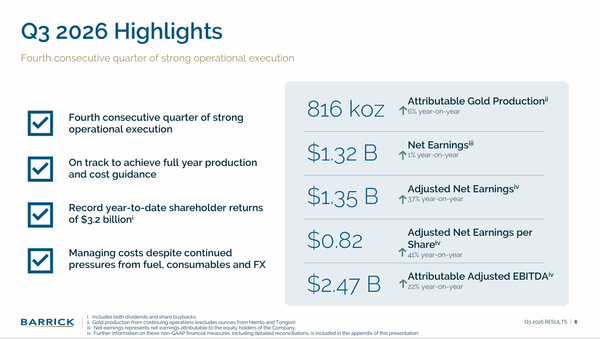
Barrick Mining Corporation (NYSE: B) generated $5.07 billion in revenue during its third-quarter 2026 earnings period, a 22% increase year over year. Adjusted EPS climbed 41% to 82 cents, while operating cash flow approached $2.5 billion. Those results reflect the extraordinary pricing environment for gold and copper, with Barrick realizing an average gold price of $4,243 per ounce.
For a mining company, selling gold at those prices should produce a substantial financial windfall. Barrick is certainly generating significant cash, but its gold all-in sustaining cost (AISC) also climbed 24% to $1,911 per ounce. Meanwhile, attributable free cash flow fell 44% year over year. The issue isn’t whether Barrick is benefiting from higher metal prices. It’s how much of that benefit remains after operating its mines, maintaining production and financing its next generation of growth projects.
Higher Gold Prices Are Doing the Heavy Lifting for Revenue
Barrick’s gold production declined 2% year over year to 816,000 ounces, even as its realized gold price increased 23%. Revenue growth is therefore being driven much more by pricing than by an expanding production base. There is a better comparison when divested operations are excluded, with continuing-operations production increasing 6%, helped by the return of Loulo-Gounkoto.
That recovery is meaningful because Loulo-Gounkoto produced 102,000 ounces during the quarter after contributing nothing to the comparable period. However, its improvement was partly offset by weaker performance elsewhere. North Mara’s production declined to 47,000 ounces from 64,000 a year earlier, as lower grades, throughput and recoveries weighed on output. Veladero also faced repeated weather-related suspensions, with production falling 25% sequentially.
These disruptions leave room for production improvement, particularly as Barrick expects access to higher-grade material at North Mara to improve in Q4. But investors should distinguish a recovery in disrupted operations from sustained production growth across the portfolio. Barrick needs both if it wants to increase its share of the metals-price windfall through higher volumes rather than relying predominantly on selling prices.
Rising Mining Costs Are Eating Into Barrick’s Gold Windfall
The increase in gold AISC to $1,911 per ounce deserves attention alongside the $4,243 realized selling price. Barrick still has a substantial margin between the two, but the 24% annual increase in AISC shows that higher gold prices are not translating dollar for dollar into additional cash generation. Royalties linked to realized prices, operating expenses, and sustaining capital requirements all contribute to the cost pressure.
Copper adds another complication. Production fell 9% year over year to 50,000 tonnes, while copper AISC increased 44% to $4.52 per pound. At Lumwana, a planned mill reline pushed the processing of higher-grade ore into October, while higher diesel costs and currency movements added pressure. The mine’s expansion is intended to double copper production, but that growth requires substantial investment before the additional output arrives.
The combination leaves Barrick exposed to two separate execution challenges. It needs to restore production where operational disruptions have reduced output, while controlling the costs of running and expanding its mines. Higher gold and copper prices provide considerable support, but shareholders ultimately benefit from the cash left after those requirements have been met.
Big Growth Projects Are Taking Priority Over Shareholder Cash Flow
Barrick generated $2.49 billion in operating cash flow during Q3, yet attributable free cash flow declined 44% to $642 million. One should pay attention here because consolidated cash generation includes the interests of non-controlling shareholders. Attributable free cash flow offers a more relevant measure of the cash generated for Barrick’s own shareholders.
The company is directing substantial capital toward future production. Lumwana’s Super Pit Expansion is a major commitment, while Goldrush is expected to produce more than 400,000 ounces annually at full production by 2028. Ren is also expected to contribute an average of 140,000 ounces annually once fully operational in 2027. These projects could expand Barrick’s production base, but their value to shareholders depends on delivering the additional output at attractive costs.
Barrick has the balance sheet to support that investment, with $5.59 billion in cash and equivalents against $4.68 billion in debt. It also repurchased $761 million of shares and paid $280 million in dividends during Q3. The financial position is strong, but the decline in attributable free cash flow makes capital allocation more consequential. The company must fund growth and shareholder distributions without allowing rising project commitments to weaken the cash returns investors receive from today’s operations.
Barrick Stock Faces a Critical Moving-Average Test
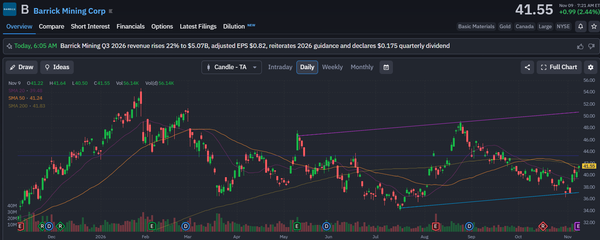
Barrick shares traded at $41.55, with the 50-day moving average at $41.24 and the 200-day average at $41.83. The recovery from the July low around 34–35 has brought the stock back toward this moving-average cluster, but buyers still need to establish control above it.
The $43.50 area is the next important resistance zone. A sustained move above it would strengthen the recovery and open a path toward the upper $40s. On the downside, $39-$40 is initial support, followed by the rising trendline near $37. The chart is improving from its summer lows, but a convincing breakout has yet to confirm a stronger uptrend.
Barrick Needs Better Cash Flow to Justify a More Bullish Outlook
Barrick remains well positioned to benefit from elevated gold and copper prices, and its project pipeline offers a credible route to higher future production. However, rising AISC and weaker attributable free cash flow show that the current metals windfall is not translating into proportionate shareholder cash generation. I’m cautiously constructive on the business, but a more bullish view of the stock needs stronger evidence of production growth and cost control.