Oklo (NYSE: OKLO) just gave investors a reminder of the tantalizing hope for nuclear energy and just how far away that opportunity is from reality. In its Q3 2026 earnings report, Oklo reported $1.86 million in revenue, a 53% increase from the prior quarter. The company also reported a 22-cent loss per share that came in four cents better than analysts expected.
That makes the report a useful lens for anyone holding or considering nuclear stocks. The sector has been punished in 2026. Yet the demand story behind it hasn’t gone away. What has changed is investors’ patience with timelines that stretch into the next decade.
Oklo’s Quarter Was Better Than Expected, and Further Away Than Hoped
OKLO stock jumped 22.66% on Friday to close at $23.55. The earnings beat explains part of that move. A bigger factor may be that shares had already fallen about 80% from their 52-week high of $117.44.
Operationally, the report showed real progress. The Department of Energy approved the preliminary documented safety analysis for the Aurora-Idaho powerhouse. Excavation of the reactor area is complete, and vertical structural steel is going in. Oklo also reserved manufacturing capacity for 27 Aurora modules from 2030 through 2035.
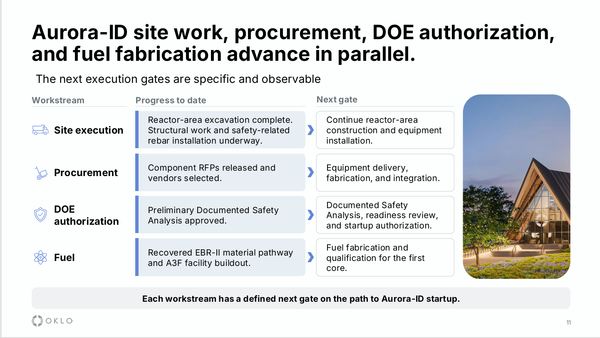
But the timeline moved the wrong way. Management now expects full commissioning of Aurora-Idaho in 2028 to 2029, a modest pushout. The first full fuel assembly is targeted for 2027. Meaningful power revenue is still years away.
It’s important to note that Oklo has the cash to wait. It ended the quarter with $3.1 billion in cash and marketable securities. However, about $2.3 billion of that came from at-the-market stock sales this year. That means shareholders are funding the runway through dilution. That’s the tradeoff of owning a pre-revenue nuclear developer.
Three Ways to Own the Nuclear Opportunity
Oklo is one way to invest in nuclear stocks. It’s also one of the riskiest. Investors can spread that risk across the nuclear value chain. Three stocks offer very different exposure.
Cameco: Getting Uranium Out of the Ground
Cameco (NYSE: CCJ) is the picks-and-shovels play. Every reactor, old or new, needs fuel. Cameco is one of the world’s largest uranium producers. That gives it revenue today, not a decade from now.
That hasn’t spared the stock. Shares slid after the company reported lower nine-month profit in late October. Barclays recently cut its price target to $89. Still, a consensus price target of $147.38 implies roughly 100% upside.
NuScale Power: The First Mover in Small Modular Reactors
NuScale Power (NYSE: SMR) holds the only small modular reactor design approved by the Nuclear Regulatory Commission. That’s a meaningful head start. Its Q3 report also showed first-article manufacturing underway with Doosan Enerbility.
The numbers show how early it is. Revenue was just $0.3 million, down from $8.2 million a year ago. Operating expenses ran $65 million. The company holds about $1.9 billion in liquidity. But the timing of a commercial agreement with TVA remains undefined.
Constellation Energy: The Utility with Nuclear Ambitions
Constellation Energy (NASDAQ: CEG) is the largest nuclear operator in the United States. It already sells carbon-free power to customers including Amazon, Google, and Walmart. The Calpine acquisition added a large natural gas fleet. The planned Crane Clean Energy Center restart adds future nuclear capacity.
After its Q2 report, Constellation raised full-year adjusted earnings guidance to $11.50 to $12.50 per share. It reports Q3 results on November 9. The company also expects to grow its dividend 10% in 2026. The yield is modest, though, at under 1% at current prices.
What the Charts Say About Nuclear Stocks
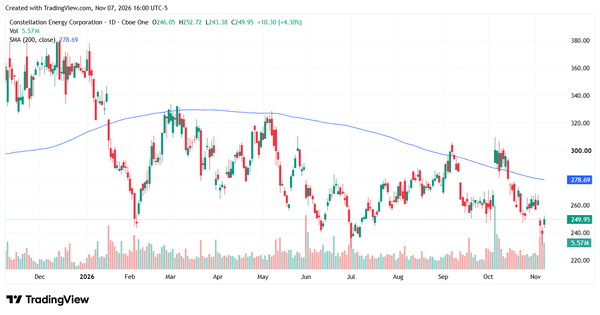
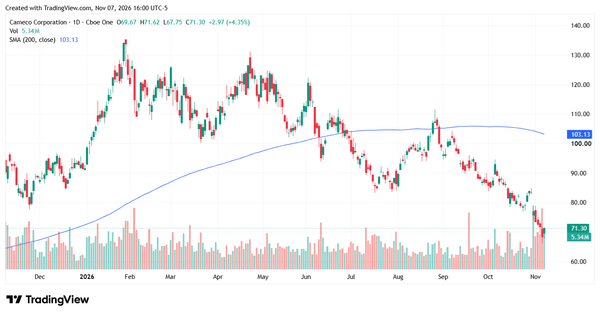
All four stocks are down in 2026. All four also trade below their 200-day simple moving average (SMA). But it’s the distance from the 200-day SMA that tells the story.
Constellation is the “less bad” chart. It closed Friday at $249.95, about 10% below its 200-day SMA of $278.69.
Cameco sits about 31% below its 200-day SMA.
Oklo and NuScale are each more than 50% below theirs. Their 200-day lines are also sloping steeply lower.
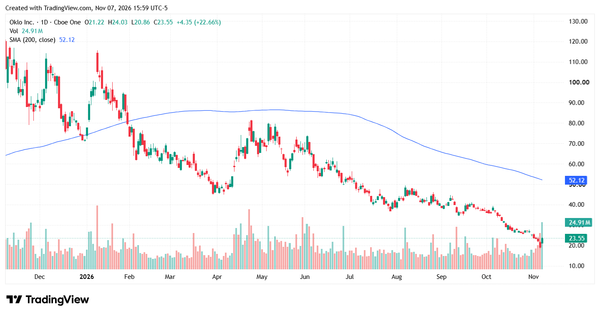
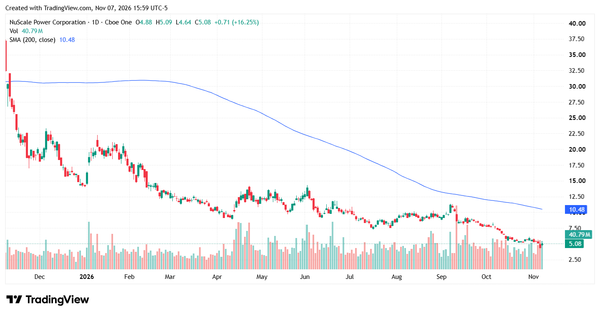
Short sellers have noticed. As of Nov. 6, 2026, about 22% of Oklo’s float sold short. NuScale’s short interest has also run in the mid-teens or higher. Heavy short interest can fuel sharp rallies like Friday’s. Oklo traded 24.9 million shares and NuScale 40.8 million as both jumped.
Still, one strong day doesn’t make a bottom. Conviction in a long-term thesis doesn’t mean timing the low or catching a falling knife. But analysts see value at these levels. Oklo’s average price target sits around $65. Cameco’s consensus implies roughly double the current price. While analyst ratings are only one factor to consider, it’s fair to say that at some point, these stocks won’t be this cheap.
That’s where position size matters. A small starter position limits the damage if the slide continues. It also leaves room to add as milestones like Aurora-Idaho’s commissioning get closer.
It’s Still So Early for Nuclear Stocks
In a 2025 research report, Goldman Sachs projected that global nuclear generating capacity is expected to rise from 378 gigawatts to 575 gigawatts by 2040. In the same report, Goldman Sachs noted that an increasing number of countries are backing a pledge to triple nuclear energy capacity by 2050.
However, context matters. That growth in capacity would increase nuclear energy’s share of the global electricity mix to 12% from its current level of around 9%.
The 3% increase shouldn’t be dismissed, but it also relies on a lot going on schedule. Either way, the real payoff for nuclear stocks is likely to happen over the next 10 to 15 years. That means investors have time to establish and build a position.
It’s a little different story for shareholders who have already suffered through the first downturn in the sector. Continuing to hold will require conviction, but that conviction is grounded in the reality that nuclear energy is no longer a pariah.
Constellation Energy may be an attractive option because of a dividend that pays you to wait. However, Oklo, NuScale Power, and Cameco potentially offer more upside. Using pullbacks to buy dips is a good strategy for growth investors.