ajax loader

Loading...


Ride-the-Wave Strategy – Best for Stock Traders

Ride-the-Wave targets multi-day price momentum following a company’s earnings announcement (EA). With this strategy:

  1. Buy a stock one day post-EA if a stock reacts positively post-earnings:
    1. Near the close of trading the EA-day for a pre-market-EA
    2. Near the close of the following day for a post-market-EA
  2. Sell-to-close after 7-10 days, or possibly earlier if a desired price target is reached

Similarly,

  1. short a stock one day post-EA if a stock reacts negatively post-earnings:
    1. near the close of trading the EA-day for a premarket-EA
    2. near the close of the following day for a post-market-EA
  2. then buy-to-close after 7-10 days, or possibly earlier if a desired price target is reached

Important: Ride-the-Wave is predicated on significant price momentum triggered by an EA. The 7-10 day scenario is the maximum trade hold-time. If you see post EA-momentum is halted or reversed by a significant opposite move, re-evaluate your presence in the trade.

This popular StockEarnings screen below will give you a list of stocks that historically exhibit significant price momentum following an EA for the next seven days:

  1. Stocks exhibiting positive post-EA price moves are buy-candidates
  2. Stocks exhibiting negative post-EA price moves are sell/short-candidates

The screen includes those stocks whose Earnings just came out in last two days.

Screen criteria:

  1. Earnings Date Start Date : Current Date + -1 Day
  2. Earnings Date End Date : Current Date + -2 Days
  3. Predicted Move (Next Day) Max : 7%
  4. Predicted Move (On 7th Day) Min : 7%

Strategy Guideline:

  1. Buy the stock if stock has reacted positively. Short the stock if stock has reacted negatively (see above).
  2. Close the position in 7-10 days, or possibly earlier based on price move.

Volatility Crush Strategy - Best for Options Traders

The Volatility Crush strategy is used with stocks that typically experience relatively low-to-moderate price moves (≤4%) following their Earnings Announcements (EA). The basic trade idea is to sell put or call options right before the EA, collecting a credit when options premium is very high due to elevated implied volatility (IV). You then close the position right after the EA by buying the option back much cheaper due to the significant drop in IV that occurs after the mystery of the EA disappears. In assessing this trade, you need to do your homework to ensure you collect sufficient premium to make the trade worthwhile.

This trade is practical due to the low-to-moderate price-move after the EA, which generally won’t significantly affect the options price, unlike an “action” stock, which experience great price moves post-EA. With these symbols, if you’re on the right side of the price move, that’s a great thing. But if you’re on the wrong side of the move, not so great. Consequently, by minimizing the effect of the post-EA price move, you have a much better chance to profit from the reduction in IV without it being ruined by a violent price move.

For this trade, open the position either (1) the night before the EA when the company announces earnings or (2) during the EA day when it announces post-market, generally capturing IV at or close to its peak.

For this trade, open the position either (1) the night before the EA when the company announces earnings or (2) during the EA day when it announces post-market, generally capturing IV at or close to its peak.

This popular stockearnings screen will give you a list of stocks which do not react more than 4% fpost-EA. It includes only those stocks whose earnings are releasing next day.

Screen criteria:

  1. Earnings Date Start Date : Current Date + 1
  2. Earnings Date End Date : Current Date + 1
  3. Predicted Move (Next Day) Max : 4%
  4. Options Type: Weekly

Strategy Guideline:

  1. Options Strategy: Sell Call and Put
  2. Options Strike Price: Current Stock Price – (% Predicated Move x 2)
  3. Expiration Date: It should generally be the closest expiry immediately after the EA.
  4. Buy Insurance: Buying back Call and Put at Strike price which 10% lower than Sell Strike Price is optional but recommended.

Watch Video for More Detail

Volatility Rush Strategy - Best for Options Traders

The Volatility Rush takes advantage of increasing options premiums into earnings announcements (EA) caused by an anticipated rise in Implied Volatility (IV). With this strategy, Buy a Call and Put at-the-money (a long straddle) 2-3 weeks before the EA when IV is lower. Sell the position either (1) the night before the EA when the company announces earnings pre-market, or (2) during the EA day when it announces post-market, generally capturing IV at or close to its peak.

This popular screen will give you a list of stocks whose Options premiums tend to rise into Earnings. It includes only those stocks whose Earnings are at least two weeks away from today.

Screen criteria:

  1. Earnings Date Start Date : Current Date + 15 Days
  2. Earnings Date End Date : Current Date + 30 Days
  3. Predicted Move (Next Day) Min : 5%
  4. Options Type: Weekly or Monthly if that lines up with the two to three-week lead-time for entering the trade

Strategy Guideline:

  1. Buy a Straddle at or close to the money two to three weeks pre-EA.
  2. Sell the position either the night before the EA when the company announces earnings pre-market, or during the EA day when it announces post-market.
  3. Expiration date should generally be the closest expiry immediately after the EA.
  4. Straddle price should not be more 60% of predicted move.

Predicted Move (Volatility)

Similar to Implied Volatility in Options. Expected volatility % based on our Proprietary Volatility Predication Model. We are expecting that stock price will likely to reach % in either direction by the end of next trading session after Earnings are released and not necessarily the closing volatility %.

Why is it important?

    This indicator helps

  1. Knowing expected volatility in stocks after Earnings helps to decide trading stocks before Earnings Announcement.
  2. Taking Advantage of volatility collapse following Earnings Results by using Advance Options strategies such as Spread and Straddles.

Since Last Earnings

Change in share price since last Earnings release.

Why is it Important?

When share has gained more than 10% since it's last Earning release, it tends to over react to minor bad news and give up some gains if not all. So, it contains more downside volatility than upside When share has dropped more than 10% since it's last Earning release, it tends to over react to minor good news and recover some drops if not all. So, it contains more upside volatility than downside.

EPS Surprise (%)

Occurs when a company's reported quarterly or annual profits are above or below analysts' expectations. Here is the formula to derive % EPS Surprice:

Actual EPS - Estimated EPS
------------------------------------- x 100
Estimated EPS

Why is it Important?

Earnings surprises can have a huge impact on a company's stock price. Several studies suggest that positive earnings surprises not only lead to an immediate hike in a stock's price, but also to a gradual increase over time. Hence, it's not surprising that some companies are known for routinely beating earning projections. A negative earnings surprise will usually result in a decline in share price.

Next Day Price Change (%)

Next Regular trading session Closing price following Earnings result.

For After Market Close Earnings, It is a next trading day closing price. For Before Market Open Earnings, It is the same trading day closing price.

Why is it Important?

Next Day price change is a reaction of Earnings result.

IonQ’s Revenue Surges 336%, but a Manufacturing Bottleneck Looms

Posted on Nov 06, 2026 by Grayson Cavern

IonQ’s Revenue Surges 336%, but a Manufacturing Bottleneck Looms

IonQ (NYSE: IONQ) grew third-quarter 2026 revenue by 336% to $173.8 million, beating analyst expectations of $141.5 million. Adjusted EPS came in at a loss of $0.29, ahead of the expected $0.35 loss, while the company raised its full-year revenue forecast to $505 million-$515 million. 

For a business trying to commercialize quantum computing, that’s tremendous progress. Customers are committing to its technology, revenue is accelerating, and management says every available production slot for its Superion 256 system in 2027 has already been sold. But commercial demand is only one part of building a successful business. IonQ recorded a $433.1 million operating loss during the quarter. 

The company still has to turn those customer commitments into finished systems without allowing the cost of fulfilling them to overwhelm the economics. And that’s where the acquisition of SkyWater Technology (NASDAQ: SKYT) comes in.

Quantum Computing Demand Is Outpacing Production Capacity


IonQ’s quantum platform generated $90.3 million in Q3 revenue, up 127% from $39.9 million a year earlier, showing that the original quantum business is expanding rather than relying entirely on the newly acquired foundry to lift consolidated sales. 

That expansion is also showing up in the contract pipeline. The company signed approximately $290 million in new platform contracts during the quarter, including roughly $180 million from quantum-computing sales, while platform remaining performance obligations reached $689 million, up from $485 million. 

The customer mix adds another dimension to that growth, with more than 40% of platform revenue coming from customers purchasing multiple products. This suggests the company is building relationships that extend beyond individual computing engagements. Its $33 million agreement with South Korea’s SDT, covering a Superion 256 system and quantum networking memory, illustrates the potential scale of those relationships. 

Investors should, however, distinguish contracted work from revenue already earned. RPO includes short- and long-term obligations across both IonQ and SkyWater, so the entire figure cannot be treated as future quantum-computing sales.

The sold-out 2027 production schedule creates a more immediate challenge. IonQ has customers waiting for systems, but it must increase manufacturing throughput to capitalize on those commitments. Management expects multiple Tempo systems to expand cloud capacity in 2027 and plans to deploy a Superion 256 at NVIDIA’s Accelerated Quantum Research Center. Those deployments could strengthen its position in hybrid computing, provided IonQ can manufacture and deliver the systems on schedule.

SkyWater Provides Greater Control Over Quantum Chip Manufacturing

SkyWater gives IonQ a semiconductor foundry operation alongside its quantum platform, adding $83.5 million in external revenue during the two months included in Q3. The foundry also serves customers beyond the company itself, giving the combined entity another source of commercial business. 
ionq - StockEarnings

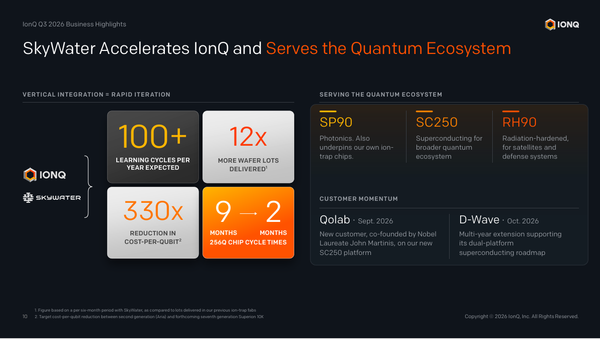
Management highlighted multi-year agreements with Qolab and D-Wave, alongside a take-or-pay agreement with Infineon. External quantum foundry revenue also grew more than 30% year over year, excluding revenue from IonQ. 

Greater control over semiconductor manufacturing could become valuable as IonQ scales its hardware business. Management says integrating SkyWater has increased wafer lots twelvefold and accelerated tape-out cycles more than threefold for 256-qubit chips over six months. That progress could help the company manufacture chips more efficiently, although chip production and finished-system production remain different challenges.

IonQ still needs to assemble, test, deliver and install complete quantum computers. SkyWater may ease a critical part of the supply chain without automatically resolving the entire manufacturing bottleneck.

The acquisition is also adding costs before its full benefits have emerged. SkyWater recorded a $49.9 million segment operating loss during its two months in the quarter, while IonQ’s platform segment reported a $105.6 million operating loss. SkyWater’s result included substantial non-cash depreciation from acquisition accounting. The manufacturing capabilities are now part of the company’s business, but their contribution to better operating economics remains to be demonstrated.

Manufacturing Ambitions Come With Mounting Costs

IonQ’s $563.1 million in GAAP net income gives an incomplete picture of its operating performance because an $896.2 million non-cash gain from the revaluation of warrant liabilities lifted the bottom line. The company actually recorded a $433.1 million operating loss, while adjusted EBITDA showed a $133.6 million loss. 

The cash-flow statement reinforces the scale of the investment. Operating cash outflow reached $570.3 million during the first nine months of 2026. IonQ subsequently raised approximately $2 billion in October, bringing its pro forma cash, cash equivalents and investments to $3.7 billion. 

That financing gives management considerable room to fund research, manufacturing and acquisitions, but capital availability and capital efficiency are different things. IonQ needs its investment in production capacity to translate into more delivered systems and, eventually, narrower operating losses. Management has discussed improving pricing, sales productivity, and removing duplicated back-office systems and sites. Those efforts will need to show up in the financial results.

IONQ Stock Remains Bearish Despite Explosive Revenue Growth

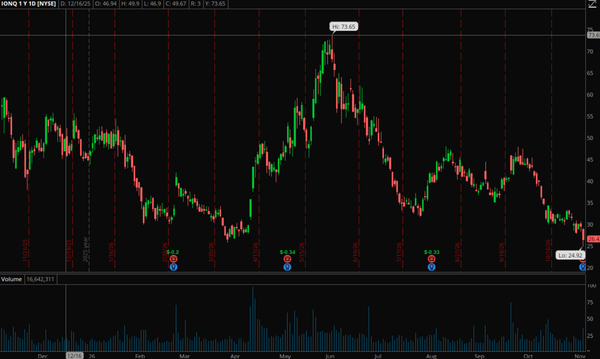
IONQ’s one-year daily chart shows shares falling from $73.65 in June to a recent low of $24.92, with the August rebound toward $47 failing to establish a new uptrend. Another recovery attempt in September stalled before sellers pushed the stock below $35 and then $30.

Trading around $26.40, shares are close to immediate support around $25. A decisive break below $24.92 would expose the stock to further downside. Buyers first need to reclaim 30–32, followed by resistance around $35 and $39-$40. The sequence of lower highs and lower lows remains intact, leaving the technical trend bearish.
ionq - StockEarnings

The Long-Term Opportunity Looks Stronger Than the Stock Chart

IonQ’s commercial opportunity is becoming more tangible, and SkyWater could give it manufacturing capabilities that competitors may struggle to replicate. However, the company still has to prove it can turn customer commitments into finished systems while improving production economics.

For now, I’m constructive on the long-term business opportunity, but cautious on the stock’s near-term outlook.


Join over 1.2M+ investors/traders who receive daily and weekly notable earnings alerts with predicted move