As you’re about to see in its third-quarter’s 2026 earnings report, CVS Health (NYSE: CVS) is preparing to split its retail pharmacy business from its insurance and healthcare services operations by 2028, giving investors two companies with very different earnings profiles. The timing is ambitious. Aetna is recovering, but the pharmacy services business is heading into another difficult year, leaving CVS with a lot to prove before shareholders can judge whether the separation will unlock value.
Third-quarter adjusted EPS rose 30.6% to $2.09, revenue increased 5.4% to $108.4 billion, and management raised its 2026 adjusted EPS forecast to at least $8.20. It also established a preliminary 2027 floor of $8.65, representing approximately 13% growth from its adjusted 2026 baseline.
That growth target depends on two businesses moving in opposite directions. Aetna is rebuilding its margins, while Health Services is preparing for an earnings trough. The success of the breakup will depend on whether both can deliver what management is promising.
Aetna’s Recovery Is Finally Showing Up In Earnings
CVS’s Health Care Benefits segment produced the third-quarter’s strongest operating improvement, with adjusted operating income climbing to $912 million from $314 million a year earlier. Revenue increased 2.4% to $36.9 billion, while the medical benefit ratio improved 150 basis points to 91.3%.
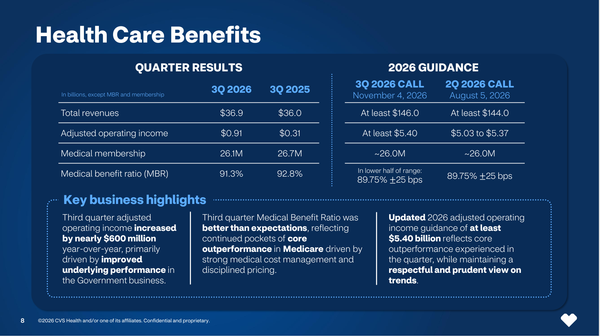
That margin improvement suggests Aetna is getting better control of the gap between premium revenue and medical claims. Management attributed the gains primarily to underlying Medicare performance, disciplined pricing, and medical cost management. Aetna President Steven Nelson expects another year of meaningful Medicare Advantage margin improvement in 2027. CVS is repositioning its plans through changes to benefits, pricing, geographic exposure, and provider networks. Approximately 75% of its Medicare Advantage book is expected to be repriced by the end of 2027.
However, investors should be careful about extrapolating the quarter’s improvement. CVS recorded approximately $1.3 billion in favorable development of prior-year healthcare cost estimates during the first nine months of 2026. That helped reported results, even though management also pointed to better underlying Medicare performance.
The real test is whether Aetna can sustain its improved margins as those favorable reserve adjustments become less of a contributor. Until then, the recovery is encouraging, but its durability remains unproven.
Health Services Is the Weak Link In CVS’s Earnings Outlook
The contrast becomes clearer in Health Services, which generated $54 billion in revenue, up 9.5%, but increased adjusted operating income by only 2.7% to $2.1 billion. Revenue growth is running well ahead of profit growth, suggesting that scale alone isn’t translating into stronger earnings.
Management expects at least $7 billion in adjusted operating income from the segment in 2027 and described next year as its earnings trough. Lower contributions from the 340B business, pharmacy benefit manager client attrition, and a less robust selling season are expected to weigh on results.
This is a significant obstacle to the turnaround. Aetna’s recovery can lift consolidated earnings, but Health Services still needs to absorb its own pressures before it can contribute meaningfully to the next stage of growth.
Management sees specialty pharmacy and healthcare delivery as offsets, and expects the 340B impact to largely stabilize by the end of 2027. Caremark also secured approximately $6 billion in gross new business wins during its 2026 selling season. Those wins offer some reassurance, but they don’t erase the near-term earnings pressure.
The 2028 Breakup Needs to Justify Its Execution Risk
The proposed separation would leave Aetna, Caremark, specialty pharmacy, Oak Street Health, and Signify Health under CVS Health. Retail stores, mail-order pharmacy, MinuteClinic, and the Health 100 consumer platform would form CVS Pharmacy.
CEO David Joyner argues that separate companies would have sharper management focus, more tailored capital allocation, and greater operating flexibility. The logic is understandable. Retail pharmacy has a different operating model from insurance and healthcare services, while the latter businesses rely more heavily on integration.
But a cleaner corporate structure does not automatically create more earnings. Shareholders still need details on stranded corporate expenses, separation costs, debt allocation, and the financial impact of losing some shared infrastructure.
Management called the costs manageable, but has not yet provided a detailed financial breakdown. With the transaction targeted for the first half of 2028, investors have time to assess the plan, but execution will be just as important as the strategic rationale.
CVS Stock Needs More Than a Better Earnings Report
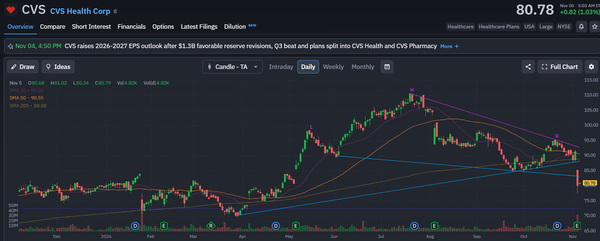
The operating recovery has not translated into a bullish chart. At $80.78, CVS traded below its 20-day moving average of $90.02, its 50-day average of $90.55, and its 200-day average of $88.88. The recent break below the lower boundary of its narrowing trading pattern reinforces the downtrend.
The $80 area is the immediate support to watch. Buyers need to defend that level and reclaim the 89–91 zone, where the three moving averages converge, before the technical picture begins to improve.
CVS Requires Investors to Have Conviction
CVS is asking investors to look beyond the next few quarters and judge what these businesses could earn independently. Aetna has made considerable progress, but Health Services still has to work through the pressures management expects to persist into 2027. That leaves the $8.65 target as the next real test of the turnaround.
If CVS reaches it while keeping Aetna’s margins intact, the planned separation will have a much stronger financial foundation. If it falls short, investors may start questioning whether the company is moving into two stronger businesses or simply dividing the same problems between them.