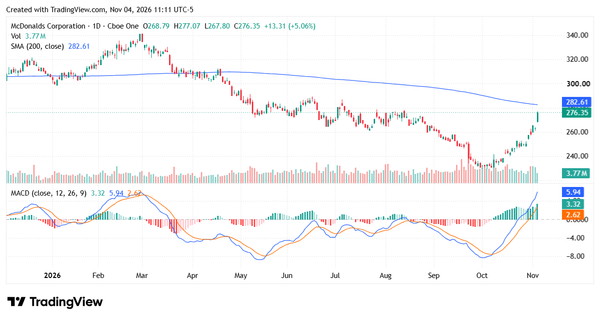
McDonald’s (NYSE: MCD) gave investors something to cheer about, even as it struggled to bring more U.S. customers through its doors. As a result, shares jumped about $6.50 in premarket trading after the fast-food giant reported quarterly earnings above Wall Street’s expectations.
Adjusted earnings reached $3.57 per share, beating the $3.38 analysts expected. Revenue rose about 1% to $7.16 billion, but fell short of the $7.29 billion forecast. Overall, the results offered some encouragement, even though declining U.S. customer traffic showed that McDonald’s still has work to do.
Helping, CEO Chris Kempczinski pointed to solid international results and improving U.S. performance as the quarter progressed, which he attributed to the company’s efforts to offer better value. The challenge now is turning that improvement into sustained growth and giving budget-conscious customers more reasons to return.
In fact, as quoted in the company’s earnings release:
“McDonald’s delivered another quarter of global growth, with solid performance across much of our international business. In the U.S., we’re encouraged by improvement as the quarter progressed following our intervention on value,” said Chris Kempczinski, Chairman and CEO. “We’re focused on building from here, strengthening the business today and investing in the next chapter of growth.”
U.S. Customers Still Need a Reason to Return
Domestic same-store sales slipped 0.2%. Although the decline was small, it came alongside falling customer traffic. That means McDonald’s still has work to do to bring people back.
There was an encouraging detail, however. The decline was smaller than the 0.5% drop anticipated by analysts.
Management also pointed to improvement as the quarter progressed. Chief Executive Chris Kempczinski said the company was encouraged by the response to its renewed emphasis on value. That offers a reason for optimism, although an improving trend does not yet establish a sustained recovery.
In addition, the affordability issue goes beyond advertising another meal deal. Customers need to feel that visiting McDonald’s fits comfortably into their budgets. Think about someone deciding whether to pick up lunch or eat something already in the refrigerator. A familiar brand helps. Convenience helps. But the final price can decide whether that visit happens at all.
International Growth Helps Offset U.S. Weakness
While McDonald’s works through those challenges at home, its international businesses helped support the quarter. Worldwide same-store sales increased 1.5%, ahead of the 1.3% growth expected. That result shows why the company’s reach across different markets matters. Its international developmental licensed markets division, which includes Japan and China, delivered same-store sales growth of 4.2%.
That was twice the 2.1% increase analysts had forecast.
The result was a bright spot, although the division’s overall performance should not be mistaken for identical growth in every country it includes.
The international operated markets division produced a more modest outcome. That business, which includes Australia and Germany, reported same-store sales growth of 1.4%, below expectations of 2.1%. France remained a weak market, according to the company.
Taken together, the international results provided support without removing every concern. McDonald’s has multiple sources of growth, but performance remains uneven.
What Investors Should Watch Next
The next reports should help clarify whether better value is translating into more frequent visits. Investors should watch U.S. traffic, sales at existing restaurants and whether earnings remain resilient as promotions continue. McDonald’s has given shareholders something to work with: an earnings beat, overseas growth and management’s description of improving domestic trends. The next step is turning those early signs into consistent customer demand.
Still, despite the good news, we wouldn’t rush to buy the stock just yet. In fact, we’d wait for shares of MCD to cool off a bit before buying. Not only does it appear to have priced in expectations of good news, it’s technically overbought on relative strength (RSI), MACD, and Williams’ %R. We’d to look to buy on a pullback.