Palantir Technologies (NASDAQ: PLTR) has spent years building its reputation through government and defense contracts, but its third-quarter 2026 earnings report delivered a development that could change how investors view the business. The company generated $2.313 billion in Q3 revenue, up 96% year over year, while U.S. commercial revenue surged 148% to $984 million, edging past U.S. government revenue of $953 million for the first time.
That shift comes alongside another impressive quarter, with Palantir raising its full-year revenue guidance to at least 91% growth. Yet the stock fell 8% in premarket trading, reaching $164.08. The selloff gives us another story to examine, but the bigger development sits inside the revenue breakdown. Palantir’s commercial business is no longer playing second fiddle to its government contracts.
Commercial Revenue Has Crossed A Major Threshold
For a company so closely associated with government intelligence and defense work, having U.S. commercial revenue overtake government revenue represents a meaningful change in its business mix. Commercial customers generated $984 million during the third quarter, compared with $953 million from U.S. government contracts. A year earlier, U.S. commercial revenue was growing from a much smaller base. It has now become Palantir’s largest U.S. revenue category.
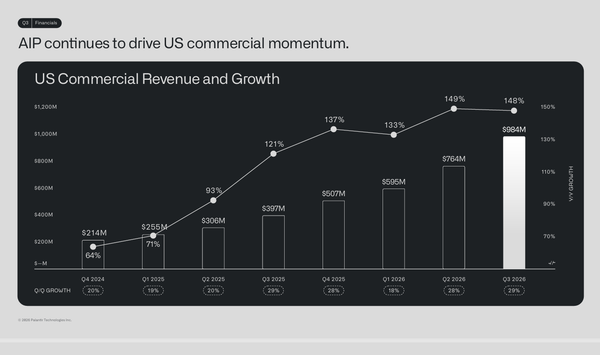
The growth rate makes the shift even more striking. U.S. commercial revenue increased 148% year over year and 29% sequentially, while U.S. government revenue grew 96% year over year and 18% from the previous quarter. Both businesses are expanding rapidly, but commercial is currently moving faster.
This is important because commercial adoption gives Palantir another avenue for growth beyond the government relationships that established its business. A larger commercial operation could broaden its customer base and reduce the extent to which investors associate its future growth with government spending cycles and contract awards.
The company is also seeing substantial activity in its commercial pipeline. U.S. commercial remaining deal value reached $6.617 billion, up 79% year over year and 4% sequentially. That figure represents the remaining value of contracts, rather than revenue already earned, but it provides a useful indication of the business Palantir has signed and still has to deliver.
The Contract Pipeline Is Growing Alongside Revenue
Palantir‘s remaining deal value gives investors another way to assess whether commercial growth has room to continue beyond the latest quarter. The 79% annual increase in U.S. commercial remaining deal value suggests that the expansion is supported by a growing pool of contracted business, rather than relying entirely on a single quarter’s revenue performance.
Total contract value also reached $2.918 billion, up 6% year over year. Palantir closed 212 deals worth at least $1 million, including 107 deals worth at least $5 million and 64 worth at least $10 million. Those larger contract wins show that the company is securing meaningful commercial relationships, although contract value and remaining deal value should not be confused with revenue that has already been recognized.
Management’s updated guidance adds another layer to the growth picture. Palantir now expects full-year 2026 revenue between $8.530 billion and $8.534 billion, representing at least 91% year-over-year growth. Its U.S. commercial revenue guidance has also increased to more than $3.559 billion, implying growth of at least 143%.
For Q4, the company expects revenue between $2.649 billion and $2.653 billion. That would put another substantial quarter behind the commercial expansion already recorded. The next test is whether Palantir can keep converting its growing contract base into recognized revenue at this pace.
PLTR’s Earnings Beat Didn’t Protect The Stock
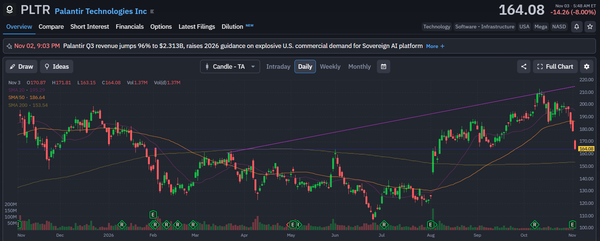
Despite the growth figures and higher guidance, Palantir shares fell 8% to $164.08 in the November 3 premarket session. The stock is trading below its 20-day moving average of $195.29 and its 50-day average of $186.64, after retreating sharply from its October highs above $200.
The decline has also brought PLTR closer to its 200-day moving average near $153.54, which now provides an important technical reference point. A break below that level would put further pressure on the chart, while a recovery above the shorter moving averages would help repair the recent damage.
The earnings release alone doesn’t establish why investors sold. However, Palantir’s rapid growth has created exceptionally high expectations, and a strong report can still trigger selling when shareholders decide the valuation already reflects much of the good news. We should also avoid treating the premarket decline as proof that the commercial thesis has weakened. The operating figures point to continued expansion, even as the stock market delivers a very different verdict.
Can Commercial Growth Justify PLTR’s Price Tag?
Palantir has crossed a threshold many investors have been waiting to see. Its U.S. commercial business is now larger than its government business, and it is growing fast enough to become the company’s biggest growth engine. That’s a powerful development, but shareholders buying PLTR today are paying for a lot of that future already.
The $6.617 billion commercial remaining deal value gives Palantir a substantial pool of contracted business to convert into revenue. The opportunity is there. The challenge is delivering it fast enough to keep the growth story alive as the company gets bigger.
At $164.08, after an 8% premarket drop, I wouldn’t call the stock cheap simply because it has pulled back. I’d want to see whether commercial revenue can keep growing sequentially and whether Palantir can turn those contracts into sales without sacrificing its impressive margins.