Mondelez International (NASDAQ: MDLZ) and The Hershey Company (NYSE: HSY) both delivered earnings beats on October 29. On paper, the candy and snack giants had similar quarters. Both topped profit estimates. And both posted much wider margins as cocoa costs eased.
Yet the market’s reaction tells a different story. MDLZ stock gapped higher and is pressing against its 2026 highs. HSY shares fell about 3% after the report before recovering. They still trade about 10% below their 200-day moving average.
The gap isn’t about valuation. Both candy stocks trade at roughly 20x forward earnings. That’s a premium to most packaged food names. But it’s a discount to the S&P 500 and the broader consumer staples sector.
The difference comes down to one word: volume. Mondelez is growing because people are buying more of its products. Hershey is growing because each product costs more. In a market that prizes predictability, that distinction matters.
For income investors, the choice is closer than it looks. Here’s how the two candy makers stack up after earnings, and what each candy stock offers investors right now.
After two brutal years, the cost picture for chocolate makers has flipped. Cocoa futures hit a record above $12,900 per ton in December 2024. They bottomed near $2,850 in March 2026, a drop of roughly 78%.
Prices have since bounced into the mid-$5,000 range. That’s still well under half the peak. Sugar has followed a similar path. Global surpluses pushed raw sugar futures to their lowest level since 2020 earlier this year.
For investors, the payoff is showing up in margins. Hershey’s adjusted gross margin jumped 1,090 basis points to 42.7%. Mondelez grew adjusted gross profit 14% in constant currency.
There may be more relief ahead. Mondelez pointed to an expected global cocoa surplus of about 500,000 tons. That supports management’s call for strong earnings growth in 2027.
Mondelez Offers Investors Volume-Led Growth They Can Count On
Mondelez’s quarter wasn’t flashy on the top line. Revenue rose 2.3% to $9.97 billion, a hair below consensus. Organic net revenue grew 2.1%.
The quality of that growth is what matters. Volume/mix contributed 1.8 percentage points. Pricing added just 0.3 points. That’s a sharp turnaround from a year ago, when volume/mix fell 4.6%.
Adjusted EPS of $0.78 beat the $0.72 consensus. It rose 5.5% in constant currency. Adjusted operating income climbed 17% on the same basis.
Emerging markets did the heavy lifting. They account for about 40% of revenue and grew 4.1% organically. The AMEA region grew 7.7%. Europe returned to volume growth. North America gained market share despite a soft consumer.
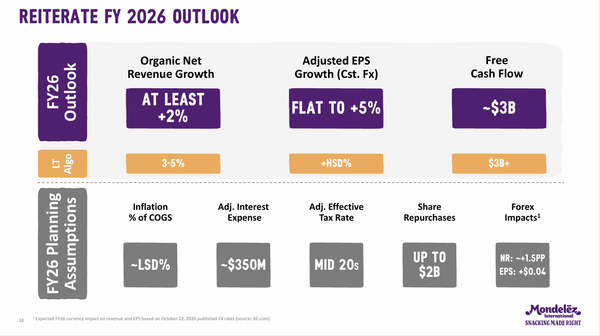
Management reaffirmed 2026 guidance for at least 2% organic growth. It still expects adjusted EPS growth of flat to 5% in constant currency, plus about $3 billion in free cash flow. Mondelez also returned $2.8 billion to shareholders through the first nine months.
That’s the profile of a defensive compounder. It helps explain why analysts give MDLZ a Moderate Buy rating.
Hershey Delivers Earnings Power While It Works to Win Back Volume
Hershey’s headline numbers were arguably stronger. Adjusted EPS more than doubled to $2.64. That topped the $2.11 consensus by 25%. Net sales rose 3% to $3.28 billion.
Hershey also raised its full-year adjusted EPS outlook to $8.58 to $8.74. But the details explain the stock’s muted reception.
Organic sales rose just 0.8%. Price realization added about 11 points, while volume fell about 10 points. In North America Confectionery, pricing rose 13%, and volume/mix fell 11%.
Hershey also trimmed its organic sales outlook to about 3%, down from 3% to 3.5%. And the EPS raise roughly matches about $0.22 in tariff refunds booked in the quarter. In other words, the operating outlook didn’t really improve.
There are bright spots. North America Salty Snacks grew more than 22%, helped by the LesserEvil acquisition. Retail sales in the segment rose 4% excluding LesserEvil.
The question is whether volume returns as price increases lap. Management expects low-single-digit carryover pricing next year. Until volume stabilizes, analysts are content with a Hold rating.
The Charts Give Steady and Speculative Investors Different Entry Points
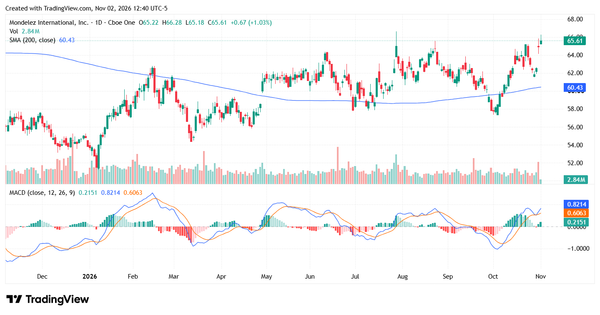
MDLZ closed at $65.61, above a rising 200-day simple moving average (SMA) near $60.43. That average turned higher this summer, a sign the long-term trend has shifted. Shares are now testing resistance near $66, a level that capped rallies in August and October. The MACD sits above its signal line, confirming momentum.
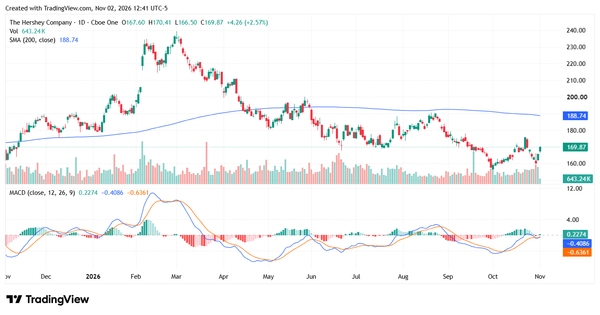
HSY sits at $169.87, about 10% below a declining 200-day SMA at $188.74. The stock has made lower highs since its early-March peak near $240. However, it’s bouncing off an October low near $158. The MACD also just crossed above its signal line. The first test is near $175, then $180. Reclaiming the 200-day SMA would signal a true trend change.
Contrarian Investors Should Watch These Risks for Both Candy Stocks
Cheaper cocoa isn’t guaranteed. Ghana expects a smaller 2026/27 crop, and forecasters warn El Niño could hurt West African harvests.
Both companies also flagged a stretched lower-income consumer. Shoppers are buying smaller bags and hunting for value.
GLP-1 drugs remain a wildcard, though both companies describe the impact as manageable. Hershey even credits GLP-1 users for growth in Ice Breakers mints.
Finally, institutions have slowed their buying in 2026. Neither candy stock carries heavy short interest. But without new buyers, rallies could stall.
Match the Candy Stock to Your Risk Tolerance
Mondelez and Hershey both proved they can turn cheaper cocoa into fatter margins. The market is rewarding the one growing volume.
MDLZ suits investors who want stability through volatile markets. It offers an uptrend, positive volume, and a Moderate Buy consensus.
HSY is the comeback play. It yields about 3.4% versus about 3.0% for Mondelez. But investors need patience while volume recovers. Hershey gets the slight edge on yield. Mondelez’s steady buybacks narrow that gap on a total-return basis.