Super Micro Computer (NASDAQ: SMCI) is busy ringing up sales. The company’s latest quarterly results offered investors plenty to like. Earnings beat expectations, revenue nearly quadrupled, and it posted a stronger outlook.
For a market increasingly nervous about how much technology companies are spending on AI, Super Micro delivered a timely reminder: somebody is selling the equipment behind it all.
And right now, that business is booming. Super Micro reported fiscal first-quarter adjusted earnings of $1.81 per share on revenue of $19.95 billion. Analysts had expected earnings of $1.23 per share and revenue of $17.53 billion.
That wasn’t a narrow victory. Earnings beat expectations by about 47%, while revenue exceeded forecasts by roughly $2.4 billion.
The comparison with a year earlier was even more striking. Back then, Super Micro earned an adjusted 35 cents per share on $5 billion in revenue. In other words, quarterly sales nearly quadrupled, while adjusted earnings grew more than fivefold.
Even the company’s recent preview proved too conservative. On Oct. 20, Super Micro estimated quarterly revenue would land between $18.5 billion and $19.5 billion. The reported figure topped that range. Investors had already been given reason to expect a strong quarter. Super Micro still managed to deliver an extra helping.
AI Needs More Than a Clever Chatbot
It’s easy to think about AI in terms of what appears on a screen: a chatbot answering questions, software writing code, or an application creating images.
Behind those tools sits a mountain of computing equipment.
Super Micro sells servers, storage systems, and other technology that helps businesses run demanding workloads. As companies expand their AI operations, they need more of that infrastructure. Think of an AI application as a busy restaurant. The chatbot gets to greet the customers, but somebody still has to build and equip the kitchen.
Super Micro helps supply that kitchen. Management is also pushing beyond individual pieces of hardware toward more complete data-center offerings, including networking, software, and support. The appeal is straightforward: customers want systems they can put to work quickly without having to assemble every piece themselves.
That gives Super Micro an opportunity to compete for more of the spending attached to each project. However, fulfilling larger projects also makes reliable execution increasingly important.
The Forecast Keeps the Momentum Going
Super Micro’s outlook gave investors another reason to pay attention.
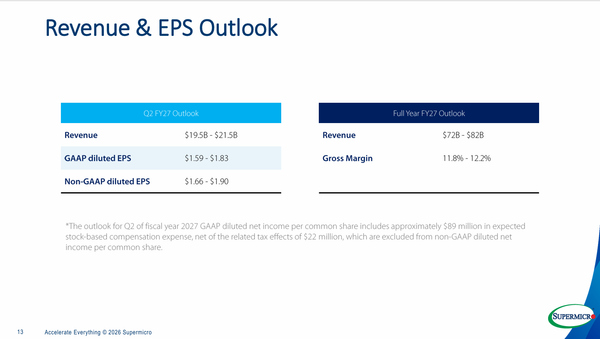
For its fiscal second quarter, management expects revenue between $19.5 billion and $21.5 billion, with adjusted earnings of $1.66 to $1.90 per share. Both ranges sit above the Wall Street expectations cited ahead of the report: $18.1 billion in revenue and earnings of $1.14 per share. The company also raised its fiscal 2027 revenue forecast to $72 billion to $82 billion, from $65 billion to $72 billion.
Following the update, Rosenblatt reiterated its Buy rating and $57 price target.
For now, though, the company has given investors something more useful than another exciting AI prediction: substantial sales, stronger earnings, and an increased forecast.
The next test is turning that momentum into consistent cash generation while protecting margins. Super Micro has shown it can attract a crowd to the AI hardware party. Investors now want to see how much money it takes home.
Super Micro is Still Technically Oversold
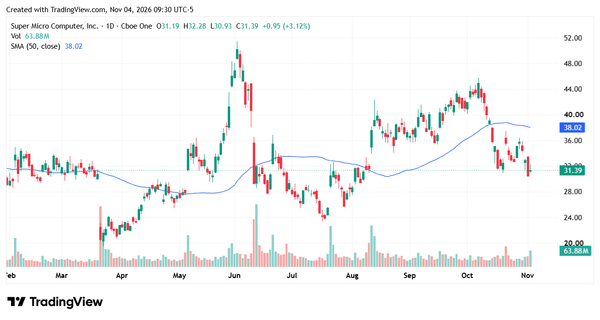
Despite all of the good news, SMCI is still technically oversold at triple-bottom support dating back to August. It’s also oversold on relative strength (RSI), MACD, and Williams’ %R. From its last traded price of $31.39, we’d like to see the SMCI stock rally back to initially refill its bearish gap at around $35.63. From there, longer-term, we’d like to see it retest the $45.77 highs.