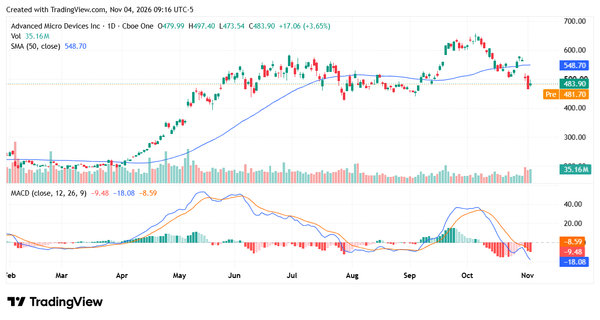
Advanced Micro Devices (NASDAQ: AMD) just gave nervous investors something they needed: strong results and a reason to believe more growth is coming.
The chipmaker beat Wall Street’s third-quarter earnings and revenue expectations. But the bigger attraction was its outlook. AMD expects demand for its data center products to keep climbing, potentially helping the company overcome a weaker personal computer market.
Strong Earnings Give Investors Something Concrete
For the third quarter, AMD reported adjusted earnings of $2.09 per share on revenue of $13.38 billion. Those figures topped the $1.95 per share and $13.09 billion analysts expected. The year-over-year performance was also impressive. Revenue increased 45%, while adjusted earnings per share climbed 74%. The company’s data center business led the way, with sales nearly doubling from a year earlier.
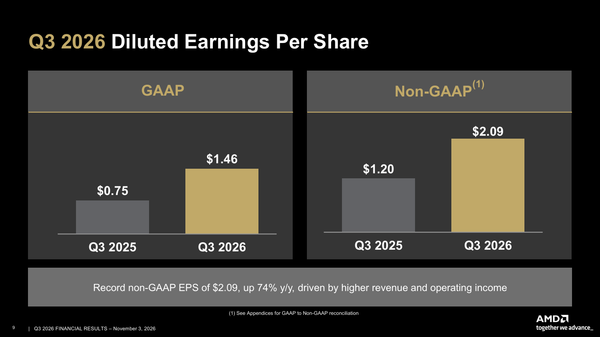
Put simply, Advanced Micro Devices is selling considerably more, and its adjusted profits are growing faster than its revenue. That gives investors something more concrete than enthusiasm about what artificial intelligence might eventually become.
Still, the latest quarter tells only part of the story.
AMD Sees Even Bigger Growth Ahead
Chief Executive Lisa Su told investors that server revenue is expected to double in 2027. She also indicated that growth in the company’s data center AI business could accelerate faster than the company anticipated three months earlier.
AMD’s broader outlook calls for revenue growth of more than 80% in 2027. That is a substantial forecast for a company already generating billions of dollars in quarterly sales.
Plus, data centers should offset PC weakness.
Analysts cited in the report expect weakness in that market to remain a challenge. When computer manufacturers slow production or work through excess inventory, demand for the chips inside those machines can suffer.
However, AMD’s growing data center business could make that weakness less influential.
Barclays expects AMD’s client business, which includes PC processors, to represent less than 10% of company sales by the second half of 2027. That is the bank’s projection, but it illustrates how dramatically AMD’s revenue mix could change.
A soft PC market would still matter. It simply might have less power to derail the company’s overall growth.
Wall Street Likes the Outlook, but Opinions Differ
Goldman Sachs (NYSE: GS) maintained its Buy rating and a $675 price target, although it lowered that target from $700. The bank sees AMD gaining a larger share of the computing market through its established CPU business and expanding AI customer base.
Citigroup (NYSE: C) remained particularly optimistic, maintaining a Buy rating and an $800 target. Its argument centers on AMD’s ability to expand production and turn rising sales into stronger profitability.
Other analysts were more restrained. Morgan Stanley (NYSE: MS) raised its target to $550 but retained an Equal Weight rating.
JPMorgan Chase (NYSE: JPM) increased its target to $575 while keeping a Neutral rating.
Several firms also reduced their price targets despite remaining bullish. Strong operating results do not automatically mean a stock deserves an ever-higher valuation.
Now AMD Has to Deliver
According to Citi, supply availability remains a greater constraint than customer demand. Orders are encouraging, but the company still needs sufficient manufacturing capacity, components, and completed systems to turn that interest into revenue. Profit margins deserve attention as well. Expanding a business quickly can bring additional costs, and the mix of products sold can affect how much profit remains from each dollar of revenue.
Investors will also continue watching the customers paying for the AI buildout. Their willingness to keep spending will help determine how durable AMD’s growth becomes.
For now, AMD has strengthened its case. It delivered an earnings beat and outlined a future in which data centers could increasingly drive the business. The next test is execution: meeting demand, shipping products, and protecting profitability. If Advanced Micro Devices delivers on those priorities, its latest results could help rebuild confidence after a bruising month for the stock.