Apple (NASDAQ: AAPL) just delivered fourth-quarter earnings that would have made most companies’ shareholders very happy. Revenue climbed 12% year over year to $114.5 billion, beating Wall Street’s $113.4 billion estimate, while diluted EPS came in at $2.10 against expectations of $1.99. iPhone revenue also jumped 17.5% to $57.6 billion. Yet, the stock was trading around $322.58 in premarket trading, down 4.65%.
That’s quite a reception for an earnings beat. And Apple wasn’t the only major technology stock facing pressure, with the broader sector already struggling during Monday’s session. But there’s something in Apple’s own results and management’s outlook that makes this reaction particularly worth examining. To see it, we need to look beyond September’s numbers and into what the company has lined up for the quarter ahead.
The iPhone Is Still Apple’s Biggest Growth Engine
Apple’s fourth quarter report show that its flagship product continues to generate substantial growth, even against the enormous revenue base the company has built over the years. iPhone revenue reached $57.6 billion, up 17.5% year over year, while Mac sales climbed 23.7% to $10.8 billion.
The rest of the hardware lineup delivered a less convincing performance, with iPad revenue falling 10.4% to $6.2 billion and Wearables, Home and Accessories declining 7.9% to $8.3 billion. Services, meanwhile, generated $31.6 billion, up 9.8%, and reached a new quarterly revenue record.
That mix becomes more revealing when we look at management’s expectations for the December quarter, which is traditionally Apple’s biggest sales period. The company expects revenue growth of 7% to 10% year over year, potentially setting another quarterly record, although management indicated that supply constraints will limit how much demand it can satisfy.
Rising Memory Costs Are Changing The Earnings Picture
The biggest clue behind the selloff came from Apple’s profitability forecast, with management guiding to a December-quarter gross margin of 45% to 46%, compared with the 47.9% reported in September. Rising memory chip costs and expenses associated with ramping its Siri AI capabilities are expected to contribute to that decline.
This is an awkward combination for a company heading into its strongest sales period. Apple expects to sell more products, but the components required to manufacture those products are becoming more expensive. At the same time, supply constraints could prevent it from shipping every device customers want. More demand does not necessarily mean more profit when the cost of meeting that demand is rising.
The September quarter also benefited from tariff refunds, which Apple said contributed approximately one percentage point to gross margin and $0.05 to diluted EPS. That gave the reported figures a temporary lift, making the expected margin decline even more important when assessing how much of September’s profitability can carry into the next quarter.
Services present another complication because management expects December-quarter growth of 8% to 9%, below analyst expectations of approximately 10.7%. With the segment already generating $31.6 billion every quarter, slower growth could weigh on a business that has become an important source of recurring, higher-margin revenue.
The Broader Tech Selloff Made Apple’s Reaction Worse
Apple reported into a technology market that was already under pressure, as investors reassessed expensive technology shares and the enormous spending required to build out AI infrastructure. On November 2, the Nasdaq Composite fell 1.07%, while the S&P 500 declined 0.51%. With the bigwigs like Microsoft (NASDAQ: MSFT), Nvidia (NASDAQ: NVDA), Meta Platforms (NASDAQ: META), and Alphabet (NASDAQ: GOOGL) all slipping.
However, Amazon (NASDAQ: AMZN) gained 2.20% during the same session, showing that investors were not simply dumping every major technology stock. Apple’s subsequent 4.65% premarket decline reflects both the weak sector backdrop and concerns specific to its earnings outlook. The broader selloff created the pressure, but Apple’s margin and Services forecasts gave investors another reason to sell.
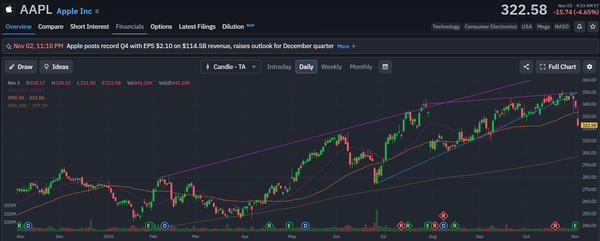
The technical picture has deteriorated alongside that sentiment, with AAPL trading below its 20-day moving average near $341.80 and its 50-day average around $333.86. The stock has also broken beneath the rising trendline on the chart, leaving its 200-day moving average near $297.29 as the next major reference point below the current price.
Is The Selloff Creating a Long-Term Buying Opportunity?
For investors considering Apple as a long-term holding, the latest report presents a distinction between owning a strong business and buying its shares at an attractive price. The company still has substantial demand for its flagship products, but the coming quarters will test its ability to protect profitability while dealing with higher component costs and slower Services growth.
I wouldn’t rush to buy AAPL because it has fallen after earnings, especially when management has already signalled that margins will come under pressure. A move toward the $297 area around the 200-day moving average could bring the stock into a more attractive technical position, but that level alone would not establish that the shares are undervalued or that the decline has run its course.
The better approach is to watch how the next couple of quarters develop, particularly whether memory costs begin to stabilize, supply constraints ease, and Services growth improves. Those developments would give investors a stronger basis for judging Apple’s earnings power beyond the current sales cycle.