Pfizer (NYSE: PFE) is making progress on a difficult assignment. It needs to replace billions of dollars in revenue from older medicines while building a new portfolio capable of carrying the company into the next decade.
Its third-quarter earnings report offers evidence that the transition is gaining momentum. Revenue from launched and acquired products increased 32% operationally to $3.8 billion, while the company raised its full-year revenue and earnings guidance. Yet total quarterly revenue fell from $16.654 billion to $16.583 billion, a $71 million decline year over year.
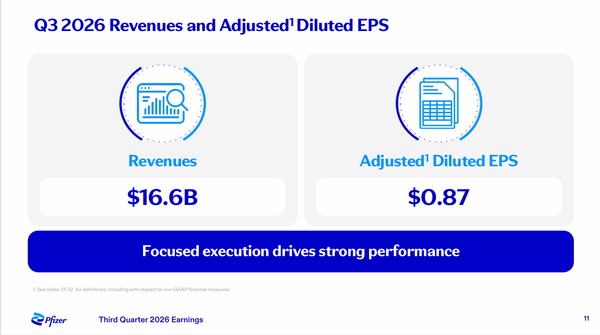
That gap tells investors where Pfizer stands. Its newer medicines are growing quickly, but declining sales elsewhere are still absorbing much of that progress.
Pfizer’s New Drug Portfolio Is Growing Fast
Pfizer’s product breakdown shows that the company is already generating substantial growth outside its COVID franchise, although those gains have yet to produce a meaningful increase in total revenue. Excluding Comirnaty and Paxlovid, revenue increased 7% operationally, while launched and acquired products generated $3.8 billion, up 32%.
The five major growth contributors added approximately $1.21 billion in quarterly revenue. Eliquis increased by $513 million to $2.523 billion, Padcev added $255 million to reach $720 million, and the Vyndaqel family contributed another $193 million to reach $1.77 billion. Nurtec added $135 million, while Lorbrena gained $114 million.
What I find encouraging this third quarter is that these gains aren’t all coming from the same source. Padcev is gaining market share in first-line bladder cancer treatment, Nurtec is benefiting from U.S. demand and international launches, and Lorbrena is gaining patients in first-line lung cancer treatment. Eliquis, meanwhile, benefited from stronger global demand and higher U.S. net pricing.
That gives Pfizer several growing products rather than one drug carrying the entire recovery. However, the Eliquis increase also deserves some scrutiny because part of its U.S. growth came from lower rebates and favorable channel mix. Investors should distinguish that pricing benefit from the market-share gains driving products such as Padcev.
The Patent Cliff Is Absorbing Nearly All Those Gains
The problem becomes clearer when we compare the growth contributors with Pfizer’s declining products, because three major franchises lost approximately $1.29 billion in quarterly revenue against the $1.21 billion added by the five growth contributors.
Paxlovid surrendered $771 million as lower COVID infections reduced demand. Comirnaty lost $339 million amid lower U.S. utilization and international deliveries, while the Prevnar family declined by $180 million because of lower vaccination rates and market-share erosion.
In other words, those three products alone gave back more revenue than the five major growth contributors added. That’s why Pfizer’s Q3 total revenue barely changed, despite the impressive expansion elsewhere. The replacement portfolio is making progress, but it hasn’t yet grown large enough to overcome the contraction in established products.
The next wave of pressure comes from patent expirations and generic competition. Pfizer already expects approximately $1.1 billion in 2026 revenue losses from generic and biosimilar competition, with further exposure involving Ibrance, Xtandi, and Eliquis discussed during the earnings call.
This is why the next few years will be a demanding period for Pfizer. The company must expand its newer medicines quickly enough to replace existing sales while investing in products that can eventually take their place. Management is targeting a return to high-single-digit revenue growth toward the end of the decade, but the 2027 outlook, expected in December, should give investors a clearer view of the transition.
Guidance Upgrade Gives Pfizer More Room
Pfizer’s higher 2026 guidance gives the turnaround some breathing room, with management raising its revenue forecast midpoint by $1.5 billion to $63 billion and its adjusted EPS midpoint by $0.10 to $3.00.
The earnings upgrade is particularly useful because the revised range includes an approximately $0.10 per-share charge from the $650 million Innovent transaction. Pfizer is also increasing its full-year adjusted R&D spending forecast to $10.8 billion to $11.8 billion, reflecting greater investment in oncology and obesity candidates.
That spending is part of the company’s attempt to build the next generation of growth products. Pfizer is also targeting nearly all of its $7.2 billion cost-savings program by the end of 2026, followed by another $2.5 billion in savings between 2027 and 2029. The combination gives management room to invest in its pipeline while continuing to improve operating efficiency.
What PFE Investors Should Watch Next
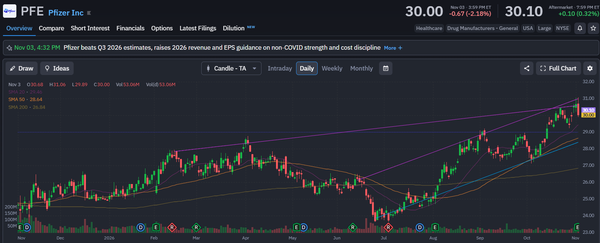
Pfizer closed November 3 at $30, down 2.18%, before edging up to $30.10 after hours. The shares remained above their 20-day moving average of $29.46, 50-day average of $28.64 and 200-day average of $26.84.
The company generated $8.8 billion in operating cash flow during the first nine months of 2026 and paid $7.3 billion in dividends. Its leverage ratio stood at 2.6 times, while management expects debt leverage to remain around current levels or rise modestly during the patent-loss transition.
I’d focus on December’s 2027 guidance before making a long-term call on PFE. The company has demonstrated that its newer products can grow, but it still needs to show how much of that growth will survive the coming patent losses and whether the pipeline can replenish the portfolio fast enough.
Pfizer has added roughly $1.21 billion in quarterly revenue from five growing products, yet three declining franchises have already taken away approximately $1.29 billion. Until that equation turns decisively in Pfizer’s favor, the recovery remains a work in progress.