Super Micro Computer (NASDAQ: SMCI) has given investors another reason to look closely at its position in the AI infrastructure buildout, with first-quarter revenue nearly quadrupling year over year and management lifting its full-year sales target by $8.5 billion at the midpoint. The company is now projecting as much as $82 billion in FY2027 revenue, a remarkable forecast for a business that generated $39.1 billion in the entire previous fiscal year.
Yet there’s a bigger story behind that growth, and it has less to do with how many AI servers Super Micro can ship than what the company gets to keep after delivering them. Its latest results show improving margins and stronger earnings, but the cash flow statement reveals how much money is still being absorbed to support the expansion.
Super Micro’s AI Business Is Scaling at Extraordinary Speed
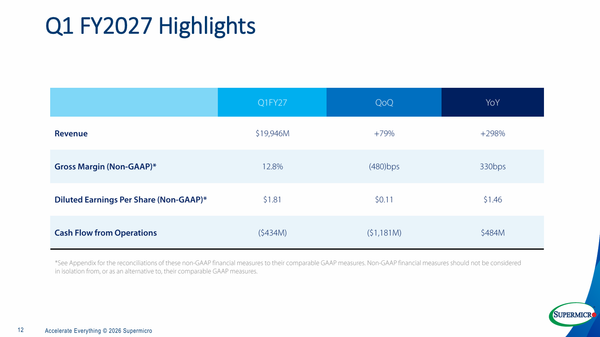
Super Micro generated $19.95 billion in first-quarter revenue, up 298% from $5.02 billion a year earlier and 79% sequentially, comfortably beating its preliminary $18.5 billion to $19.5 billion range. AI solutions contributed approximately 71% of revenue, compared with 59% in the previous quarter, while OEM appliance and large data center customers generated $14.7 billion, or 74% of sales. That segment grew 321% year over year as production ramped up on several large AI data center design wins.
However, approximately $2.3 billion of quarterly revenue came from deployments originally scheduled for earlier periods but delayed by customer and data center readiness. Excluding those catch-up shipments, underlying revenue was approximately $17.6 billion, and management’s full-year forecast does not assume the delayed deployments repeat.
Even after that adjustment, management reported record backlog and is targeting production capacity exceeding 8,000 racks per month, including more than 4,000 direct liquid cooling racks by December.
The Margin Improvement Is More Important Than the Revenue Headline
Super Micro‘s non-GAAP gross margin reached 12.8%, up from 9.5% a year earlier, showing improved economics even as AI infrastructure becomes a larger share of sales. The sequential decline from 17.6% in Q4 reflects the heavier mix of large-scale AI deployments, which management says carry lower margins than enterprise and channel business. Across Q4 and Q1 combined, however, revenue reached approximately $31.1 billion at a 14.5% non-GAAP gross margin, compared with $10.8 billion and 9.5% in the same two quarters a year earlier.
Management expects FY2027 gross margin of 11.8% to 12.2%, with the second half running below the first as AI solutions approach 70% to 80% of revenue. Supermicro is growing rapidly, but the product mix will continue to determine how much profit it earns from each dollar of sales.
Cash Flow Statement Shows What Growth Is Costing
Despite reporting $1.59 billion in net income, Super Micro used $434 million in operating cash during Q3, as receivables absorbed $3.56 billion and inventory another $2.48 billion. Those sums represent capital tied up in producing and delivering the systems behind its revenue growth.
Customer prepayments helped finance the expansion, with deferred revenue increasing approximately $3.1 billion. Management also reduced the cash conversion cycle from 149 days to 97 days, estimating that the 52-day improvement represents roughly $10 billion in working capital at the current revenue run rate.
Still, inventory reached $15.1 billion, and receivables stood at $9.7 billion, while cash fell to $6.9 billion against $8.6 billion in bank borrowings and convertible notes. Delayed deployments could leave even more capital tied up before the corresponding revenue arrives.
What SMCI Investors Should Take Away
Management raised its FY2027 revenue forecast from $65 billion – $72 billion to $72 billion – $82 billion, while projecting second-quarter sales of $19.5 billion – $21.5 billion. The higher outlook reinforces the strength of demand for Super Micro’s AI infrastructure, although component shortages and customer data center readiness remain constraints on how quickly the company can turn orders into shipments.
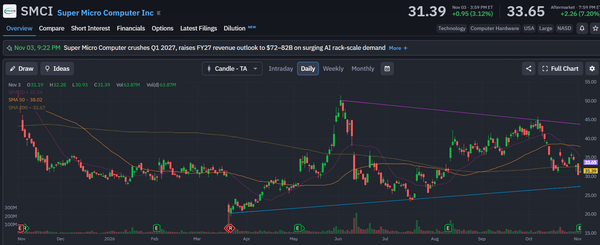
Investors responded positively, with SMCI closing November 3 at $31.39, up 3.12%, before climbing to $33.65 after hours, a 7.20% gain. That move pushed the stock back above its 200-day moving average at $32.67, but it remains below its 20-day average of $35.54 and 50-day average of $38.02. Those shorter-term averages are the next hurdles buyers need to clear.
SMCI had approached $45 in October before retreating toward $31, breaking below both shorter-term moving averages along the way. The earnings rally gives buyers an opportunity to reverse that decline, but a sustained move above $35.54, followed by $38.02, would provide stronger evidence that the recovery has legs. On the downside, losing the $32.67 area again would weaken the latest rebound and raise the possibility of another move lower.
I’d be encouraged by the stronger two-quarter margins and higher revenue outlook, but the next few quarters need to show that Super Micro can convert its backlog into shipments, collect the cash, and prevent working capital from swallowing its profits. The company is selling more AI infrastructure and improving its margins, but the next leg of the investment case depends on turning that scale into cash. Until operating cash flow begins reflecting the strength of its reported earnings, I’d want to see further execution before chasing Super Micro stock.