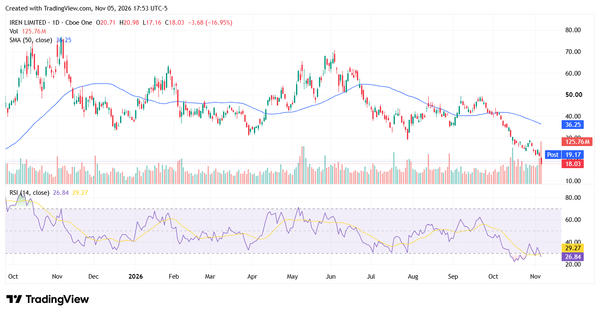
IREN Ltd. (NASDAQ: IREN) shareholders had a rough Thursday before the company even reported earnings. A media report the night before tied delays at IREN’s Childress, Texas, campus to a shortfall in Microsoft’s (NASDAQ: MSFT) quarterly AI spending. The stock fell about 17% in regular trading to close at $18.03, a new 52-week low, on nearly three times its average volume.
Then IREN reported fiscal first-quarter 2027 results after the close. The headline numbers weren’t flashy. But the report did something more important. It explained the delay, put a size on it, and showed that the money to finish the job is already lined up.
Shares rose about 6% in after-hours trading.
For investors who sold on the headline, the report is a useful reminder. Selling the news often means selling at the worst moment, before a company has had a chance to explain.
The quarter also showed why IREN’s vertically integrated model matters. IREN owns the land, the power, the data centers, and the GPUs. That gives it more ways to fund growth than most rivals have. And funding is the question hanging over every AI cloud stock right now.
The Microsoft “Delay” Was a Customer Request
IREN confirmed that its target of more than $4 billion in annualized run-rate revenue (ARR) has slipped. The company now expects to reach it in January 2027 rather than by the end of 2026. It said the date could extend to the end of February.
The reason matters. On the earnings call, co-CEO Daniel Roberts identified the customer as Microsoft. He said Microsoft asked IREN to reconfigure and upgrade network infrastructure so the 200 megawatts (MW) at Childress could serve the latest frontier AI models. Supplier timing also played a role.
That’s a very different story from a construction failure. A customer asking for a bigger, better build is a demand signal, not a warning sign. And the slip is measured in weeks to a couple of months, not quarters.
IREN also says the $4 billion target remains fully contracted and fully funded.
The Quarter: Revenue Beat, Margins Widened
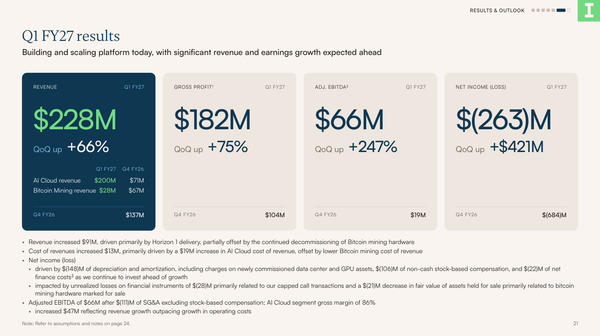
Total revenue rose 66% from the prior quarter to $228 million. That topped the $221 million analyst average compiled by LSEG. AI Cloud revenue nearly tripled to $200 million as Horizon 1 went into service for Microsoft. Bitcoin mining revenue fell to $28 million as IREN continued retiring mining hardware.
AI Cloud gross margin held at 86%. Adjusted EBITDA more than tripled to $66 million, a 29% margin, up from 14% in the prior quarter. Operating ARR doubled to $1 billion.
The net loss narrowed to $263 million from $684 million. Much of what remains is non-cash, including $148 million of depreciation and amortization and $106 million of stock-based compensation.
Revenue backlog rose 22% to $20.3 billion, and about two-thirds of it is with investment-grade counterparties. Microsoft accounts for $9.6 billion and NVIDIA for $3.4 billion. AI developers, a frontier lab, and channel partners make up the remaining $7.2 billion. After the quarter ended, IREN also doubled its capacity with a leading frontier AI lab.
Why Vertical Integration Matters Now
IREN’s pitch is simple. Most AI infrastructure companies specialize in one layer. IREN owns all three: land and power, data centers, and the GPUs that run inside them.
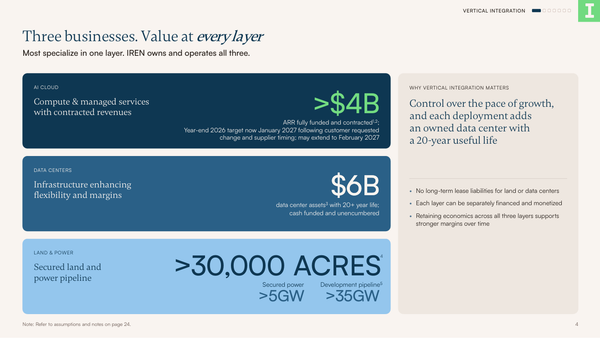
That structure shows up on the balance sheet. IREN holds about $6 billion of data center assets that are cash-funded and unencumbered, with a 20-year useful life. It has more than 5 gigawatts of secured power. And because it owns its buildings, it carries no long-term lease liabilities for land or data centers.
Ownership also lets IREN finance each layer separately. GPU contracts can come with customer prepayments. A five-year deal signed after the quarter includes prepayments covering up to 90% of the GPU cost. Using IREN’s illustrative economics, that cuts the cash payback on the GPUs from about 2.4 years to under half a year.
Pricing is moving in IREN’s favor, too. Recent five-year contracts were priced at about $22 million per MW per year. Short-term contracts came in near $40 million per MW. One H100 contract renewed at double its prior price.
Roberts acknowledged on the call that capital markets have become more selective. Investors now care less about contract size and more about delivery, financing, and profitability. Owning every layer is IREN’s answer to all three.
The Funding Picture
Financing has been the bear case all fall. The report addresses it head-on.
IREN ended September with $5.8 billion in cash, including restricted cash. Remaining planned capital spending for fiscal 2027 is about $15 billion. Of that, $9 billion is covered by cash, committed GPU financing, and customer prepayments. The other $6 billion still needs to be raised.
IREN outlined $12 billion to $15 billion of potential funding capacity at its targeted terms, before any convertible notes or new equity. That includes debt backed by its unencumbered data centers and additional GPU financing.
Near-term maturities look manageable. About $723 million of debt principal comes due over the rest of fiscal 2027. The largest share matures in fiscal 2032 or later.
There are trade-offs. Net debt rose to $4.4 billion from $216 million a quarter earlier. IREN raised about $498 million by selling shares during the quarter. And its newest GPU financing, backed by non-investment-grade customers, carries a 9% rate, compared with 6% on the Microsoft financing.
What the Chart Says
IREN peaked near $77 about a year ago. At Thursday’s close of $18.03, it was down about 76% from that high. The stock trades roughly 50% below its 50-day moving average, and its 14-day RSI sits near 27, deep in oversold territory.
For investors who bought near the top, IREN has been a painful hold. Many weren’t wrong about the business. They were early.
At $18, the setup looks different. IREN’s market value of roughly $7 billion is about a third of its $20.3 billion backlog. It’s also only about 1.4 times the company’s $5.1 billion of shareholders’ equity.
That doesn’t mean the bottom is in. The trend is still down, and the 50-day moving average is still falling. Timing a bottom is notoriously difficult, and patience will likely be required. But a collapsing share price paired with improving fundamentals looks a lot like maximum pessimism. Much of it appears unjustified.
Risks Worth Watching
The report doesn’t remove every risk. Investors should keep four in view:
- Delivery – Horizons 2 through 4 for Microsoft still have to be delivered. Further slippage past contractual grace periods could trigger delay credits.
- Texas – The company’s own risk factors flag changes to how the state’s grid operator approves large new electricity loads, along with a state-ordered review of data centers in the interconnection queue.
- Funding – About $6 billion of fiscal 2027 spending still needs financing, and more share sales are possible.
- Concentration – Microsoft accounts for nearly half of the backlog.
Is IREN Stock a Buy After Earnings?
IREN’s quarter wasn’t a blowout. It didn’t need to be. It answered the question that sent the stock to a 52-week low, and it showed the funding to deliver on its contracts.
Investors who sold on Thursday’s headline sold before hearing the explanation. For those with a long enough time horizon, IREN’s current price may prove to be an opportunity rather than a warning.