Uber Technologies (NYSE: UBER) released third-quarter results on Nov. 4 that look alarming at first glance. Net income fell 92% year over year, from $6.63 billion to $512 million. Yet gross bookings grew 20% to $59.8 billion. Investors focused on bookings, and UBER stock climbed nearly 7% in afternoon trading.
Both readings of the Uber earnings report contain some truth. The net income collapse is largely an accounting comparison problem. The deeper story is strategic.
Uber is approaching a crossroads where its shift toward autonomous vehicles collides with tougher growth comparisons. How the company manages that collision will likely decide where Uber stock goes in 2027.
Why the 92% Drop Overstates the Damage
The year-ago quarter was flattered by two large non-operating items. Uber booked a $4.05 billion income tax benefit in Q3 2025. It also recorded $1.43 billion in other income, largely from gains on its equity stakes.
This quarter reversed both. Uber posted $616 million in other expenses and a $244 million tax provision. It also absorbed $484 million in legal and regulatory reserve charges and $186 million in restructuring costs.
Strip out that noise and operations look healthy. GAAP income from operations rose 30% to $1.45 billion. Non-GAAP operating income climbed 38% to $2.3 billion. Non-GAAP earnings per share (EPS) grew 35% to 88 cents.
Cash generation was also strong. Trailing 12-month free cash flow reached a record of $10.4 billion.
Uber Gross Bookings Grow 20% as Delivery Leads
Gross bookings have now grown 20% or more for five consecutive quarters. Monthly active platform consumers (MAPCs) reached 215 million, up 14%. Total trips rose 16% to 4.06 billion.
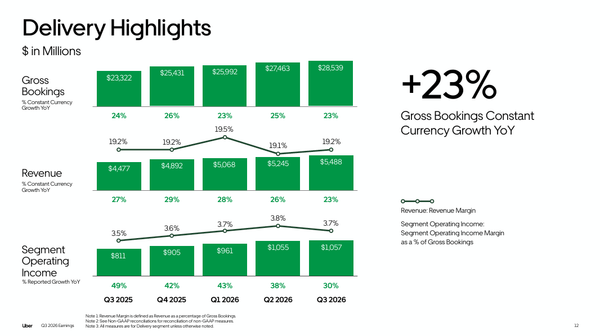
Delivery was the standout. Segment gross bookings grew 23% in constant currency to $28.5 billion. Management credited accelerating organic growth, better merchant selection, and stronger membership engagement. Grocery and retail reached a $15 billion annual run rate, up 40% year over year.
Mobility profitability also improved. Segment operating income rose 27% to $2.36 billion. Margin as a share of bookings hit 8.0%, up from 7.4% a year ago.
Slowing Growth Raises Questions About Uber’s Momentum
Revenue tells a less flattering story. Total revenue grew just 10% to $14.8 billion. Uber said business model changes cut eight percentage points from that growth rate.
Mobility revenue actually fell 2% in constant currency. Mobility bookings grew 17%, down from 20% in each of the prior two quarters. Management said growth missed expectations because driver supply lagged demand in several international markets. Fuel costs and immigration trends contributed.
Uber is making targeted supply investments. It said supply hours growth improved in October. However, seasonal constraints remain, and rider prices could face pressure.
The broader trend is deceleration. Trip growth has slowed from 22% to 16% over five quarters. MAPC growth has eased from 18% to 14%. Delivery segment profit growth slid from 49% to 30%.
That matters because the comparisons are getting harder. The fourth quarter of 2025 produced 22% bookings growth and 20% revenue growth. Clearing that bar will be difficult.
The Autonomous Bet Raises the Stakes
This is where the crossroads comes into focus. Uber expects about 700 fully driverless vehicles on its network by year-end. It targets more than 2,000 by the end of 2027 and tens of thousands from 2028.
Management cited a 30% utilization advantage for autonomous vehicles on its network. That supports Uber’s case that it is the natural aggregator for robotaxi fleets.
Still, management acknowledged that scaling requires proving the economics and securing third-party financing. That is a meaningful caveat for a company built on a capital-light model.
The balance sheet hints at the cost of transition. Long-term debt rose from $10.5 billion at year-end to $15.7 billion. Equity method investments jumped from $287 million to $3.5 billion. GAAP research and development spending grew 48% to $1.27 billion. Share repurchases fell to $750 million from $1.46 billion a year earlier.
Not all of that is tied to autonomy. But together, the figures suggest a company that’s spending more to secure its future position.
AI agents are a smaller, earlier-stage question. During one recent high-volume week, agents placed about 500 Uber Eats orders and booked four rides. Uber is building its own AI features while negotiating terms with outside AI providers.
Can Shares Break Above the 200-Day Average?
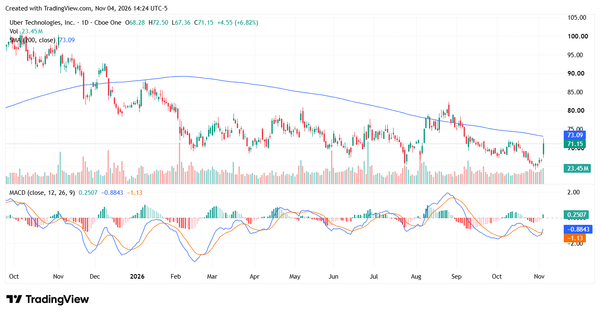
The post-earnings rally started from a beaten-down level. Uber stock traded near $100 a year ago. It closed at $66.60 the day before the report.
Even after the jump, shares sit near $71, below the 200-day simple moving average (SMA) at about $73. That average has been falling since early 2026, confirming a longer-term downtrend.
Momentum is improving, though. The moving average convergence divergence (MACD) line has crossed above its signal line. The histogram has turned positive for the first time since mid-October.
A close above the 200-day SMA would be the first real confirmation of a trend change. A rejection at that level would suggest the bounce is only a relief rally.
Strong Fundamentals Meet Growing Execution Risks
The headline net income figure creates a perception problem that the fundamentals don’t fully support. Uber’s core operating profit grew faster than bookings this quarter. Free cash flow remains at a record level.
But the market’s longer-term skepticism isn’t misplaced either. Growth is slowing across most metrics, and comparisons stay tough through the fourth quarter. Meanwhile, the autonomous transition demands capital, partners, and patience.
Uber earnings over the next few quarters will show whether the company can bridge those two realities. For now, investors are getting a profitable platform priced for doubt. Whether that doubt fades depends on autonomy proving it can add to growth rather than replace it.