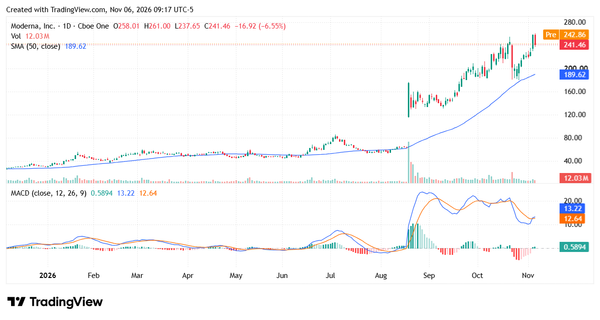
Moderna (NASDAQ: MRNA) gave investors something to cheer about with a profit Wall Street wasn’t expecting and a stronger sales outlook.
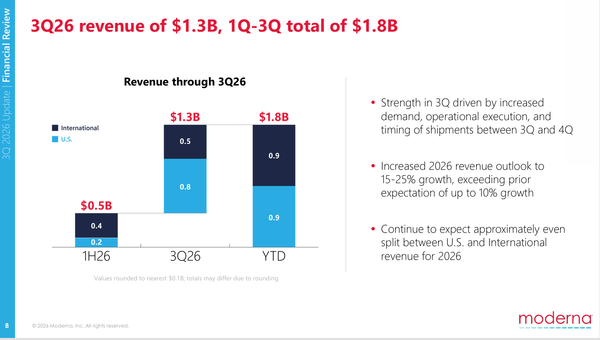
The biotech company reported third-quarter earnings of 38 cents per share, easily beating expectations for a loss of $1.25. Revenue reached $1.31 billion, well above the $885.1 million analysts anticipated. Along with the earnings surprise, Moderna raised its full-year revenue growth forecast to between 15% and 25%, up from its previous expectation of as much as 10%.
For a company working to expand beyond its original COVID vaccine business, the quarter offered encouraging evidence that its strategy is making progress.
A Big Improvement in the Numbers
Moderna’s quarterly revenue increased 29% from a year earlier, helped by stronger international COVID vaccine sales and deliveries under long-term government partnerships.
U.S. revenue totaled $780 million, while international markets contributed $533 million. Overseas markets accounted for roughly 41% of quarterly revenue, showing how much business Moderna now generates outside the United States.
The improvement also reached the bottom line.
Moderna earned $162 million, compared with a loss of $200 million during the same quarter last year. That represents a $362 million improvement. On a per-share basis, the company moved from a loss of 51 cents to a profit of 38 cents. Revenue exceeded Wall Street’s forecast by about $425 million, or 48%.
Still, investors should remember that vaccine sales fluctuate throughout the year. A profitable quarter is encouraging, but it does not automatically mean Moderna will deliver similar results every quarter. The more useful question is whether the company can build on this performance as newer products reach more customers.
Why Vaccine Launch Timing Matters
CEO Stéphane Bancel credited newer products and expansion into additional markets for the strong results. One contributor was Moderna’s next-generation COVID vaccine, which received U.S. approval in May 2025. According to Bancel’s comments in the supplied report, the company is now benefiting from a fuller selling cycle for that product.
The timing matters because receiving regulatory approval and generating meaningful sales are two separate steps.
Bancel explained that vaccine contracts are typically arranged during the first quarter. A product approved later in the year can miss important purchasing decisions, leaving less opportunity to generate sales immediately. That helps explain why the next-generation COVID vaccine had a relatively small initial launch last year.
Moderna’s new stand-alone flu vaccine faces a similar situation. It received U.S. approval in August, after many purchasing decisions had already been made. The company therefore expects a limited U.S. launch in 2026.
For investors, the takeaway is straightforward: an approval can open the door to future revenue, but building that revenue takes time. The next test will be whether these products attract more business when Moderna can participate in a full contracting season.
The Cancer Vaccine Remains a Major Attraction
While respiratory vaccines are producing sales today, Moderna’s experimental personalized cancer vaccine remains a major reason investors are excited about its future. The company is developing the treatment with Merck, pairing it with Merck’s cancer immunotherapy Keytruda.
The companies recently presented encouraging late-stage results involving certain melanoma patients. However, the stock’s response showed how complicated biotech investing can be.
Some trial information leaked on social media before investigators were scheduled to present the results at a European medical conference. Moderna shares subsequently fell despite the positive findings described in the supplied report.
Bancel said the reaction surprised him. He also pointed to favorable responses from doctors, analysts and long-term investors who reviewed the complete findings.
Stronger Results Bring Higher Expectations
Moving forward, Investors want pipeline progress and stronger performance from products already on the market.
This quarter delivered on the second part. Higher revenue, a return to quarterly profitability, and an improved sales forecast give investors concrete reasons for encouragement.
Now Moderna needs to show that the momentum can last. Expanding vaccine sales and advancing its cancer treatment would strengthen that case. Friday’s results were a meaningful step forward, but the next chapter will depend on turning promising products into a broader, more dependable business.