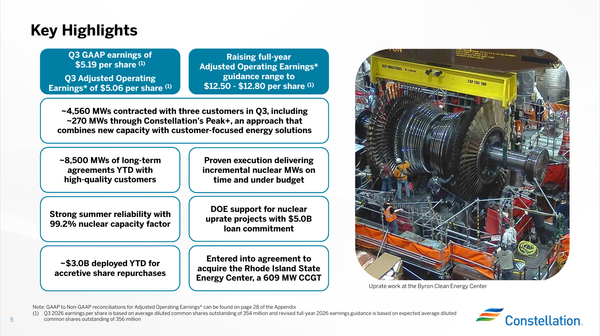
Constellation Energy (NASDAQ: CEG) beat Wall Street’s third-quarter 2026 estimates with revenue of approximately $9.6 billion, up 45% year over year, and adjusted operating earnings of $5.06 per share, a 66% increase. GAAP earnings reached $5.19 per share, compared with $2.97 a year earlier, while management raised the midpoint of its full-year adjusted earnings guidance for the second time this year.
The earnings beat is impressive, particularly for a company still integrating Calpine and investing heavily in additional generating capacity. The more consequential development, however, is that the company is now securing customers for electricity that will be delivered years from now, and its latest agreements suggest that the commercial opportunity is expanding faster than its existing generation fleet can grow.
Customers Are Arriving Before the Megawatts
Remember the Crane Clean Energy Center? In our Q2 analysis, we examined how Constellation was removing regulatory hurdles around a nuclear plant that wasn’t expected to restart until 2027, while signing long-term agreements with customers for future generation. The investment argument was that an asset could become considerably more valuable before producing another megawatt, provided the company could establish a credible path to operation and secure buyers for its output.
The third quarter has taken that strategy to another level. Constellation contracted approximately 4,560 MW with three customers during the quarter, including a 270 MW agreement through Peak+, while year-to-date long-term agreements reached approximately 8,500 MW. The company now expects those agreements to support 45% of its clean baseload fleet by 2032.
That commercial visibility is becoming a meaningful part of the company’s earnings proposition. Constellation projects long-term agreements will support approximately 91 million MWh of expected generation in 2032, compared with 60 million MWh in 2029. The contracts generally run for 15 to 20 years, and management says 91% of the counterparties supporting its nuclear agreements carry credit ratings of BBB+ or better.
For investors, this offers something beyond the prospect of higher electricity prices. Long-duration agreements can give Constellation greater visibility into future revenue and reduce its exposure to wholesale market volatility. The company is effectively building a more predictable commercial foundation around generation assets that would otherwise have to sell more of their output into changing market conditions.
The Real Test Is Turning Contracts Into Earnings
There is a reason Constellation is pursuing this strategy so aggressively. Large customers need reliable electricity, but bringing new generating capacity online takes years of investment, engineering, and regulatory work. Existing nuclear plants offer a potential shortcut, provided they can safely operate longer and generate additional power.
Constellation plans approximately 1,165 MW of nuclear uprates, with estimated project costs of roughly $4.3 billion. Its agreements with Amazon and Google illustrate the opportunity. The 20-year Amazon agreement supports more than $3 billion of investment at Calvert Cliffs, including a 190 MW expansion expected between 2030 and 2032. The Google collaboration supports more than $4.3 billion of investment across 11 nuclear units, with approximately 890 MW of incremental generation expected and the first uprate scheduled for 2028.
The conditional DOE loan commitment of up to $5 billion could help finance these projects, potentially covering as much as 80% of eligible costs. That is meaningful financing support, but investors should remember that a conditional commitment is not cash already received, nor does it remove construction and execution risk.
Meanwhile, the current earnings base still has to carry the expansion. Adjusted operating earnings rose to $5.06 per share, and management lifted full-year guidance to 12.50–12.80. Yet the company also cited higher operations and maintenance expenses associated with commercial outperformance as a partial offset to its improved outlook. The Calpine integration, financing costs, and the scale of planned investment all deserve attention as Constellation works to turn its growing contract portfolio into higher earnings and free cash flow.
CEG Has More Ground to Reclaim
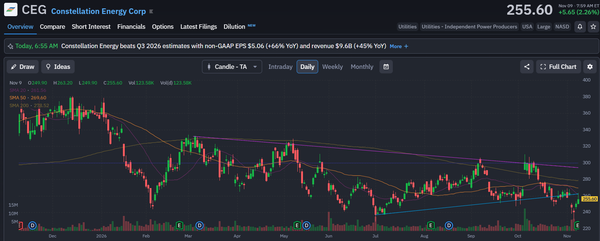
The stock has a different story to tell from the operating business. After climbing above $400 earlier in the year, Constellation shares have surrendered a substantial portion of those gains and were trading at $255.60 on November 9. The latest recovery has not yet changed the broader technical picture, with the shares still below their 20-day moving average at $261.56, 50-day average at $269.60, and 200-day average at $278.52.
The stock needs to reclaim the 260-262 area, followed by the 50-day average near $270. A stronger move through 278-280 would give buyers a more convincing case that the stock is rebuilding its longer-term uptrend. Until then, rallies remain vulnerable to selling from investors who bought at higher prices and are waiting to exit. The recent low around $240 is the downside level to watch if the recovery loses momentum.
Investors Are Paying for the Next Decade
I believe Constellation has one of the more compelling long-term growth opportunities in the power sector. Its ability to secure customers years before new generation comes online gives it a commercial advantage, while nuclear uprates offer a route to expanding output without building an entirely new fleet. But the market has already shown how aggressively it can price that opportunity, and the stock still has considerable ground to recover.
I would lean bullish on the business, but I want to see the contracts translate into completed capacity additions, stronger earnings, and durable free cash flow before becoming equally bullish on the shares. Crane’s restart, the Amazon and Google projects, and the pace of nuclear uprates will be important tests. No doubt the company has shown that it can find buyers for tomorrow’s electricity. Now it has to deliver the electricity, and the returns that came with selling it.