Constellation Energy (NASDAQ: CEG) beat Wall Street’s second-quarter earnings expectations with adjusted operating earnings of $2.55 per share, raised its full-year earnings guidance to $11.50-$12.50 per share, signed another 920 megawatts of long-term power purchase agreements and agreed to sell its 606 MW Brazos Valley Energy Center for $860 million as it continues integrating Calpine. Investors welcomed the update, sending the shares 1.19% higher to $264.20, even though GAAP earnings fell to $1.42 per share from $2.67 a year ago.
Most of those headlines describe a business performing well today. The announcement that may matter most, however, involves an asset that won’t produce a single megawatt until 2027. During the quarter, Constellation cleared two of the biggest regulatory hurdles needed to restart the Crane Clean Energy Center, while continuing to lock customers into power purchase agreements that stretch as far out as 2032. Those milestones help explain why management sounded increasingly confident about the company’s long-term earnings power, even though its most valuable growth project is still sitting idle.
Constellation Already Has Customers For Power It Hasn’t Produced
Booking a hotel months before your vacation doesn’t put you in the room any sooner. It does tell the hotel owner something valuable: demand already exists. Electricity isn’t much different. Constellation spent the second quarter signing another 920 megawatts of long-term power purchase agreements with investment-grade customers, even though those contracts won’t begin until 2029 through 2032, years after many utilities would still be searching for buyers.
That helps explain why the Crane Clean Energy Center already carries so much weight in the investment story despite remaining on track for a 2027 restart. As FERC approved the transfer of its capacity interconnection rights and the Nuclear Regulatory Commission cleared another key licensing milestone, management wasn’t simply moving a power plant closer to operation – it was steadily removing uncertainty around an asset whose future output is already attracting long-term demand. By the time Crane sends its first electrons onto the grid, much of its commercial value may already have been created.
The Market Pays More For Certainty Than Capacity
Building additional generating capacity has never been the hardest part of the utility business, unlike building it without knowing who will eventually buy the electricity. Which is an enterprise way of saying “building a castle in the air”. But thanks to this quarter, Constellation Energy now seems to be gradually removing that uncertainty, not only by securing long-term customers years in advance, but also by clearing the regulatory hurdles that have historically delayed or derailed nuclear projects.
During the quarter, FERC approved the transfer of Crane’s capacity interconnection rights while the Nuclear Regulatory Commission approved a key fuel licensing amendment, bringing the restart another step closer to reality.
That combination helps explain why management felt comfortable raising full-year earnings guidance even though Crane won’t contribute meaningful generation until 2027. Investors aren’t assigning value to electricity that exists today; they’re assigning value to the growing probability that future electricity will actually reach the grid on schedule, with customers already waiting to buy it. That distinction may seem subtle, but it’s exactly why an idle nuclear plant can already influence the value of Constellation Energy.
The Easy Money Was Last Year
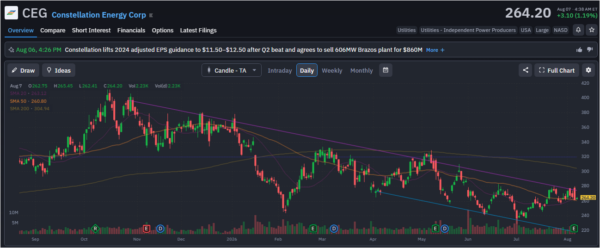
Constellation’s biggest move didn’t come after this earnings report because it did months ago, when investors began pricing in a future powered by rising electricity demand, nuclear restarts and data-center expansion, sending the stock above $400 before a long period of profit-taking pulled it back toward $240. That correction has gradually given way to accumulation, with the shares reclaiming both the 20-day and 50-day moving averages as buyers quietly returned. Wednesday’s 1.19% gain simply extended that recovery instead of redefining it.
That kind of price action fits a company whose biggest catalysts still lie ahead. Crane isn’t expected to restart until 2027, while much of the newly contracted generation won’t begin flowing until 2029 through 2032, leaving investors little reason to chase the stock after one strong quarter. The chart suggests the market is comfortable waiting, provided each earnings report keeps turning future projects into nearer-term realities.
Investors Who Bought The Dreams Are Now Waiting For Power
Every investment story eventually reaches the point where promises have to become proof, and Constellation is now entering that phase. Management has shown it can secure long-term customers years before new generating capacity comes online, navigate one of the most demanding regulatory environments in the country and raise earnings guidance while building projects whose biggest financial contributions still sit several years away. Those are meaningful achievements, but they also raise the standard for what comes next.
I believe the stock can work its way back toward last year’s highs, but probably not because of another earnings beat. Investors have already demonstrated they’re willing to pay for visibility; the next leg higher will likely require more of the same, additional long-term power purchase agreements, steady progress toward Crane’s 2027 restart, a smooth Calpine integration and continued evidence that electricity demand from data centers and large industrial customers remains as durable as management believes.
Miss on those milestones, and the market will quickly remember that many of today’s growth assumptions still belong to tomorrow. Keep delivering them quarter after quarter, and Constellation won’t just own one of America’s largest clean-energy fleets; it will own something even harder to build in the utility sector, investor confidence that extends well beyond the next quarter.