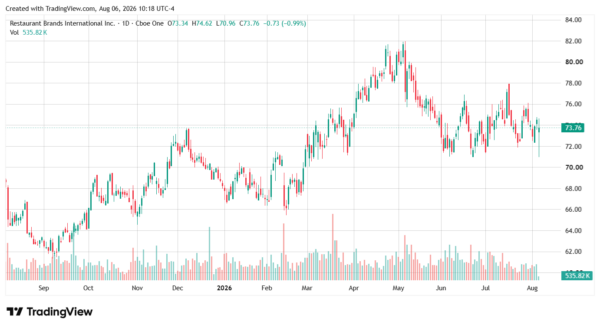
Restaurant Brands (NYSE: QSR) posted better-than-expected second-quarter earnings thanks to impressive sales growth at Burger King.
The company reported adjusted earnings of $1.07 per share for the second quarter, topping Wall Street analysts’ expectations of $1.03 per share. Revenue reached $2.52 billion, matching forecasts. Net income attributable to shareholders increased to $507 million, or $1.45 per share, compared with $189 million, or 57 cents per share, during the same period last year.
Burger King’s Turnaround Continues
The biggest story from the quarter was Burger King’s continued momentum.
Same-store sales at U.S. Burger King locations jumped 8.5%, marking another strong quarter for the chain as its turnaround strategy gains traction. Restaurant Brands has spent the past several years investing heavily in the fast food chain through restaurant remodels, updated marketing campaigns, and operational improvements.
“Burger King’s performance is a great example of what’s possible when you invest in the fundamentals and execute well – an approach we’re applying across all of our brands,” QS CEO Josh Kobza said in the company’s earnings release.
The gains suggest the burger chain is attracting more customers even as many restaurant chains continue to navigate cautious consumer spending.
The fast food chain’s strong performance stood out even more when compared with its biggest competitor. McDonald’s recently reported U.S. same-store sales growth of just 0.8% during its second quarter, a much slower pace than Burger King’s 8.5% increase.
The momentum was not limited to the United States.
Restaurant Brands reported that international Burger King locations posted same-store sales growth of 5.4% during the quarter, demonstrating continued demand across global markets.
The international business has long been an important growth driver for Restaurant Brands, with thousands of franchised locations operating around the world. Continued expansion and steady customer traffic overseas have helped offset slower performance in some of the company’s other brands.
Other Brands Face Headwinds
While Burger King delivered impressive gains, Restaurant Brands’ other restaurant chains struggled to generate similar momentum.
Tim Hortons, the company’s iconic coffee and doughnut chain, reported essentially flat same-store sales in Canada as well as across its overall business. Popeyes Louisiana Kitchen had an even more difficult quarter. The fried chicken chain reported a 5.2% decline in U.S. same-store sales as competition within the chicken restaurant category remained intense.
At the same time, many consumers have become more selective about dining out as they look for ways to manage higher living costs.
Looking Ahead
Restaurant Brands’ latest results show that focused investments can produce meaningful improvements, particularly at established brands with strong customer recognition.
Burger King’s continued sales growth demonstrates that renovations, operational improvements, and a renewed emphasis on core menu favorites can help revive a mature restaurant chain. The brand’s gains in both the U.S. and international markets also provide an encouraging sign that its turnaround strategy is producing consistent results.
However, the quarter also illustrates that Restaurant Brands still faces challenges across its broader portfolio. Flat sales at Tim Hortons and declining traffic at Popeyes indicate that not every brand is benefiting from the same momentum.
Going forward, investors will be watching to see whether the company can apply the same strategies that revitalized Burger King to its other restaurant concepts. If the burger chain’s recent performance is any indication, Restaurant Brands believes that investing in the basics—better restaurants, stronger marketing, and a focus on signature products—can deliver long-term growth across its portfolio.