ajax loader

Loading...


Ride-the-Wave Strategy – Best for Stock Traders

Ride-the-Wave targets multi-day price momentum following a company’s earnings announcement (EA). With this strategy:

  1. Buy a stock one day post-EA if a stock reacts positively post-earnings:
    1. Near the close of trading the EA-day for a pre-market-EA
    2. Near the close of the following day for a post-market-EA
  2. Sell-to-close after 7-10 days, or possibly earlier if a desired price target is reached

Similarly,

  1. short a stock one day post-EA if a stock reacts negatively post-earnings:
    1. near the close of trading the EA-day for a premarket-EA
    2. near the close of the following day for a post-market-EA
  2. then buy-to-close after 7-10 days, or possibly earlier if a desired price target is reached

Important: Ride-the-Wave is predicated on significant price momentum triggered by an EA. The 7-10 day scenario is the maximum trade hold-time. If you see post EA-momentum is halted or reversed by a significant opposite move, re-evaluate your presence in the trade.

This popular StockEarnings screen below will give you a list of stocks that historically exhibit significant price momentum following an EA for the next seven days:

  1. Stocks exhibiting positive post-EA price moves are buy-candidates
  2. Stocks exhibiting negative post-EA price moves are sell/short-candidates

The screen includes those stocks whose Earnings just came out in last two days.

Screen criteria:

  1. Earnings Date Start Date : Current Date + -1 Day
  2. Earnings Date End Date : Current Date + -2 Days
  3. Predicted Move (Next Day) Max : 7%
  4. Predicted Move (On 7th Day) Min : 7%

Strategy Guideline:

  1. Buy the stock if stock has reacted positively. Short the stock if stock has reacted negatively (see above).
  2. Close the position in 7-10 days, or possibly earlier based on price move.

Volatility Crush Strategy - Best for Options Traders

The Volatility Crush strategy is used with stocks that typically experience relatively low-to-moderate price moves (≤4%) following their Earnings Announcements (EA). The basic trade idea is to sell put or call options right before the EA, collecting a credit when options premium is very high due to elevated implied volatility (IV). You then close the position right after the EA by buying the option back much cheaper due to the significant drop in IV that occurs after the mystery of the EA disappears. In assessing this trade, you need to do your homework to ensure you collect sufficient premium to make the trade worthwhile.

This trade is practical due to the low-to-moderate price-move after the EA, which generally won’t significantly affect the options price, unlike an “action” stock, which experience great price moves post-EA. With these symbols, if you’re on the right side of the price move, that’s a great thing. But if you’re on the wrong side of the move, not so great. Consequently, by minimizing the effect of the post-EA price move, you have a much better chance to profit from the reduction in IV without it being ruined by a violent price move.

For this trade, open the position either (1) the night before the EA when the company announces earnings or (2) during the EA day when it announces post-market, generally capturing IV at or close to its peak.

For this trade, open the position either (1) the night before the EA when the company announces earnings or (2) during the EA day when it announces post-market, generally capturing IV at or close to its peak.

This popular stockearnings screen will give you a list of stocks which do not react more than 4% fpost-EA. It includes only those stocks whose earnings are releasing next day.

Screen criteria:

  1. Earnings Date Start Date : Current Date + 1
  2. Earnings Date End Date : Current Date + 1
  3. Predicted Move (Next Day) Max : 4%
  4. Options Type: Weekly

Strategy Guideline:

  1. Options Strategy: Sell Call and Put
  2. Options Strike Price: Current Stock Price – (% Predicated Move x 2)
  3. Expiration Date: It should generally be the closest expiry immediately after the EA.
  4. Buy Insurance: Buying back Call and Put at Strike price which 10% lower than Sell Strike Price is optional but recommended.

Watch Video for More Detail

Volatility Rush Strategy - Best for Options Traders

The Volatility Rush takes advantage of increasing options premiums into earnings announcements (EA) caused by an anticipated rise in Implied Volatility (IV). With this strategy, Buy a Call and Put at-the-money (a long straddle) 2-3 weeks before the EA when IV is lower. Sell the position either (1) the night before the EA when the company announces earnings pre-market, or (2) during the EA day when it announces post-market, generally capturing IV at or close to its peak.

This popular screen will give you a list of stocks whose Options premiums tend to rise into Earnings. It includes only those stocks whose Earnings are at least two weeks away from today.

Screen criteria:

  1. Earnings Date Start Date : Current Date + 15 Days
  2. Earnings Date End Date : Current Date + 30 Days
  3. Predicted Move (Next Day) Min : 5%
  4. Options Type: Weekly or Monthly if that lines up with the two to three-week lead-time for entering the trade

Strategy Guideline:

  1. Buy a Straddle at or close to the money two to three weeks pre-EA.
  2. Sell the position either the night before the EA when the company announces earnings pre-market, or during the EA day when it announces post-market.
  3. Expiration date should generally be the closest expiry immediately after the EA.
  4. Straddle price should not be more 60% of predicted move.

Predicted Move (Volatility)

Similar to Implied Volatility in Options. Expected volatility % based on our Proprietary Volatility Predication Model. We are expecting that stock price will likely to reach % in either direction by the end of next trading session after Earnings are released and not necessarily the closing volatility %.

Why is it important?

    This indicator helps

  1. Knowing expected volatility in stocks after Earnings helps to decide trading stocks before Earnings Announcement.
  2. Taking Advantage of volatility collapse following Earnings Results by using Advance Options strategies such as Spread and Straddles.

Since Last Earnings

Change in share price since last Earnings release.

Why is it Important?

When share has gained more than 10% since it's last Earning release, it tends to over react to minor bad news and give up some gains if not all. So, it contains more downside volatility than upside When share has dropped more than 10% since it's last Earning release, it tends to over react to minor good news and recover some drops if not all. So, it contains more upside volatility than downside.

EPS Surprise (%)

Occurs when a company's reported quarterly or annual profits are above or below analysts' expectations. Here is the formula to derive % EPS Surprice:

Actual EPS - Estimated EPS
------------------------------------- x 100
Estimated EPS

Why is it Important?

Earnings surprises can have a huge impact on a company's stock price. Several studies suggest that positive earnings surprises not only lead to an immediate hike in a stock's price, but also to a gradual increase over time. Hence, it's not surprising that some companies are known for routinely beating earning projections. A negative earnings surprise will usually result in a decline in share price.

Next Day Price Change (%)

Next Regular trading session Closing price following Earnings result.

For After Market Close Earnings, It is a next trading day closing price. For Before Market Open Earnings, It is the same trading day closing price.

Why is it Important?

Next Day price change is a reaction of Earnings result.

Tremendous Q4 Plus Raised Guidance Couldn’t Stop Sandisk From Falling 9%

Posted on Aug 06, 2026 by Grayson Cavern

Tremendous Q4 Plus Raised Guidance Couldn’t Stop Sandisk From Falling 9%

Sandisk Corporation (NASDAQ: SNDK) couldn’t have asked for a much stronger finish to fiscal 2026. Fourth-quarter revenue jumped 51% sequentially to $8.97 billion, GAAP diluted earnings per share reached $43.97, and management forecast another step higher next quarter with revenue expected between $10.3 billion and $10.8 billion. The board also expanded its share repurchase authorization by $14 billion, capping a fiscal year in which revenue soared 175%.

Wall Street shrugged as the stock sank 9.14% after the report, stretching a pullback that has already erased hundreds of dollars from the share price since July’s high near $2,300. That reaction came despite 84.6% gross margins, operating income rising 71% from the prior quarter and net income climbing 91%. By almost any traditional measure, Sandisk delivered exactly what investors spend years waiting for.

Maybe that’s the problem.Memory stocks have spent decades teaching investors that spectacular quarters rarely stay spectacular for long. Sandisk is asking the market to believe this one belongs in a different category, and judging by the selloff, that case is still a work in progress.

Memory Companies Don’t Get The Benefit Of The Doubt


Semiconductor investors have seen this movie before. NAND manufacturers enjoy a few spectacular quarters as prices climb, profits explode and optimism returns, only for excess supply to creep back into the market and send margins right back where they started. That’s why memory stocks have historically traded as cyclical businesses rather than durable compounders.

Sandisk knows that history as well as anyone, which is why one sentence buried inside the earnings release deserved far more attention than the headline numbers. Management disclosed that roughly two-thirds of the quarter’s sequential revenue growth came from higher pricing, while only one-third came from higher shipment volumes. At the same time, the company signed five additional New Business Model (NBM) agreements, bringing the total announced since April to ten, while guiding revenue even higher for the coming quarter.

Taken together, those updates read less like a company celebrating another upcycle and more like one trying to convince investors that the next downturn won’t look like the last.

Ten Contracts Tell A Bigger Story Than One Quarter

Beneath Sandisk’s record Q4 earnings was a disclosure management seemed almost as eager to highlight as the financial results themselves. Since April, the company has signed five additional New Business Model (NBM) agreements, bringing the total to ten, including three with entirely new customers and two expansions of existing relationships, while simultaneously telling investors that roughly two-thirds of sequential revenue growth came from pricing rather than higher shipment volumes. Those aren’t the statistics companies usually emphasize after posting the strongest quarter in their history, which makes the choice itself worth paying attention to.

Memory manufacturers have spent decades living at the mercy of spot prices, where today’s shortage often becomes tomorrow’s oversupply, yet Sandisk appears determined to convince investors that its future will depend less on that cycle and more on long-term commercial relationships. The company has already received billions of dollars tied to these NBM arrangements – so much that it now strips those prepayments out of adjusted free cash flow – and keeps returning to them because they represent something far more valuable than another quarter of exceptional pricing: a business built around customers making commitments before the next pricing cycle ever begins.

One Quarter Couldn’t Undo A 20-Year Reputation

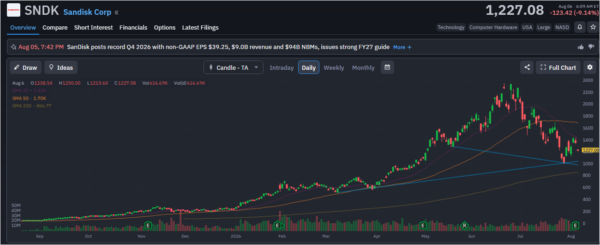
After nearly quadrupling from around $600 earlier this year to a peak above $2,300 in July, the stock entered the results already carrying enormous expectations, making Wednesday’s 9.14% decline look more like a reassessment of what comes next than a rejection of what just happened. The selloff also arrived as the shares continued trading below both the declining 20-day and 50-day moving averages, reinforcing the idea that momentum had already begun cooling before the earnings release.

Even so, the broader structure remains intact, buyers stepped in almost exactly where the rising long-term trendline intersects the $1,000 area, producing a sharp rebound that has carried the stock back toward $1,200 while keeping it comfortably above the 200-day moving average near $867. No conclusive evidence that investors are abandoning ship yet, all they are asking now is for the company to prove that record margins, extraordinary pricing and a new commercial model can survive the next turn in the memory cycle.
sandisk-StockEarnings

Escaping Commodity Status Takes More Than One Quarter

Turning a commodity business into something investors value differently doesn’t happen in ninety days, no matter how extraordinary the quarter looks. Sandisk still operates in a memory market where every surge in pricing has historically been followed by a painful correction, and that’s why Wall Street erased more than 9% from the stock despite record revenue, record profitability and guidance that points even higher. Investors have learned, often the hard way, that one spectacular cycle doesn’t necessarily become the next normal.

What makes this quarter different isn’t that Sandisk produced exceptional numbers. It’s that management spent as much time showing how those numbers were produced as it did celebrating them. Pricing, customer commitments, New Business Model agreements and a datacenter business growing far faster than consumer flash all point toward a company trying to make its next record quarter look less like a cycle and more like a business model. Whether Wall Street eventually agrees is still an open question, but for the first time in a long time, Sandisk has given investors something more durable than another memory boom to debate.


Join over 1.2M+ investors/traders who receive daily and weekly notable earnings alerts with predicted move