ajax loader

Loading...


Ride-the-Wave Strategy – Best for Stock Traders

Ride-the-Wave targets multi-day price momentum following a company’s earnings announcement (EA). With this strategy:

  1. Buy a stock one day post-EA if a stock reacts positively post-earnings:
    1. Near the close of trading the EA-day for a pre-market-EA
    2. Near the close of the following day for a post-market-EA
  2. Sell-to-close after 7-10 days, or possibly earlier if a desired price target is reached

Similarly,

  1. short a stock one day post-EA if a stock reacts negatively post-earnings:
    1. near the close of trading the EA-day for a premarket-EA
    2. near the close of the following day for a post-market-EA
  2. then buy-to-close after 7-10 days, or possibly earlier if a desired price target is reached

Important: Ride-the-Wave is predicated on significant price momentum triggered by an EA. The 7-10 day scenario is the maximum trade hold-time. If you see post EA-momentum is halted or reversed by a significant opposite move, re-evaluate your presence in the trade.

This popular StockEarnings screen below will give you a list of stocks that historically exhibit significant price momentum following an EA for the next seven days:

  1. Stocks exhibiting positive post-EA price moves are buy-candidates
  2. Stocks exhibiting negative post-EA price moves are sell/short-candidates

The screen includes those stocks whose Earnings just came out in last two days.

Screen criteria:

  1. Earnings Date Start Date : Current Date + -1 Day
  2. Earnings Date End Date : Current Date + -2 Days
  3. Predicted Move (Next Day) Max : 7%
  4. Predicted Move (On 7th Day) Min : 7%

Strategy Guideline:

  1. Buy the stock if stock has reacted positively. Short the stock if stock has reacted negatively (see above).
  2. Close the position in 7-10 days, or possibly earlier based on price move.

Volatility Crush Strategy - Best for Options Traders

The Volatility Crush strategy is used with stocks that typically experience relatively low-to-moderate price moves (≤4%) following their Earnings Announcements (EA). The basic trade idea is to sell put or call options right before the EA, collecting a credit when options premium is very high due to elevated implied volatility (IV). You then close the position right after the EA by buying the option back much cheaper due to the significant drop in IV that occurs after the mystery of the EA disappears. In assessing this trade, you need to do your homework to ensure you collect sufficient premium to make the trade worthwhile.

This trade is practical due to the low-to-moderate price-move after the EA, which generally won’t significantly affect the options price, unlike an “action” stock, which experience great price moves post-EA. With these symbols, if you’re on the right side of the price move, that’s a great thing. But if you’re on the wrong side of the move, not so great. Consequently, by minimizing the effect of the post-EA price move, you have a much better chance to profit from the reduction in IV without it being ruined by a violent price move.

For this trade, open the position either (1) the night before the EA when the company announces earnings or (2) during the EA day when it announces post-market, generally capturing IV at or close to its peak.

For this trade, open the position either (1) the night before the EA when the company announces earnings or (2) during the EA day when it announces post-market, generally capturing IV at or close to its peak.

This popular stockearnings screen will give you a list of stocks which do not react more than 4% fpost-EA. It includes only those stocks whose earnings are releasing next day.

Screen criteria:

  1. Earnings Date Start Date : Current Date + 1
  2. Earnings Date End Date : Current Date + 1
  3. Predicted Move (Next Day) Max : 4%
  4. Options Type: Weekly

Strategy Guideline:

  1. Options Strategy: Sell Call and Put
  2. Options Strike Price: Current Stock Price – (% Predicated Move x 2)
  3. Expiration Date: It should generally be the closest expiry immediately after the EA.
  4. Buy Insurance: Buying back Call and Put at Strike price which 10% lower than Sell Strike Price is optional but recommended.

Watch Video for More Detail

Volatility Rush Strategy - Best for Options Traders

The Volatility Rush takes advantage of increasing options premiums into earnings announcements (EA) caused by an anticipated rise in Implied Volatility (IV). With this strategy, Buy a Call and Put at-the-money (a long straddle) 2-3 weeks before the EA when IV is lower. Sell the position either (1) the night before the EA when the company announces earnings pre-market, or (2) during the EA day when it announces post-market, generally capturing IV at or close to its peak.

This popular screen will give you a list of stocks whose Options premiums tend to rise into Earnings. It includes only those stocks whose Earnings are at least two weeks away from today.

Screen criteria:

  1. Earnings Date Start Date : Current Date + 15 Days
  2. Earnings Date End Date : Current Date + 30 Days
  3. Predicted Move (Next Day) Min : 5%
  4. Options Type: Weekly or Monthly if that lines up with the two to three-week lead-time for entering the trade

Strategy Guideline:

  1. Buy a Straddle at or close to the money two to three weeks pre-EA.
  2. Sell the position either the night before the EA when the company announces earnings pre-market, or during the EA day when it announces post-market.
  3. Expiration date should generally be the closest expiry immediately after the EA.
  4. Straddle price should not be more 60% of predicted move.

Predicted Move (Volatility)

Similar to Implied Volatility in Options. Expected volatility % based on our Proprietary Volatility Predication Model. We are expecting that stock price will likely to reach % in either direction by the end of next trading session after Earnings are released and not necessarily the closing volatility %.

Why is it important?

    This indicator helps

  1. Knowing expected volatility in stocks after Earnings helps to decide trading stocks before Earnings Announcement.
  2. Taking Advantage of volatility collapse following Earnings Results by using Advance Options strategies such as Spread and Straddles.

Since Last Earnings

Change in share price since last Earnings release.

Why is it Important?

When share has gained more than 10% since it's last Earning release, it tends to over react to minor bad news and give up some gains if not all. So, it contains more downside volatility than upside When share has dropped more than 10% since it's last Earning release, it tends to over react to minor good news and recover some drops if not all. So, it contains more upside volatility than downside.

EPS Surprise (%)

Occurs when a company's reported quarterly or annual profits are above or below analysts' expectations. Here is the formula to derive % EPS Surprice:

Actual EPS - Estimated EPS
------------------------------------- x 100
Estimated EPS

Why is it Important?

Earnings surprises can have a huge impact on a company's stock price. Several studies suggest that positive earnings surprises not only lead to an immediate hike in a stock's price, but also to a gradual increase over time. Hence, it's not surprising that some companies are known for routinely beating earning projections. A negative earnings surprise will usually result in a decline in share price.

Next Day Price Change (%)

Next Regular trading session Closing price following Earnings result.

For After Market Close Earnings, It is a next trading day closing price. For Before Market Open Earnings, It is the same trading day closing price.

Why is it Important?

Next Day price change is a reaction of Earnings result.

Disney Earnings: The Magic Never Left, But What’s Next?

Posted on Aug 06, 2026 by Chris Markoch

Disney Earnings: The Magic Never Left, But What’s Next?

The Walt Disney Company (NYSE: DIS) posted its Q3 earnings report for fiscal year 2026. The result was a split decision. DIS stock jumped 3.83% after the company beat on adjusted earnings but came up light on the top line. Adjusted EPS hit $2.06, up 28% from $1.61 a year ago. Revenue grew 7% to $25.2 billion.

That combination told investors two things at once.

First, Disney’s theme park business is still the company’s beating heart. Global guests rose 4%. Domestic attendance climbed 3%. Guests are spending more per visit, not less. That’s a powerful signal in a quarter when many retailers have flagged a cautious consumer.

But here’s the nuance worth considering. Disney isn’t really a bet on the average consumer’s wallet. It’s a bet on how much debt that consumer is willing to take on for a week at the parks. That’s great for Disney’s margins. Whether it’s great for the household financing the trip is a separate question, and one for another day.

Second, and more importantly, Entertainment delivered a stable, unspectacular quarter. Streaming, ESPN, and linear networks all grew. Ad revenue held up. But neither the release nor the earnings call offered a clear roadmap for turning Entertainment into Disney’s next real growth engine. That gap is the story investors need to watch from here.

Disney’s Parks Keep Delivering Reliable Growth


Experiences remains Disney’s most dependable business, and this quarter proved it again. Segment revenue rose 10% to $9.97 billion. Operating income jumped 20% to $3.02 billion. Domestic parks led the way, with theme park admissions up 9% on higher ticket prices and stronger attendance.

Per capita spending at domestic parks grew 4%. That’s guests buying more food, merchandise, and premium experiences per visit. Disney also booked roughly $100 million in tariff refunds this quarter, which added about four points to Experiences’ operating income growth. That’s a one-time tailwind worth noting, not a repeatable one.

Disney Cruise Line was a standout. The Disney Destiny and Disney Adventure delivered their first full quarter together, lifting stateroom capacity by about 50% year over year. Resorts and vacations revenue grew 17%, with cruise days doing much of the heavy lifting.

disney_StockEarnings

International parks were softer. Asia attendance stayed weak, a trend management expects to continue into Q4. Disneyland Paris offset some of that softness, boosted by the World of Frozen opening.

Management now expects the Experiences segment operating income to land at the high end of its prior high-single-digit growth guidance for the full year. For a business this size, that’s a meaningfully strong outlook, tariff refund aside.

Streaming Stabilizes, But the Growth Story Isn’t Written Yet

The company’s Entertainment segment operating income more than doubled, up 64% to $1.68 billion. Entertainment SVOD, meaning Disney+ and Hulu, grew revenue 11% to $5.53 billion. Subscription revenue climbed 15%, driven by both pricing and subscriber growth. SVOD operating income more than doubled, to $712 million, with a 12.9% margin.

Advertising was a mixed bag. SVOD ad revenue grew just 3%, reflecting softer demand as ad inventory across streaming expands industry-wide. Sports segment advertising fared better, up 5%.

The bigger issue is strategic clarity. Management talked about integrating Hulu and Disney+, tripling international originals, and eventually building a “membership ecosystem.” Specifics won’t arrive until spring 2027. Until then, Entertainment looks stable rather than transformative, and investors are still waiting for the details that will turn streaming into Disney’s next real growth driver.

Technical Picture Shows Disney Stock Finding Its Footing

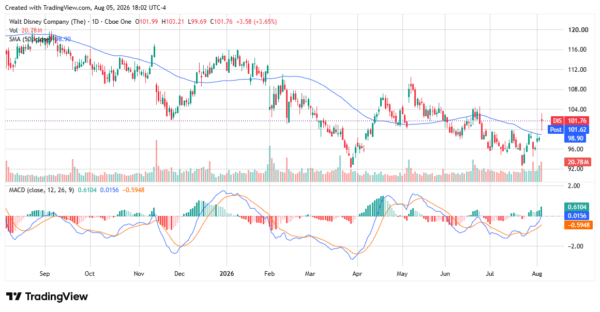
Disney stock has been in a steady downtrend since peaking near $120 last August. Shares bottomed in the low $90s in July before this quarter’s earnings pop.

The post-earnings move pushed shares to $101.76, back above the 50-day SMA near $98.90. That reclaim is a constructive short-term signal. The MACD line has crossed above its signal line, and the histogram has turned positive for the first time since May.

That points to building upside momentum, though it should be confirmed over the next few sessions rather than assumed. Volume on the earnings move came in at roughly 20.78 million shares, above recent averages, which adds some conviction to the breakout.
disney - StockEarnings

DIS Looks Fairly Valued for Both Growth and Income Investors

Put together, this was a quarter that eased fears without erasing them. Parks remain the engine. Entertainment is stable but still searching for its next chapter. Management’s guidance, roughly 12% adjusted EPS growth this year excluding the extra week, suggests steady rather than explosive progress ahead.

What’s changed is the income case. The company’s annual dividend now sits at $1.50 per share, up from $1.00 last year, its third straight annual increase. That gives income-focused investors a reason to look twice, alongside the growth crowd.

The worst may be over for Disney. But the next leg higher likely depends on Entertainment proving it can solve the same subscriber, engagement, and advertising puzzles that Netflix (NASDAQ: NFLX) and every other streamer faces.


A former marketing copywriter turned freelance financial writer and market analyst. I have a passion for delivering insights to investors. I write regularly about stocks for StockEarnings and MarketBeat. Posts are not advice.

Join over 1.2M+ investors/traders who receive daily and weekly notable earnings alerts with predicted move