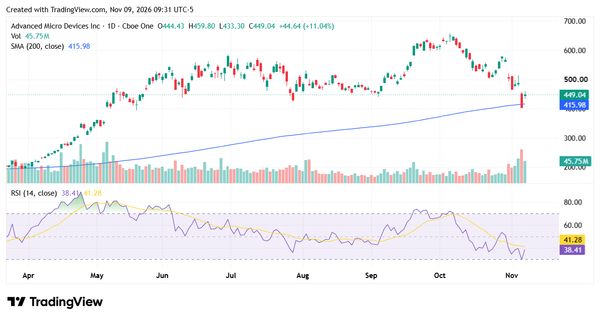
Advanced Micro Devices (NASDAQ: AMD) dropped with artificial intelligence stocks. But analysts at Oppenheimer say investors may be overlooking a business that is gaining strength.
The firm upgraded the company from ” perform ” to ” outperform ” and assigned a $600 price target, implying roughly 34% upside from Friday’s close. Analyst Rick Schafer sees a growing opportunity as AMD expands its role in the data centers powering AI.
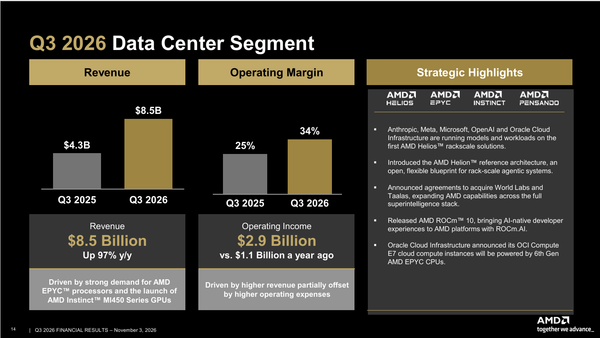
Fueling upside, Advanced Micro Devices’ latest quarter offered plenty of evidence that demand remains healthy. Third-quarter adjusted earnings reached $2.09 per share, beating the $1.95 analysts expected. Revenue climbed 45% to $13.38 billion, exceeding the $13.09 billion consensus estimate. Data center revenue was the standout, rising 97% to $8.5 billion. That business now accounts for roughly 64% of total sales, making it the main force behind AMD’s growth.
The fourth-quarter outlook suggests that momentum is continuing. AMD projected $17 billion in revenue, above Wall Street’s $16.2 billion estimate. However, its projected gross margin of 55% was slightly below the 55.3% consensus. Strong sales are encouraging, but investors also want to see how much profit the company can generate from that growth.
AI’s Next Phase Could Help AMD in Two Ways
Much of the AI investing conversation focuses on graphics processing units, or GPUs. These chips handle the massive calculations needed to train and run sophisticated AI models.
The company’s opportunity also extends to central processing units, or CPUs, which help manage computing tasks throughout a server.
That becomes especially relevant as companies develop AI agents: software designed to complete multistep tasks with less human involvement. An agent might gather information, use business applications, and carry out a workflow. Those activities create computing demands beyond the AI model itself.
AMD can potentially benefit from both sides of that workload through its Instinct GPUs and EPYC server CPUs. Management’s expectations reflect that opportunity. CEO Lisa Su said she expects server revenue to double in 2027, while data center AI growth should accelerate faster than previously anticipated.
Oppenheimer is even more ambitious in its broader forecast, modeling 135% data center revenue growth next year.
That remains an analyst projection, however. Delivering it will require strong customer spending, timely product launches, and enough supply to meet demand. Schafer’s optimism centers on Advanced Micro Devices becoming a lasting supplier of AI computing technology, with customer relationships spanning multiple product generations.
That distinction matters. A large initial order can boost revenue temporarily. Repeat purchases across successive chip launches would provide stronger evidence that customers are building long-term plans around AMD.
Helios Systems Are An Important Part Of That Strategy
These systems bring computing hardware together at the rack level, broadening AMD’s offering beyond individual processors. The company identified Anthropic, Meta, Microsoft, OpenAI and Oracle among customers running workloads on its first Helios systems.
Oppenheimer expects AMD’s Anthropic partnership to ramp up in early 2027. Schafer also points to the planned MI500 GPU launch in the second half of that year as another potential catalyst. Software progress matters, too. Powerful chips become more useful when developers can deploy applications efficiently. Improving AMD’s software tools could help make its hardware a more practical choice for additional customers.
A Recovery Still Has to Be Earned
There are reasons investors remain cautious. The industry’s enormous spending commitments have raised questions about financing and eventual returns. If customers delay projects or struggle to fund expansion, chip suppliers could feel the impact. AMD also faces uneven demand elsewhere.
Combined client and gaming revenue fell 8% to $3.7 billion. Gaming sales dropped 40%, although client revenue increased 7%, showing that weakness was not uniform across the business. Competition adds another challenge. Winning a larger share of AI infrastructure spending requires AMD to keep improving performance, software, and delivery.
Still, the bullish argument has substance: earnings are growing, data center demand is accelerating, and management expects another significant step forward.
Oppenheimer’s $600 target captures that potential. Whether AMD stock gets there will depend on the company turning ambitious plans into sustained sales and profits. For investors watching the pullback, that execution will matter far more than the target itself.