Rocket Lab (NASDAQ: RKLB) entered its third-quarter 2026 earnings with a business that looks considerably different from the launch company investors were evaluating a year ago. Revenue reached $267.8 million, up 73% from the same quarter last year, while its GAAP loss widened to $79.7 million, or twelve cents per share, from $18.3 million, or three cents per share. Yet the backlog climbed from $2.36 billion to $3.57 billion, giving Rocket Lab a larger pool of contracted work to convert into revenue.
That expansion picks up where my Q2 Rocket Lab earnings analysis left off. The argument then was that Rocket Lab had built a business with considerably more reach than its Electron launch operation, but investors still needed evidence that the company could turn that growth into sustainable financial performance. Q3 supplied more evidence of commercial demand, while introducing a more complicated timeline for the project – Neutron – that could change the company’s position in the launch market.
The Backlog Shows How Far the Business Has Expanded
The composition of Rocket Lab’s latest revenue makes clear why the company can no longer be judged by counting rocket launches alone, with Space Systems now doing most of the heavy lifting. The segment generated $214.8 million in Q3 revenue, up 88% year over year, while Launch Services contributed $53.1 million, an increase of roughly 30%. Space Systems accounted for about 80% of quarterly revenue, reflecting demand for spacecraft manufacturing, components, and related services alongside the company’s launch operations.
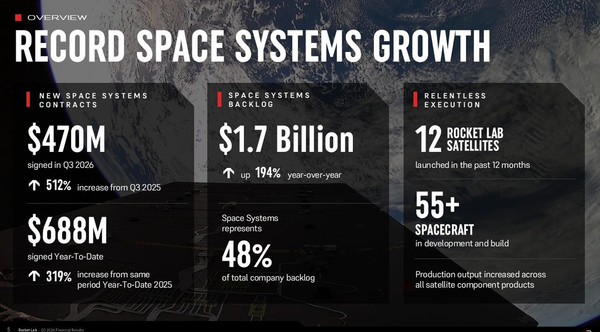
That shift is becoming more consequential as the backlog expands across both sides of the business. Rocket Lab ended September with approximately $1.85 billion in Launch Services backlog and $1.72 billion in Space Systems backlog, giving it a substantial base of contracted work beyond the next few launches. Around 33% of that total is expected to be recognized as revenue over the following 12 months, with the remainder extending beyond that period.
For investors, the important development is that RKLB is building two complementary sources of demand rather than relying on Electron to carry the entire growth story. Space Systems gives the company exposure to spacecraft and components customers need before, during, and after launch, while Launch Services provides the transportation infrastructure. That creates more opportunities to win multiple parts of a single mission, although a large backlog still has to pass through production, delivery, and revenue recognition before it becomes cash.
Revenue Is Scaling Faster Than Operating Profit
The company is generating substantially more business, but the cost of building that business remains heavy enough to keep profitability out of reach. Gross profit increased to $90.1 million from $57.3 million, yet gross margin contracted to approximately 33.6% from 37% a year earlier. Meanwhile, operating expenses rose to $169.3 million, with research and development reaching $98.4 million as the company continues funding vehicle development and broader engineering programs.
The result was a quarterly operating loss of $79.2 million, compared with $59 million in Q3 2025. That operating figure gives a cleaner view of the underlying business than the headline net loss comparison, which was affected by a sizeable tax benefit in the prior-year quarter. The margin picture also differs across the two segments. Space Systems gross margin improved to 33.2% from 29.4%, while Launch Services margin fell to 35.3% from 58.1%.
That decline makes it harder to assume that higher launch volume automatically produces better economics in every quarter. Mission mix, contract structure, and the cost of maintaining launch capacity all influence the result, so investors need to see whether additional scale eventually improves the economics of the launch operation.
Neutron Is Becoming the Biggest Test of the Backlog
The commercial case for Neutron has continued to strengthen even as the vehicle’s development schedule has moved further out, creating a gap between customer demand and Rocket Lab’s ability to begin serving that market. The company now expects Neutron’s first launch in 2027 after identifying voids in portions of a composite propellant tank dome. Manufacturing of a replacement forward dome has started, but assembly, inspection, and testing still need to progress before a more specific launch timeline can be established
That delay matters because Neutron is intended to move Rocket Lab into the medium-lift market, where it can compete for larger constellation deployments and government missions that Electron cannot accommodate. Rocket Lab also secured more than $515 million in Neutron launch contracts during the quarter, taking its pre-debut mission backlog to 16. Demand is forming before the rocket has flown, which is a meaningful commercial achievement, but those contracts make successful development and execution even more important.
RKLB Stock Needs to Reclaim Its Trend
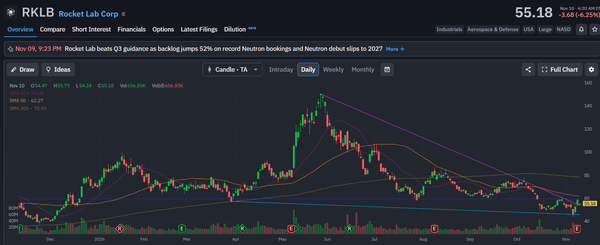
The stock is still working through a significant correction, even as the company’s operating footprint and backlog have expanded. At approximately $55.18, RKLB was trading just above its 20-day simple moving average near $54.08, but remained below its 50-day average around $62.27 and its 200-day average near $78.59. That positioning leaves the short-term price action showing some stabilization while the intermediate and longer-term trends remain under pressure.
The $50 area is an important nearby zone to watch because a sustained hold there would help establish a base after the recent decline. A move back above the 50-day average would provide a more convincing sign that buyers are regaining control, while the 200-day average remains a much larger hurdle for any broader trend reversal.
The Only Thing Left
Rocket Lab’s Q3 results strengthen the long-term business case through record backlog, rapid Space Systems growth, and new demand for Neutron, while the delayed debut and margin pressure leave execution as the central risk. The company has built a much larger commercial platform, but its operating losses show that scale has yet to translate into consistent profitability. I see a stronger long-term business with a credible path into a larger launch market, but RKLB still needs to demonstrate better operating leverage and repair its chart before the stock offers a more convincing entry.