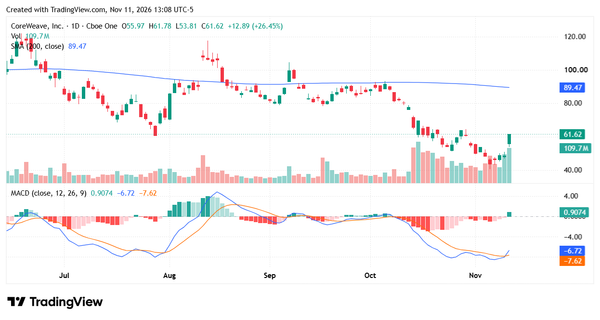
CoreWeave (NASDAQ: CRWV) just gave nervous investors something they needed: a breath of fresh air and evidence that its business is still growing quickly, even as questions about its spending and borrowing weigh on the stock.
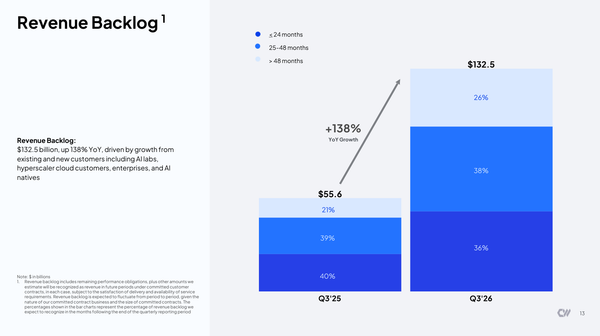
The artificial intelligence cloud provider reported stronger-than-expected third-quarter revenue, a smaller loss than analysts anticipated, and a higher sales outlook. In fact, its EPS loss of $1.27 beat by 28 cents. Revenue of $3.66 billion, up 169.1% year over year, beat by $120 million. Revenue backlog was about $132.5 billion as of the end of September.
That’s welcome relief for CRWV stock that had fallen almost 65% from its 52-week high. Still, one encouraging quarter won’t settle every concern. CoreWeave must show it can turn enormous demand into lasting profits while paying for an expensive expansion.
Revenue Growth Gives Investors Something to Work With
CoreWeave provides computing infrastructure that customers use to develop and run AI applications. That puts it directly in the path of AI spending, but also requires substantial investment in equipment and data centers.
Third-quarter revenue reached $3.66 billion, up from $1.37 billion a year earlier. That represents growth of roughly 168%. Revenue also increased by more than $1 billion from the previous quarter. The company lost $1.27 per share, compared with the $1.54 loss analysts expected in the supplied estimates. Revenue also exceeded the $3.54 billion forecast.
Those results matter because investors have been questioning whether AI infrastructure demand can justify the money flowing into the industry. CoreWeave’s sales suggest customers are still putting substantial money behind their AI plans.
Its revenue backlog reached approximately $132.5 billion. That represents expected future revenue under committed customer contracts, subject to delivery and service requirements. It offers visibility into future business, although the money still has to be earned as CoreWeave supplies the promised capacity.
CoreWeave Raises Its 2026 Revenue Forecast
Management also raised its expectations for the full year.
CoreWeave now forecasts 2026 revenue of $13 billion to $13.3 billion, compared with its previous range of $12.4 billion to $13.2 billion. The new range sits above the $12.88 billion consensus estimate cited in the supplied report.
Adjusted operating income is expected to reach $1.275 billion to $1.375 billion. At the midpoint, that is a 26% increase from the previous forecast.
The company also expects to finish the year with an annual revenue run rate of $20 billion to $21 billion. That figure describes the annualized pace of business at year-end; it does not mean CoreWeave will collect that much revenue during 2026.
Meanwhile, adjusted operating margins reached double digits one quarter earlier than management had planned.
CoreWeave’s $39 Billion Spending Plan Raises Financing Concerns
The challenge is that CoreWeave’s expansion requires extraordinary amounts of money.
Capital spending is now expected to total $37 billion to $39 billion this year, compared with the previous forecast of $35 billion to $39 billion. Management also expects fourth-quarter interest expense of $1.05 billion to $1.15 billion.
That interest bill explains why investors remain uneasy. Strong demand can support growth, but borrowing costs still consume money that might otherwise benefit shareholders.
Management offered some reassurance. CEO Michael Intrator said CoreWeave expects approximately $9 billion in customer prepayments and deposits over the next three months. He also pointed to operating cash flow and financing supported by customer contracts as funding sources.
Wall Street Analysts Remain Divided on CRWV Stock
The analyst reactions supplied with the report show that Wall Street remains divided.
Bank of America maintained a Buy rating on CRWV stock and a $140 target, arguing that customer prepayments, vendor financing, and loans backed by contracts make funding needs manageable.
Deutsche Bank remained bullish on CRWV with a $125 target, highlighting execution and improving business economics. Goldman Sachs, Citi, UBS, and JPMorgan also maintained positive ratings.
Morgan Stanley took a more cautious approach with an Equal Weight rating and a $70 target. It welcomed the results but wanted more evidence that planned financing would come together. Barclays also maintained Equal Weight.
Bernstein remained the CRWV skeptic, keeping an Underperform rating and a $54 target because of concerns about the long-term business model.
In the end, for investors, the next few quarters need to deliver more than impressive sales. Watch whether customer cash arrives as expected, new capacity comes online, and operating improvements begin to outweigh financing costs. Those developments will help determine whether this rebound has staying power.